
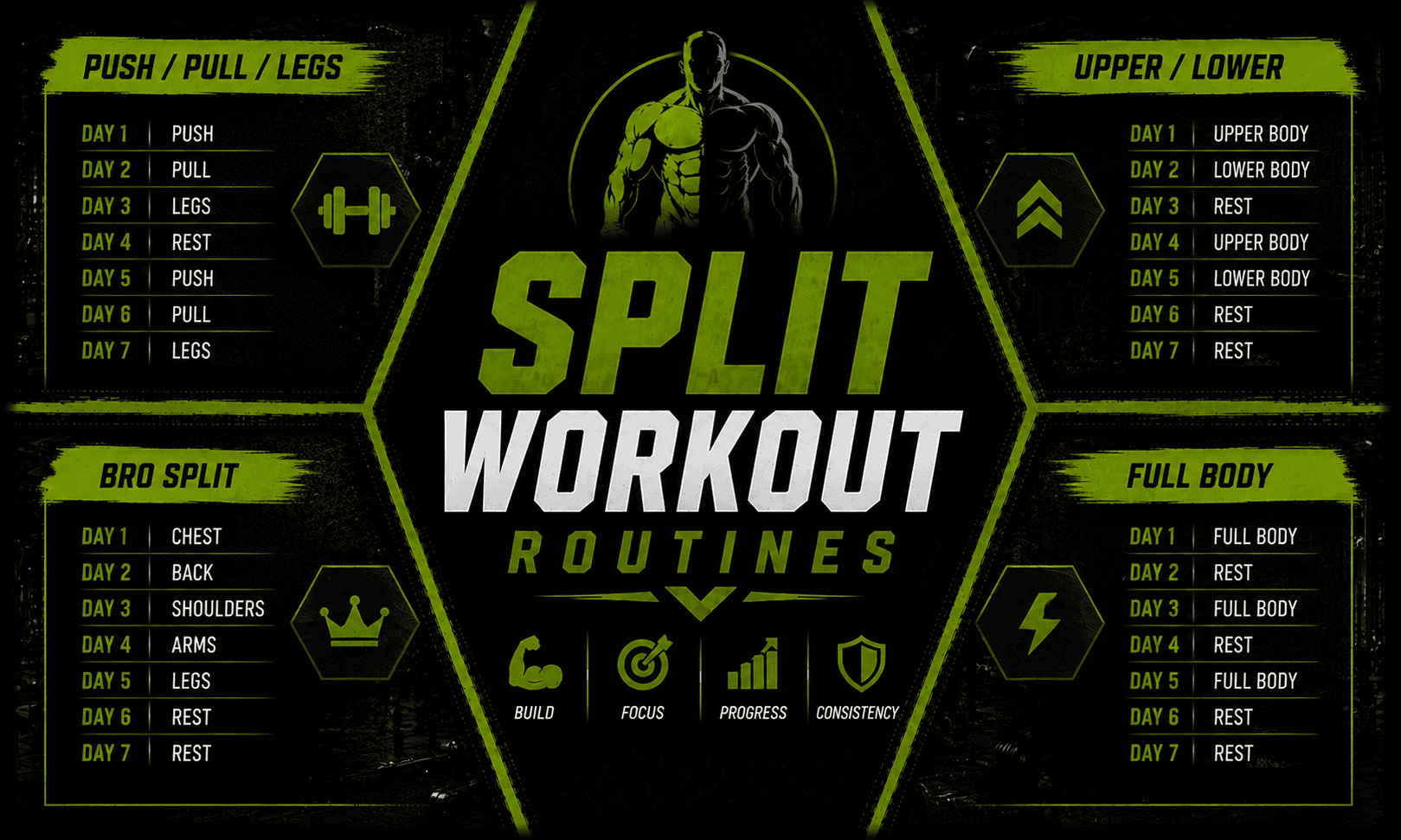
Split Workout Routines
No matter what workout routine you follow, the three things that matter most for building muscle and seeing real progress are consistency, recovery, and nutrition. The best program in the world won’t work if you only train occasionally or neglect sleep and diet. Staying consistent with your workouts over time, allowing your body enough rest to recover, and fueling yourself with enough protein and quality food are what truly drive muscle growth and long-term results. Focus on building sustainable habits, trust the process, and progress will come.



Here are some no-BS split routines designed to help you build muscle, stay consistent, and actually make progress. Whether you’re training 2, 3, 4, or 5 days per week, these routines focus on effective exercises, smart recovery, and real-world results — no unnecessary fluff, just solid training that works using only Dumbbells. Barbell. Resistance Bands.Free Weight. Pull-up Bar. Dip Station
Rest periods are an important part of training and recovery. For most muscle-building workouts, resting around 60–90 seconds between exercises and sets works well to maintain intensity while allowing your muscles to recover. Heavier compound movements may require 2–3 minutes of rest, while smaller isolation exercises and core work usually only need 30–60 seconds. The goal is to recover enough to perform your next set with good form and effort.
Focus on performing every exercise with controlled, proper form rather than rushing through reps. Slow and focused movements help keep tension on the muscles, reduce the risk of injury, and improve overall muscle growth. Concentrate on the quality of each repetition — control the lowering phase, maintain good posture, and avoid using momentum just to complete reps. Remember, training smarter is always better than training recklessly.
Each workout is designed to be efficient and effective, typically lasting around 45–60 minutes, or slightly longer depending on rest times and intensity. You do not need to spend hours training to build muscle — consistency, effort, recovery, and good nutrition are what truly produce results over time.
Note:
Most of these exercises are written using dumbbells (DB) because they are simple and accessible for home workouts, but nearly all of them can easily be modified using barbells instead. Exercises like squats, Romanian deadlifts, rows, presses, lunges, and curls all work effectively with either dumbbells or barbells depending on the equipment you have available. The most important thing is using proper form, controlling the movement, and progressively increasing resistance over time — not the specific piece of equipment you use.
2-Day Split Routine
Split Workout 1. Full Body
Day 1
Barbell Squats — 3×6-10
Push-Ups — 3×8–12
DB Bent-Over Row — 3×6–10
Barbell Hip Thrust — 3×10-15
Plank — 3×30 sec
Day 2
DB Lunges — 3×8-10
Military Press — 3×8–12
DB Romanian Deadlifts — 3×6-10
Dips — 3×10–12
Bicycle Crunches — 3×12-16
Split Workout 2. Upper/Lower
Day 1 — Upper
Banded Push-Ups — 3×10-14
Pull-Ups — 3×6-10
DB Incline Bench Press 3×6-10
Renegade Row— 2×8-12
DB Incline Curls — 3×8-12
Barbell Tricep Extension— 3×8-12
Day 2 — Lower
Bulgarian Split Squats — 3×8-10
Barbell Romanian Deadlifts — 3×6-10
Reverse Lunges — 3×8-10
Dumbbell Calf Raises — 3×10-14
Bar Hanging Knee Raises — 3×8-12
A 2-day/week split is a minimalist strength routine where you train twice weekly, usually focusing on full-body or upper/lower sessions. It’s built around consistency and recovery rather than high volume.
Who It’s for
Beginners building strength foundation
Busy people with limited training time
Anyone returning after a break from training
People prioritizing recovery (older lifters, high-stress schedules)
Those combining strength work with other sports (running, cycling, etc.)
3-Day Split Routine
Split Workout 1. Push / Pull / Legs
Day 1 — Push
Bench Press — 3×6-10
dips — 3×10-12
Day 2 — Pull
Pull-ups — 3×6-10
Day 3 — Legs
Split Workout 2. Chest/Back, Shoulders/Arms, Legs
Day 1 — Chest/Back
Chin-Ups — 3×8-10
Flys— 3×8-12
Dips — 3×8-12
Day 2 —Shoulders/Arms
Banded Pushdown— 3×10-15
Arms Superset DB Skull Crush/Band Curls — 1×Max
Day 3 — Legs
A 3-day/week split is one of the most balanced and sustainable training setups for building strength, muscle, and general fitness without overwhelming recovery demands.
Who It’s for:
Beginners progressing past basic full-body consistency
Intermediate lifters wanting steady muscle/strength gains
People with moderate weekly time (3–5 hours total)
Anyone balancing gym with sport, work, or family life
4-Day Split Routine
Split Workout 1. Upper/Lower
Day 1 — Upper
Chin-Ups — 3×8-12
Dips — 3×10-14
Day 2 — Lower
Front Squat — 3×6-10
Day 3 —Upper
Pull-Ups — 3×6-10
Barbell Row — 3×6-10
Day 4 — Lower
Split Workout 2. Chest/Triceps, Back/Biceps, Legs, Shoulders
Day 1 — Chest/Triceps
Day 2 — Back/Biceps
Chin-ups — 3×8-12
Day 3 —Legs
Squat — 3×6-10
Barbell Rollout — 1xMax
Day 4 — Shoulders
A 4-day/week split is a very effective “sweet spot” for most people once they want more progress than 2–3 days can offer, without going into advanced bodybuilding volume.
Who It’s for:
Intermediate lifters ready for more structured volume
People focused on hypertrophy (muscle growth) or strength + size mix
Those with a stable weekly routine and decent recovery capacity
Anyone wanting faster progress than 2–3 day programs allow
5-Day Split Routine
Split Workout 1. Chest, Back, Legs, Shoulders, Arms
Day 1 — Chest
Flys — 3×8-12
Dips — 3×10-14
Push ups 3×10-15
Day 2 — Back
Day 3 — Legs
Front Squat — 3×6-12
DB Leg Extension— 3×10-14
Day 4 — Shoulders
Front Raises— 3×8-12
Day 5 — Arms
Split Workout 2. Push/Pull/Legs/Upper/Lower
Day 1 — Push
Day 2 — Pull
Day 3 — Legs
Day 4 —Upper
Arms Superset — 2×12
Day 5— Lower
A 5-day/week split is a more advanced and higher-volume training approach, usually used to maximize muscle growth, address weak points, or train with more variety and focus per session.
Who It’s for:
Intermediate to advanced lifters
People prioritizing hypertrophy (muscle gain) or physique development
Those with solid recovery habits (sleep, nutrition, stress management)
Individuals who enjoy training and can consistently commit 5 days/week
Workout split routines are structured training plans that divide your weekly exercise sessions across different days, typically ranging from 2 to 5 days per week depending on experience, goals, and available time. Whether you’re following a full-body 2-day plan or a more focused 5-day split, the goal is always the same: consistent progress through smart training and recovery. Beginners often benefit from simpler routines with more rest days, while more experienced lifters use higher-frequency splits to target muscles with greater volume and precision. Regardless of the structure, results come from patience, progressive overload, and long-term consistency rather than chasing quick fixes. Building strength and muscle is a gradual process, and the most effective program is the one you can stick to week after week, while balancing effort, recovery, and sustainable habits.
Progressive overload is one of the most important principles for building muscle and strength over time. The idea is simple: as your body adapts to an exercise, you gradually increase the challenge so your muscles continue to grow. For example, if your goal is 3 sets of 10 reps, once you can successfully complete all 3 sets with good form, you can slightly increase the weight and work toward achieving 3 sets of 10 again with the heavier load. Small, consistent improvements over time are what lead to long-term results.
Key Points
Increase weight gradually
Maintain proper form
Focus on controlled reps
Track reps and sets
Train close to failure
Prioritize consistency
Progressive overload over time
Recovery and nutrition matter
Quality over ego lifting
Long-term consistency = results