
Single-Leg Dumbbell Calf Raise
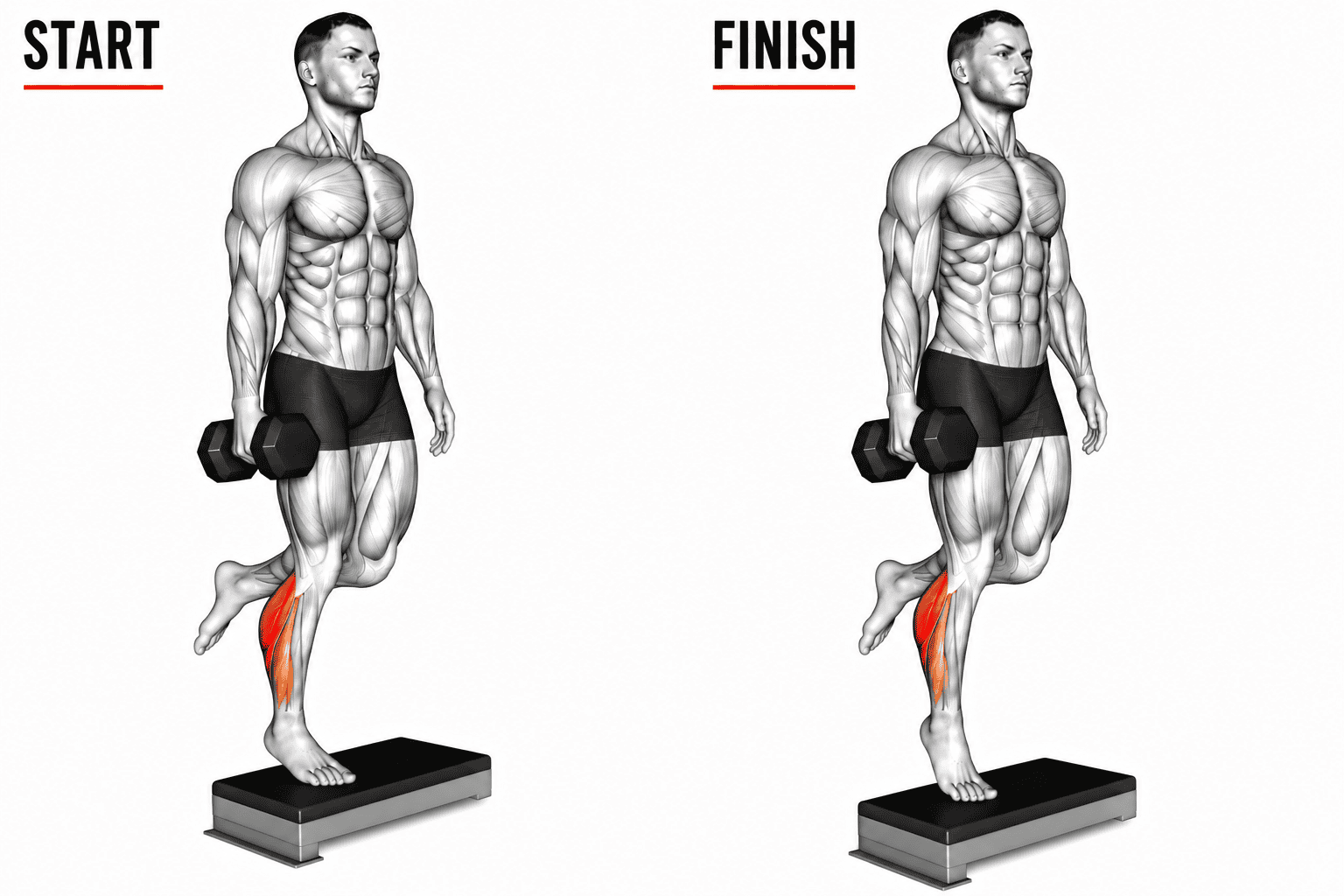
Exercise Description
The Single-Leg Dumbbell Calf Raise is an isolation exercise that strengthens the calf muscles while improving balance, ankle stability, and unilateral lower-leg strength. By performing the movement on one leg while holding a dumbbell, the exercise places significantly more resistance on the working calf than traditional bodyweight calf raises. It is highly effective for building calf size, strength, muscular endurance, and correcting strength imbalances between the left and right legs. The exercise can be performed on a flat surface or on an elevated step to increase the range of motion and provide a deeper stretch of the calf muscles.
Primary Muscles Worked
Gastrocnemius
Secondary Muscles Worked
Soleus
Tibialis Posterior
Peroneal Muscles
Intrinsic Foot Muscles
Gluteus Medius (Stabilization)
Quadriceps (Stabilization)
Hamstrings (Stabilization)
Core Muscles (Stabilization)
Forearm Muscles (Grip Stabilization)
How to Perform Correctly
Setup
Hold a dumbbell in one hand, preferably on the same side as the working leg.
Stand on one foot with the other foot lifted slightly off the floor.
Position yourself near a wall, railing, or stable object if balance assistance is needed.
Place the ball of your working foot on a step or platform if using an elevated variation.
Engage your core and maintain an upright posture.
Keep a slight bend in the working knee.
Movement
Lower your heel below the level of the platform if using an elevated surface, or to a comfortable stretch if standing on the floor.
Push through the ball of your foot and raise your heel as high as possible.
Squeeze your calf muscle at the top position.
Pause briefly at peak contraction.
Slowly lower your heel back to the starting position under control.
Maintain balance and proper alignment throughout the movement.
Complete all repetitions on one leg before switching sides.
Common Mistakes to Avoid
Using Momentum
Avoid bouncing or using body movement to assist the lift.
Incomplete Range of Motion
Fully lower and raise the heel during every repetition.
Allowing the Ankle to Roll Inward or Outward
Keep the foot stable and pressure evenly distributed through the ball of the foot.
Leaning Excessively
Maintain an upright posture and avoid shifting your body weight.
Using Excessive Weight
Heavy dumbbells can compromise balance and reduce movement quality.
Rushing the Repetitions
Perform each repetition slowly and under control.
Bending the Knee Excessively
Excessive knee flexion reduces emphasis on the gastrocnemius.