
Dumbbell Squat
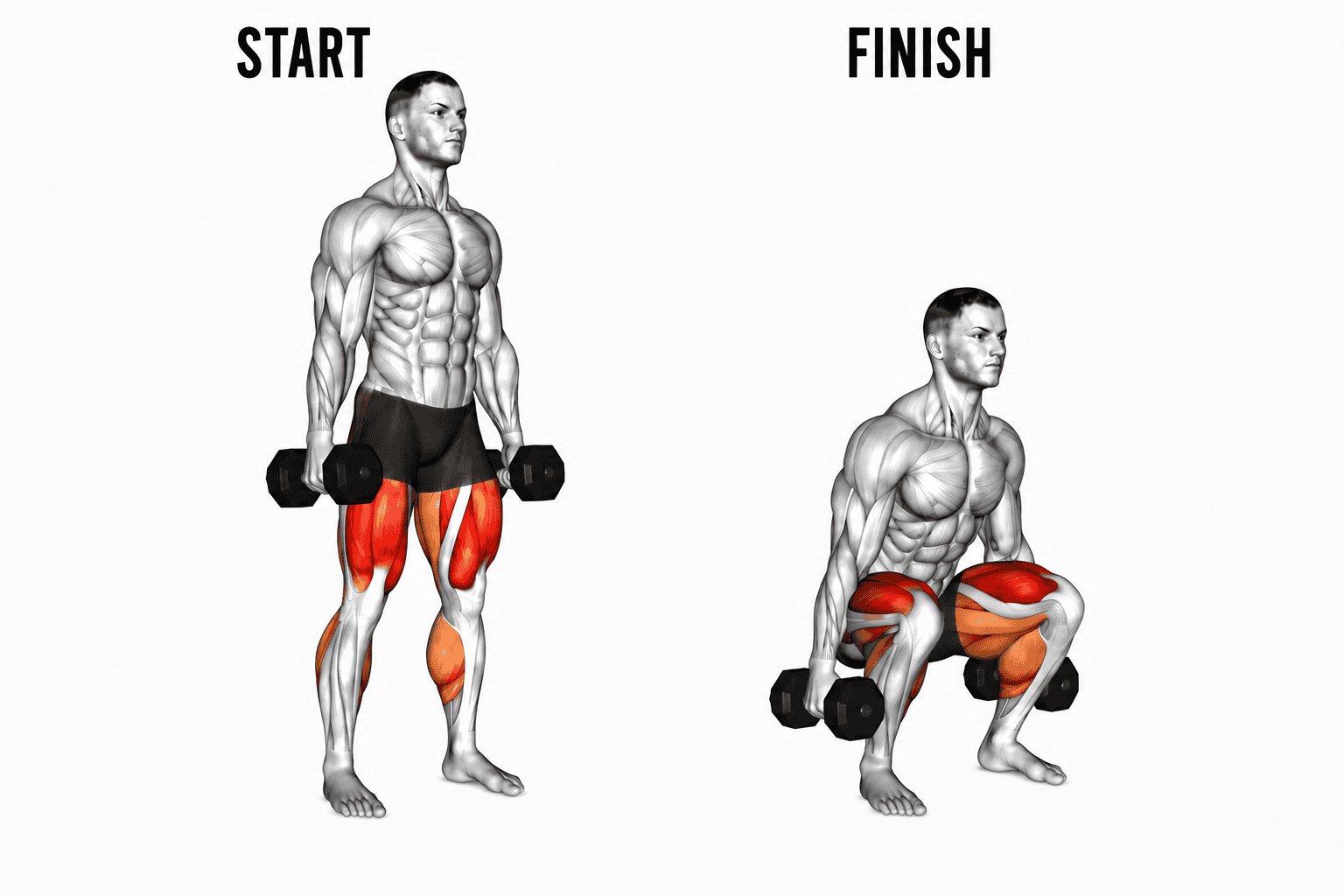
Exercise Description
The Dumbbell Squat is a compound lower-body exercise that strengthens the legs, glutes, and core while improving balance, coordination, and functional movement. Holding dumbbells at your sides or shoulders adds resistance to the traditional squat pattern, making it an effective option for building muscle and strength with minimal equipment. The Dumbbell Squat is suitable for beginners and advanced lifters alike and can be performed at home or in the gym.
Primary Muscles Worked
Quadriceps
Gluteus Maximus
Secondary Muscles Worked
Hamstrings
Adductor Magnus
Calves (Gastrocnemius and Soleus)
Erector Spinae
Rectus Abdominis
Obliques
Hip Stabilizers
Forearm Muscles (Grip Stabilization)
Upper Back Muscles (Stabilization)
How to Perform Correctly
Setup
Hold a dumbbell in each hand at your sides with your arms fully extended.
Stand with your feet approximately shoulder-width apart.
Turn your toes slightly outward if comfortable.
Lift your chest and pull your shoulders back.
Engage your core and maintain a neutral spine.
Keep your head and neck in a natural position.
Movement
Begin the squat by pushing your hips backward and bending your knees simultaneously.
Lower your body until your thighs are at least parallel to the floor or as deep as your mobility allows.
Keep your knees aligned with your toes throughout the movement.
Maintain your weight evenly distributed across your feet.
Drive through your heels and midfoot to return to the standing position.
Fully extend your hips and knees at the top without hyperextending.
Repeat for the desired number of repetitions.
Common Mistakes to Avoid
Allowing the Knees to Collapse Inward
Keep your knees tracking in line with your toes throughout the movement.
Rounding the Lower Back
Maintain a neutral spine and engaged core.
Rising Onto the Toes
Keep your heels planted and maintain pressure through the entire foot.
Looking Excessively Up or Down
Keep your head and neck aligned with your spine.
Using Excessive Weight
Heavy dumbbells can compromise technique and reduce range of motion.
Cutting the Depth Short
Squat as deeply as your mobility allows while maintaining proper form.
Leaning Forward Excessively
Keep your chest lifted and torso stable throughout the exercise.