
Barbell Rollout
Exercise Description
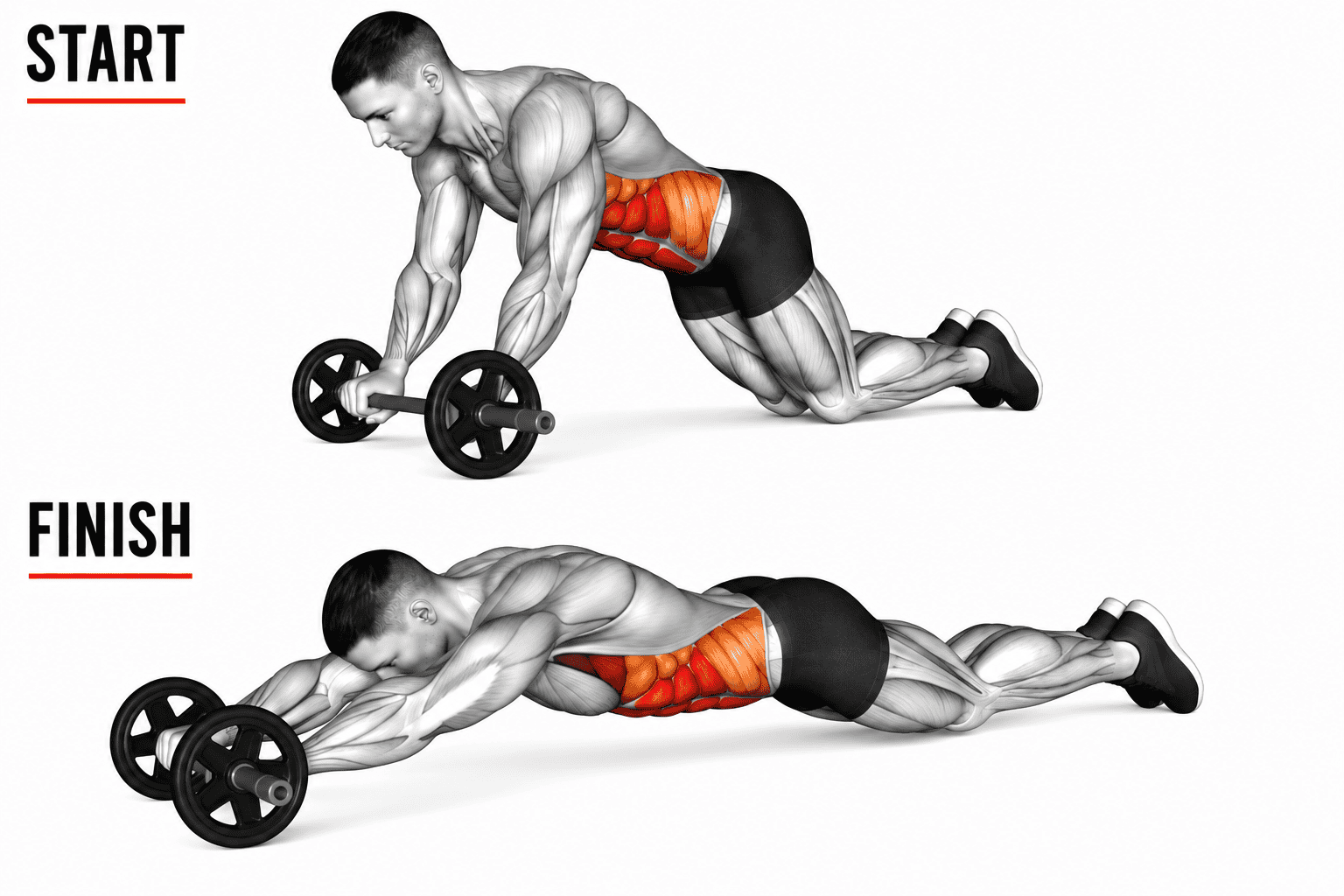
The Barbell Rollout is an advanced core exercise that develops abdominal strength, core stability, and anti-extension control. Performed by rolling a loaded barbell away from the body and then pulling it back to the starting position, the exercise challenges the entire core to resist spinal extension throughout the movement. The Barbell Rollout is often considered one of the most effective exercises for building functional core strength because it requires the abdominals to stabilize the spine rather than simply flex the torso.
Primary Muscles Worked
Rectus Abdominis
Transverse Abdominis
Secondary Muscles Worked
External Obliques
Internal Obliques
Latissimus Dorsi
Serratus Anterior
Erector Spinae (Stabilization)
Deltoids (Shoulder Stabilization)
Pectoralis Major (Stabilization)
Hip Flexors
Gluteus Maximus (Stabilization)
How to Perform Correctly
Setup
Load a barbell with equal-sized plates on both sides so it can roll smoothly.
Kneel on a padded mat with the barbell positioned directly in front of you.
Grip the barbell slightly wider than shoulder-width apart.
Engage your core and glutes.
Maintain a neutral spine with your head aligned with your body.
Movement
Slowly roll the barbell forward by extending your arms and allowing your body to move with the bar.
Keep your hips, shoulders, and torso aligned throughout the movement.
Continue rolling forward until you reach your maximum controllable range of motion.
Avoid allowing your lower back to arch excessively.
Contract your abdominals and lats to pull the barbell back toward your knees.
Return to the starting position while maintaining full-body tension.
Repeat for the desired number of repetitions.
Common Mistakes to Avoid
Arching the Lower Back
Maintain a strong core brace and neutral spine throughout the movement.
Rolling Too Far
Only extend as far as you can while maintaining proper spinal alignment.
Leading with the Hips
Keep the body moving as a single unit rather than allowing the hips to sag.
Using Momentum
Perform each repetition slowly and under control.
Shrugging the Shoulders
Keep the shoulders stable and engaged throughout the movement.
Holding the Breath Excessively
Maintain controlled breathing while keeping core tension.
Progressing Too Quickly
Master shorter ranges of motion before attempting full rollouts.