
Reverse Grip Bent-Over Row
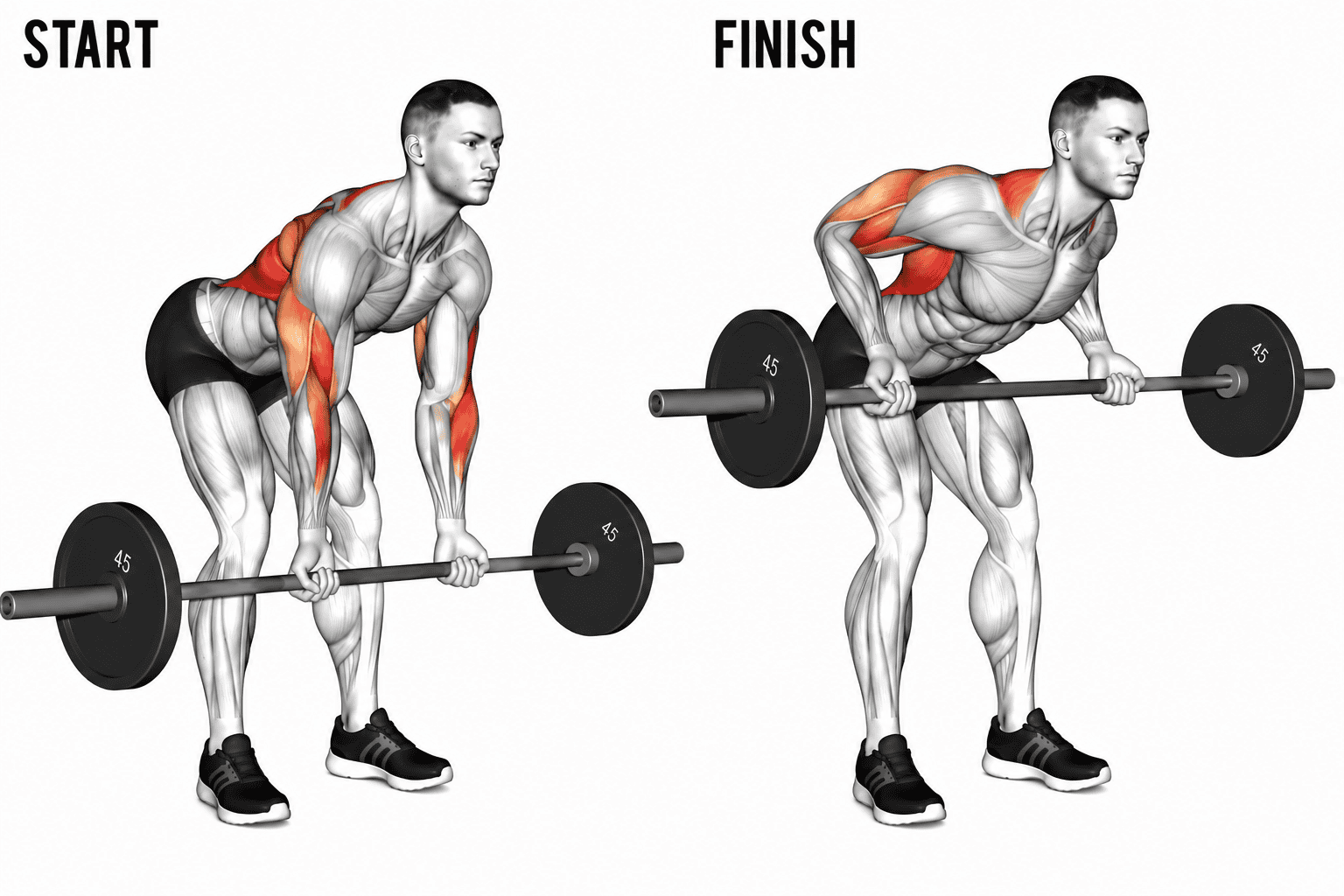
Exercise Description
The Reverse Grip Bent-Over Row is a compound pulling exercise that targets the back while using an underhand (supinated) grip. This grip variation increases the involvement of the lower latissimus dorsi and biceps compared to a traditional overhand row. The exercise is highly effective for building back thickness, improving pulling strength, and developing overall upper-body muscle mass.
Primary Muscles Worked
Latissimus Dorsi
Rhomboids
Middle Trapezius
Secondary Muscles Worked
Biceps Brachii
Brachialis
Posterior Deltoids (Rear Shoulders)
Teres Major
Forearm Flexors
Erector Spinae (Lower Back)
Core Muscles (Stabilization)
How to Perform Correctly
Setup
Stand with your feet approximately shoulder-width apart.
Grip the barbell with an underhand grip slightly narrower than shoulder-width.
Bend at the hips and slightly at the knees until your torso is about 45–75 degrees to the floor.
Keep your chest up and maintain a neutral spine.
Allow the barbell to hang directly beneath your shoulders with your arms fully extended.
Engage your core and keep your shoulders pulled back.
Movement
Pull the barbell toward your lower abdomen or waist.
Drive your elbows backward and close to your body.
Squeeze your shoulder blades together at the top of the movement.
Pause briefly when the bar reaches your torso.
Lower the barbell slowly and under control until your arms are fully extended.
Repeat for the desired number of repetitions.
Common Mistakes to Avoid
Rounding the Lower Back
A rounded spine increases stress on the lower back and can compromise lifting mechanics.
Using Excessive Momentum
Swinging the torso reduces muscle activation and places unnecessary stress on the body.
Standing Too Upright
An upright position decreases lat engagement and changes the movement pattern.
Pulling the Bar Too High
Pulling toward the chest can shift emphasis away from the lats and place more stress on the shoulders.
Allowing the Wrists to Bend Excessively
Keep the wrists neutral and aligned with the forearms.
Using Too Much Weight
Excessive loading often leads to poor form and reduced range of motion.
Incomplete Range of Motion
Fully extend the arms at the bottom and bring the bar to the torso at the top.