
Dumbbell Chest-Supported Row
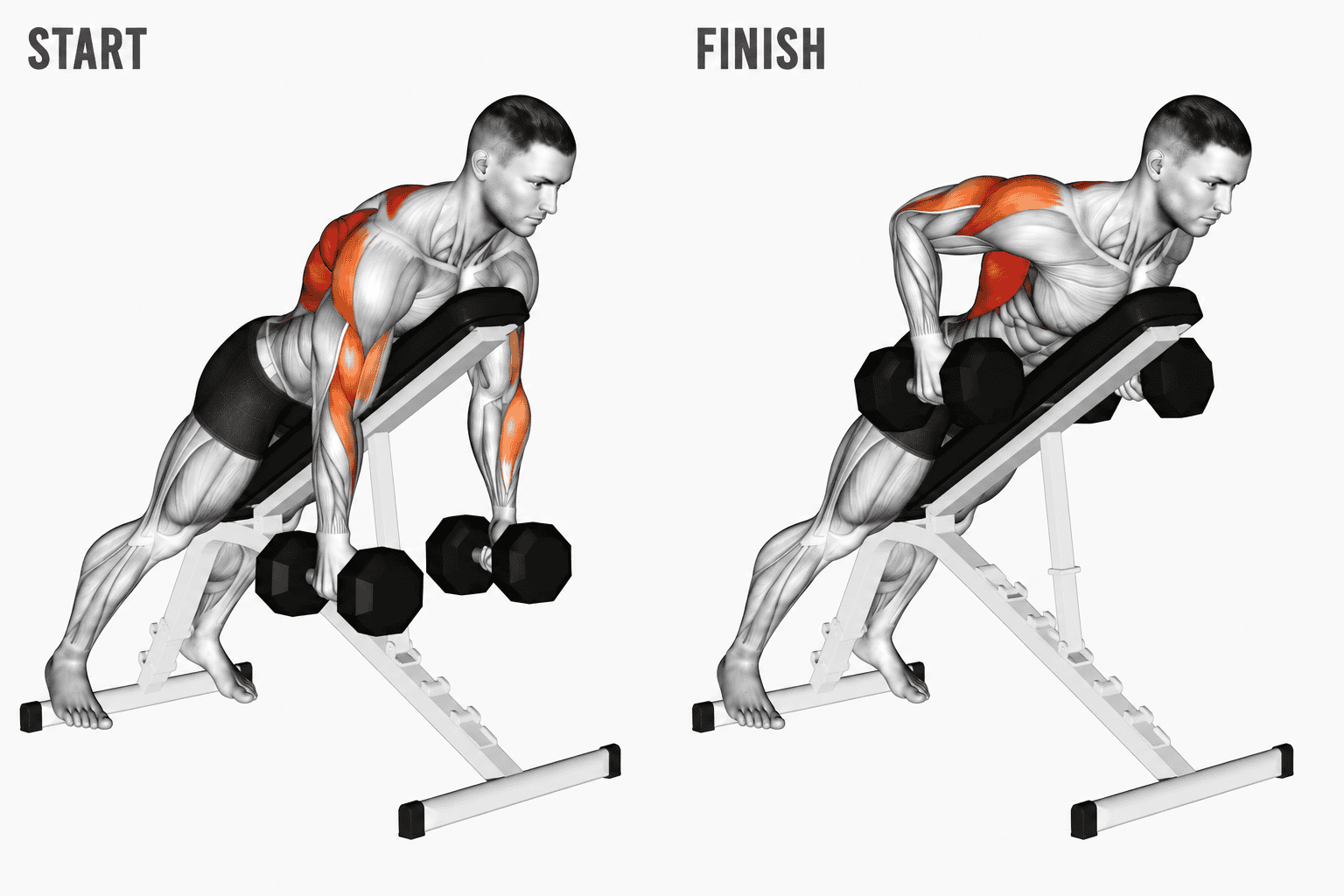
Exercise Description
The Dumbbell Chest-Supported Row is a compound pulling exercise that targets the muscles of the upper and middle back while minimizing stress on the lower back. Performed lying face down on an incline bench, this exercise provides stability and support, allowing you to focus on proper rowing mechanics and back muscle activation. It is an excellent choice for building back thickness, improving posture, and developing pulling strength.
Primary Muscles Worked
Latissimus Dorsi
Rhomboids
Middle Trapezius
Secondary Muscles Worked
Posterior Deltoids (Rear Shoulders)
Biceps Brachii
Brachialis
Teres Major
Forearm Flexors
Lower Trapezius
Rotator Cuff Muscles (Stabilizers)
How to Perform Correctly
Setup
Adjust an incline bench to approximately 30–45 degrees.
Hold a dumbbell in each hand and lie face down with your chest firmly supported on the bench.
Allow your arms to hang straight toward the floor with palms facing each other or slightly inward.
Keep your feet firmly planted on the floor for stability.
Retract your shoulder blades and maintain a neutral neck position.
Movement
Pull the dumbbells upward toward your lower ribs or sides.
Drive your elbows backward while keeping them close to your body.
Squeeze your shoulder blades together at the top of the movement.
Pause briefly at peak contraction.
Lower the dumbbells slowly and under control until your arms are fully extended.
Repeat for the desired number of repetitions.
Common Mistakes to Avoid
Using Excessive Weight
Heavy weights often reduce range of motion and lead to poor technique.
Shrugging the Shoulders
Focus on pulling with the back muscles rather than elevating the shoulders.
Using Momentum
Avoid swinging or bouncing the weights; the bench support should eliminate unnecessary body movement.
Pulling the Elbows Too High
Excessive elbow elevation can shift emphasis away from the lats and place stress on the shoulders.
Incomplete Range of Motion
Fully extend the arms at the bottom and achieve a strong contraction at the top.
Looking Forward Excessively
Keep your neck neutral to avoid unnecessary strain on the cervical spine.
Allowing the Chest to Lift Off the Bench
Maintain constant contact between your chest and the bench throughout the exercise.