
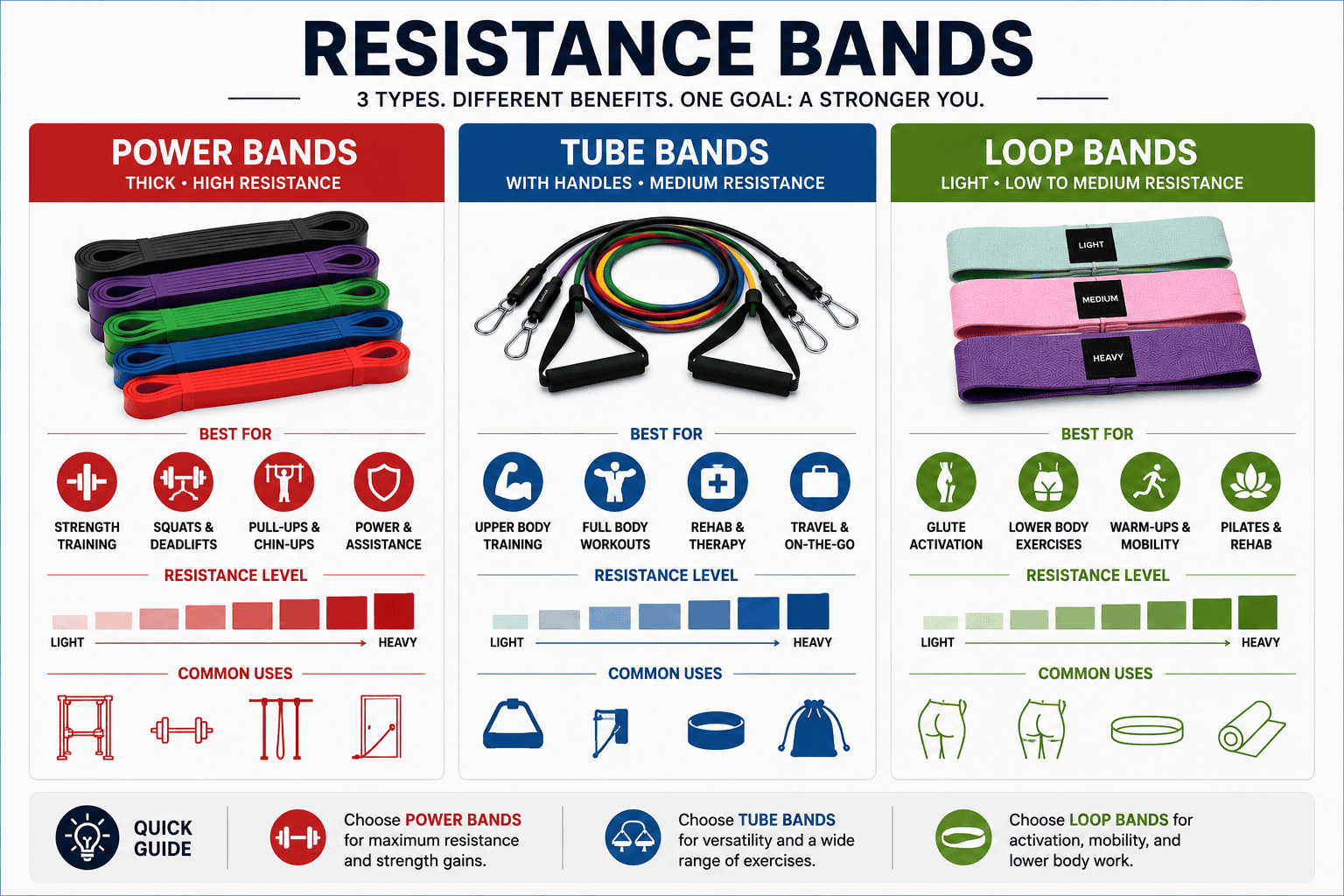
Types of Resistance Bands
Elastic resistance.
Three very different tools.
Resistance bands create tension as they stretch — the further they extend, the harder they become. Unlike dumbbells or barbells, this variable resistance loads muscles differently across the full range of motion. Power, loop, and tube bands look similar but serve distinct purposes with different weight ranges, shapes, and use cases. Getting the right type matters.
01
VARIABLE RESISTANCE
Bands load the muscle hardest at peak stretch — which often matches where muscles are mechanically strongest. This reduces joint stress and changes the stimulus compared to fixed weights.
02
THREE DISTINCT TOOLS
Power bands handle the heaviest work and pull-up assistance. Loop bands target lower body activation. Tube bands with handles replicate cable machine exercises. Each solves a different training problem.
03
COST VS EQUIPMENT
A complete set of all three band types costs under $150 and replaces thousands of dollars worth of cable machines, activation tools, and pull-up assistance equipment in commercial gyms.
04
THE TRADE-OFF
Bands can't replace maximal barbell strength training. Resistance isn't precisely measurable, and bands degrade with UV exposure and heavy use. Knowing what they're for matters as much as owning them.
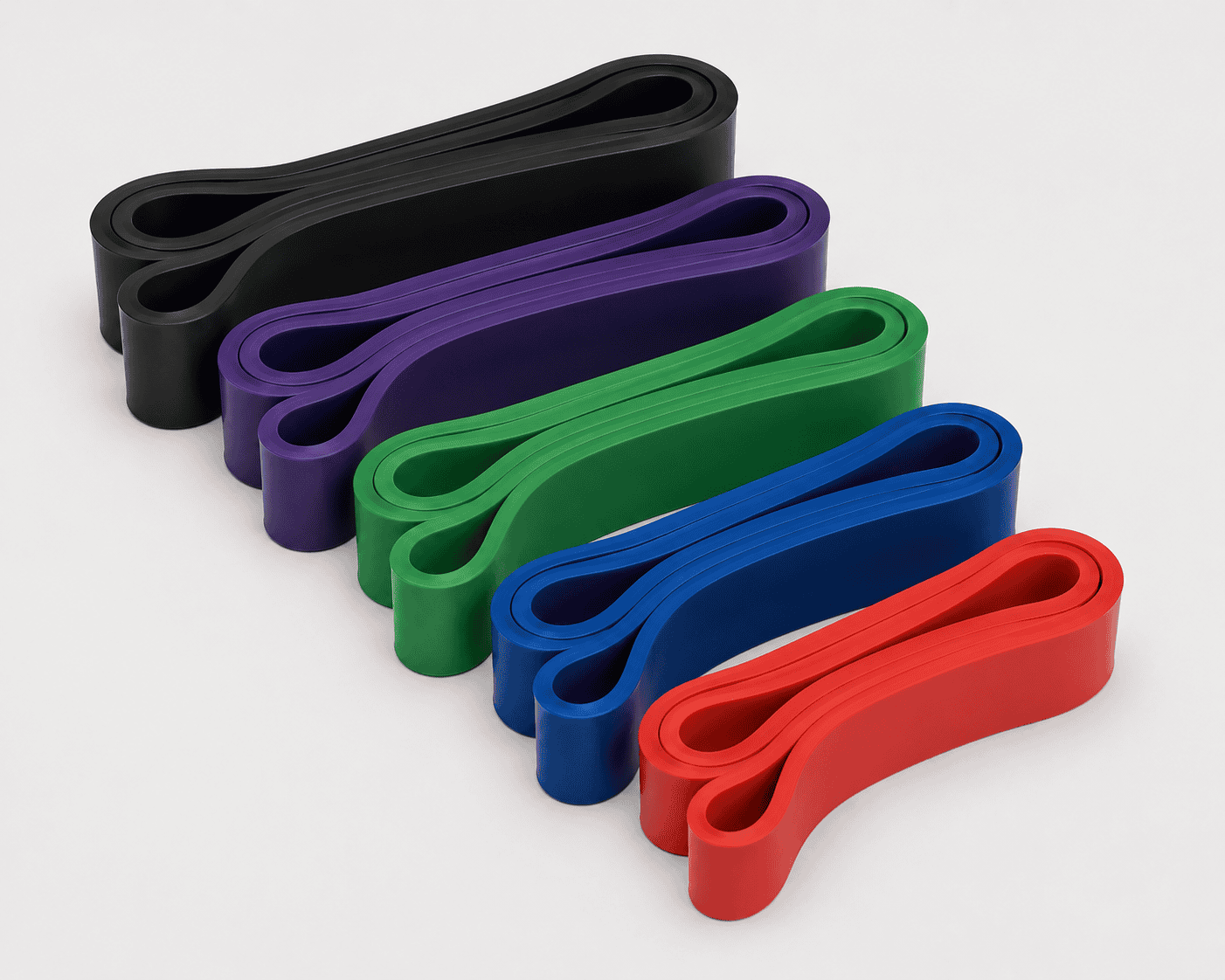
POWER / HEAVY-DUTY LOOP / PULL-UP ASSIST
Power bands
Also known as: WOD bands, resistance loops, pull-up assist bands, monster bands
Power bands are long (41-inch circumference), thick continuous latex loops — the heaviest-duty resistance band type available. They come in widths from ½ inch to 2½ inches, each corresponding to a resistance range that spans from a feather-light 5 lbs all the way to a brutal 200+ lbs for the thickest versions. Unlike mini loop bands, they're big enough to step into, loop over a pull-up bar, or anchor to a barbell.
They serve three primary purposes. First — pull-up assistance: loop the band over the bar, place your knee or foot inside, and the band reduces your effective bodyweight as it compresses at the bottom of each rep, providing more help at the hardest part of the movement and less at the top. This is far more effective than machine-assisted pull-ups for building actual pull-up strength. Second — accommodating resistance for powerlifting: attach bands to the barbell and floor anchors to make squats, bench press, and deadlifts exponentially harder at lockout where the movement is mechanically easiest. This trains explosive power through the full range. Third — mobility and stretching: power bands are standard tools in distraction-based mobility work, banded hip distraction, shoulder mobilisation, and active flexibility routines.
PROS
Highest resistance of any band — up to 200+ lbs
Best pull-up assistance tool available — beats machines
Used in elite powerlifting as accommodating resistance
Highly durable — thick latex withstands heavy loads
Doubles as a mobility and stretching tool
Can be used for full-body cable-style exercises
Assistance decreases as you get stronger — self-progressing
CONS
Requires a pull-up bar or solid post anchor for most uses
No handles — awkward for isolated upper body pulling
Heavy-gauge bands can snap violently if overloaded
Bulkier than loop or flat bands — less portable
Overkill for light rehab or glute activation work
Premium bands cost significantly more than budget types
BEST FOR
🏋️ Learning pull-ups⚡ Powerlifting accommodating resistance🧘 Mobility distraction💪 Heavy strength accessory work🔗 Barbell band tension
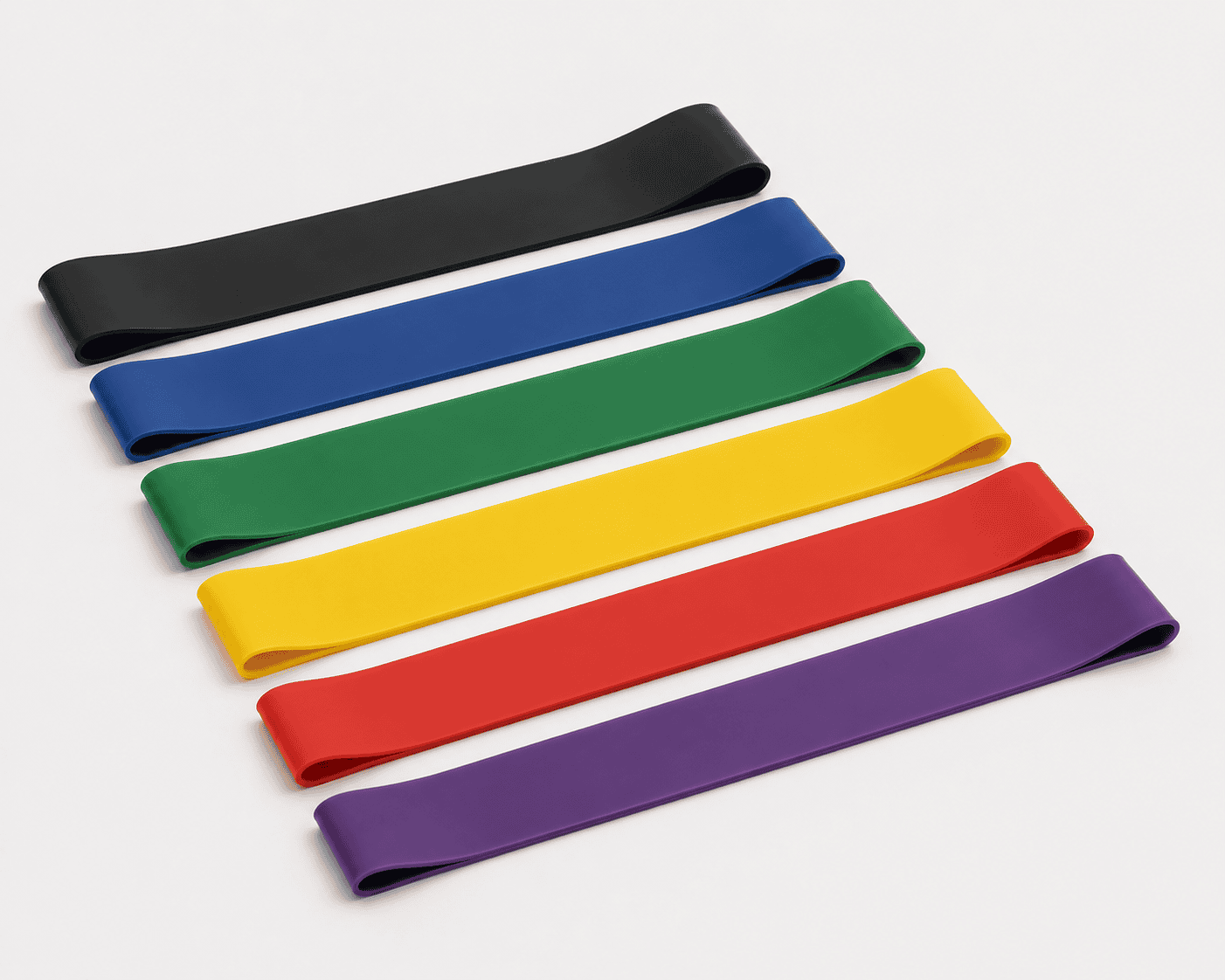
MINI LOOP / RESISTANCE LOOP / GLUTE BAND
Loop Bands
Also known as: mini loops, booty bands (latex), resistance circles, activation bands
Loop bands are short (4–12 inch diameter), flat, continuous rings of latex rubber. No handles, no length to manage — just a compact loop that sits around your thighs, knees, ankles, or wrists. They come in sets of 3–5 with increasing resistance, colour-coded from light (yellow/green) to extra-heavy (black/grey).
Their compact format makes them the go-to tool for lower body isolation and activation. Glute bridges, clamshells, lateral band walks, monster walks, standing hip abductions, fire hydrants, and squats with band resistance — loop bands excel at all of these. They're standard warm-up tools for athletes before heavy lower body sessions, particularly for activating glutes and hip stabilisers that tend to be underactive in people who sit for long periods.
PROS
Smallest and lightest band type — fits in any pocket
Ideal for glute activation, hip abduction, and lower body prehab
Cheapest effective training tool — sets from $8
No anchor needed for most exercises
Stackable — two bands at once for more resistance
Works for upper body warm-up (pull-aparts, rotator cuff)
Great for rehab and low-impact movement work
CONS
Thin latex rolls and digs into skin during exercises
Limited resistance ceiling — inadequate for strong lifters
Cheap latex degrades and snaps within months
Not suitable for heavy pulling or pressing movements
Slides out of position on smooth compression fabric
No handles limits upper body exercise options
BEST FOR
🍑 Glute activation🏥 Rehab & prehab🔥 Lower body warm-up✈️ Travel & hotel workouts🦵 Hip stability training💲 Budget training
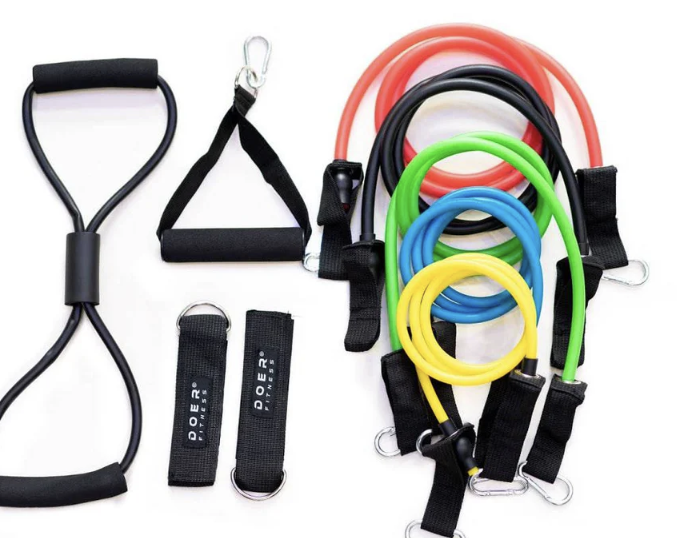
TUBE BANDS WITH HANDLES / STACKABLE BANDS / CABLE BAND SET
Tube Bands
Also known as: handle resistance bands, stackable resistance bands, home cable bands
Tube bands are hollow latex or TPE tubes with handles attached at both ends via carabiner clips or direct moulding. They come in sets of 3–5 tubes of increasing resistance (typically colour-coded), plus two padded handles, a door anchor, and often ankle straps. The handles make them the only band type truly designed for upper body pushing and pulling exercises — bicep curls, tricep pushdowns, rows, chest flyes, shoulder press, and lateral raises all work naturally with handles. Quality varies enormously. Cheap tube band sets have thin tubes, flimsy plastic clips, and handles that crack within weeks. The failure point is always the clip-to-handle junction under load. Investing in a mid-to-premium set (Bodylastics, SPRI, Undersun) dramatically extends lifespan and safety. At the top end, a quality stackable set delivers serious upper body training variety for $40–$80.
PROS
Most exercise variety of any band type — true cable machine substitute
Handles make upper body work comfortable and natural
Door anchor turns any room into a cable station
Stackable systems reach significant resistance levels
Ankle straps extend lower body exercise range
Quick resistance changes by swapping tubes between sets
Widest user base — most instructional content available
CONS
Clips and handles are failure points — cheap sets break fast
Single tubes can snap under heavy tension — safety risk
Resistance ratings between brands are inconsistent
Door anchor can damage door frames and paint
Bulkier than loop bands to pack and carry
Cannot be used for pull-up assistance or barbell loading
BEST FOR
🏠 Full home gym replacement💪 Upper body training🔌 Cable machine substitute🔄 Full-body workouts🌍 Travel with serious training🔰 Beginners building habit
PERFORMANCE RATINGS
Power Loop Bands
Max Resistance 10 / 10
Durability 9.2 / 10
Versatility 8.8 / 10
Pull-Up Assist 10 / 10
Portability 6.5 / 10
Value 8.8 / 10
Mini Loop Bands
Max Resistance 5.0 / 10
Durability 7.0 / 10
Versatility 7.5 / 10
Portability 9.8 / 10
Lower Body Use 9.0 / 10
Value 9.8 / 10
Tube Bands
Max Resistance 7.5 / 10
Durability 7.5 / 10
Versatility 9.5 / 10
Upper Body Use 9.5 / 10
Portability 8.0 / 10
Value 9.0 / 10
Top Models
Rogue Monster Bands
The elite standard. Used in professional training facilities worldwide. Available in 6 widths covering 5–120 lbs. Unmatched cycle life and consistency.
$22 – $55 / band
Serious Steel Pull-Up Bands
Strong alternative to Rogue. Popular for pull-up progression programs. Set of 5 covers full range from heavy assist to near-unassisted.
$15 – $45 / band
Fit Simplify Resistance Loop Bands
Most reviewed loop band set on the market. Consistent 5-band colour-coded set with carrying pouch. Solid quality-to-price ratio. The default recommendation for most beginners.
$10 – $15 / set of 5
WOD Nation Attack Bands
Thicker latex with better durability than standard budget sets. Preferred by athletes and physiotherapists for regular use. Slower degradation and more consistent resistance levels.
$20 – $30 / set
SPRI Xertube Resistance Band
Classic, reliable single-tube band from a well-established fitness brand. Used in commercial fitness classes. Simple, durable, consistent — great for beginners wanting one quality tube.
$15 – $25 / band
Bodylastics Stackable Band Set
The gold standard. Stackable clip-on system reaches 96 lbs. Anti-snap safety sheath on all tubes. Includes door anchor, ankle straps, and two handles. Warranty-backed.
$50 – $80 / set
DECISION GUIDE
Which one do you need?
You want to activate your glutes properly
Loop bands are the tool physiotherapists and strength coaches universally recommend before any lower body session. 2–3 sets of clamshells, glute bridges, or lateral walks with a medium loop band will switch on glutes better than any other warm-up method.
You're learning pull-ups from scratch
Power bands are the best pull-up progression tool available — bar none. Start with a heavy band that makes the rep easy, then progressively move to lighter bands as you build strength. A set of 3 bands (heavy/medium/light) covers the full progression from zero to unassisted.
You want a full home gym in a bag
Tube bands with a door anchor give you bicep curls, rows, chest press, tricep pushdowns, lateral raises, face pulls, and more — all from a single set. It's the closest a band type comes to replacing a cable machine, and fits in a small backpack.
You want to add accommodating resistance to barbell work
Power bands anchored to the floor and barbell force the hardest work at lockout — the point where most lifters coast through. This Westside-popularised technique trains explosive strength in a way no other tool replicates. Heavy bands for squats and deads; medium for bench.
You travel constantly and want something that's always with you
Loop bands are the obvious answer — a set of 5 weighs under 200g and fits in any bag. Pair with a single tube band and door anchor if you want upper body work too. Complete full-body travel kit under 500g.
You want to train arms, back, and shoulders seriously without a gym
Tube bands with handles and a door anchor is the only band type that lets you properly target biceps, triceps, rear delts, lats, and upper traps through cable-style movements with comfortable, stable grip throughout each exercise.
MAINTENANCE & SAFETY
Care & Safety
AVOID HEAT & UV
Latex degrades fast in heat and sunlight. Store bands in a cool, dry, dark place. Never leave them in a hot car, near a radiator, or by a window. Even a few days of direct sun exposure visibly cracks some budget latex.
INSPECT BEFORE USE
Check for nicks, tears, or whitening (stress marks) before every session. Any of these is a warning to retire the band. A power band snapping under 100+ lbs of tension is dangerous. This takes 5 seconds and is always worth it.
KEEP AWAY FROM OILS
Body oils, sunscreen, and petroleum-based products accelerate latex breakdown. Wipe bands with a damp cloth after use. Don't use silicone spray or lubricants on latex bands — they degrade the rubber from the inside out.
USE SOLID ANCHORS ONLY
Tube bands need sturdy door anchors used correctly (door closing away from you, not toward you). Power bands need rated pull-up bars or barbell setups. Never anchor to furniture, handles, or anything that can fail under the load you're generating.