
Bulgarian Split Squat
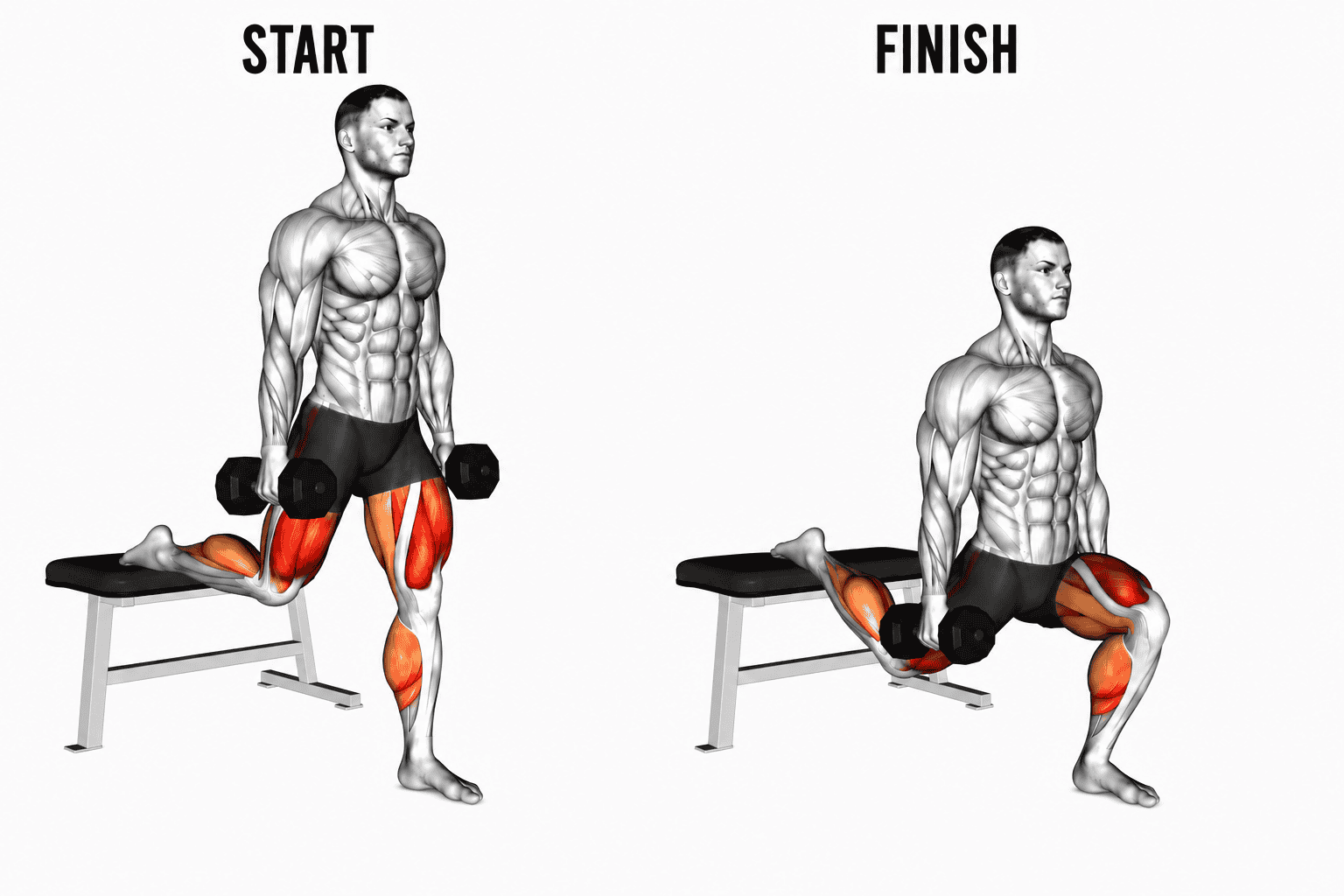
Exercise Description
The Bulgarian Split Squat is a unilateral lower-body exercise that targets the legs and glutes while improving balance, coordination, and stability. Performed with the rear foot elevated on a bench or platform, this exercise increases the range of motion and places significant demand on the working leg. The Bulgarian Split Squat is highly effective for building strength, muscle mass, correcting muscular imbalances, and enhancing athletic performance.
Primary Muscles Worked
Quadriceps
Gluteus Maximus
Secondary Muscles Worked
Hamstrings
Gluteus Medius
Adductor Magnus
Calves (Gastrocnemius and Soleus)
Rectus Abdominis
Obliques
Erector Spinae
Hip Stabilizers
How to Perform Correctly
Setup
Stand approximately two to three feet in front of a bench or elevated platform.
Place the top of one foot behind you on the bench.
Position your front foot far enough forward so that your knee remains aligned over your foot during the movement.
Keep your chest lifted and shoulders pulled back.
Engage your core and maintain a neutral spine.
Hold dumbbells at your sides if additional resistance is desired.
Movement
Lower your body by bending your front knee and dropping your rear knee toward the floor.
Keep most of your weight on the front leg throughout the exercise.
Descend until your front thigh is approximately parallel to the floor or as low as your mobility allows.
Maintain an upright torso throughout the movement.
Drive through the heel and midfoot of the front leg to return to the starting position.
Fully extend the hip and knee of the working leg at the top.
Complete all repetitions on one side before switching legs.
Common Mistakes to Avoid
Standing Too Close to the Bench
This can place excessive stress on the knee and limit range of motion.
Pushing Off the Rear Leg
The front leg should perform the majority of the work.
Allowing the Front Knee to Collapse Inward
Keep the knee aligned with the toes throughout the movement.
Leaning Excessively Forward
Maintain a tall chest and neutral spine.
Taking Steps That Are Too Long
Overextending the stance can reduce stability and comfort.
Using Excessive Weight
Prioritize balance, depth, and control before increasing resistance.
Rushing the Repetitions
Perform each repetition slowly and under control.