
Alternate Dumbbell Shoulder Press
Exercise Description
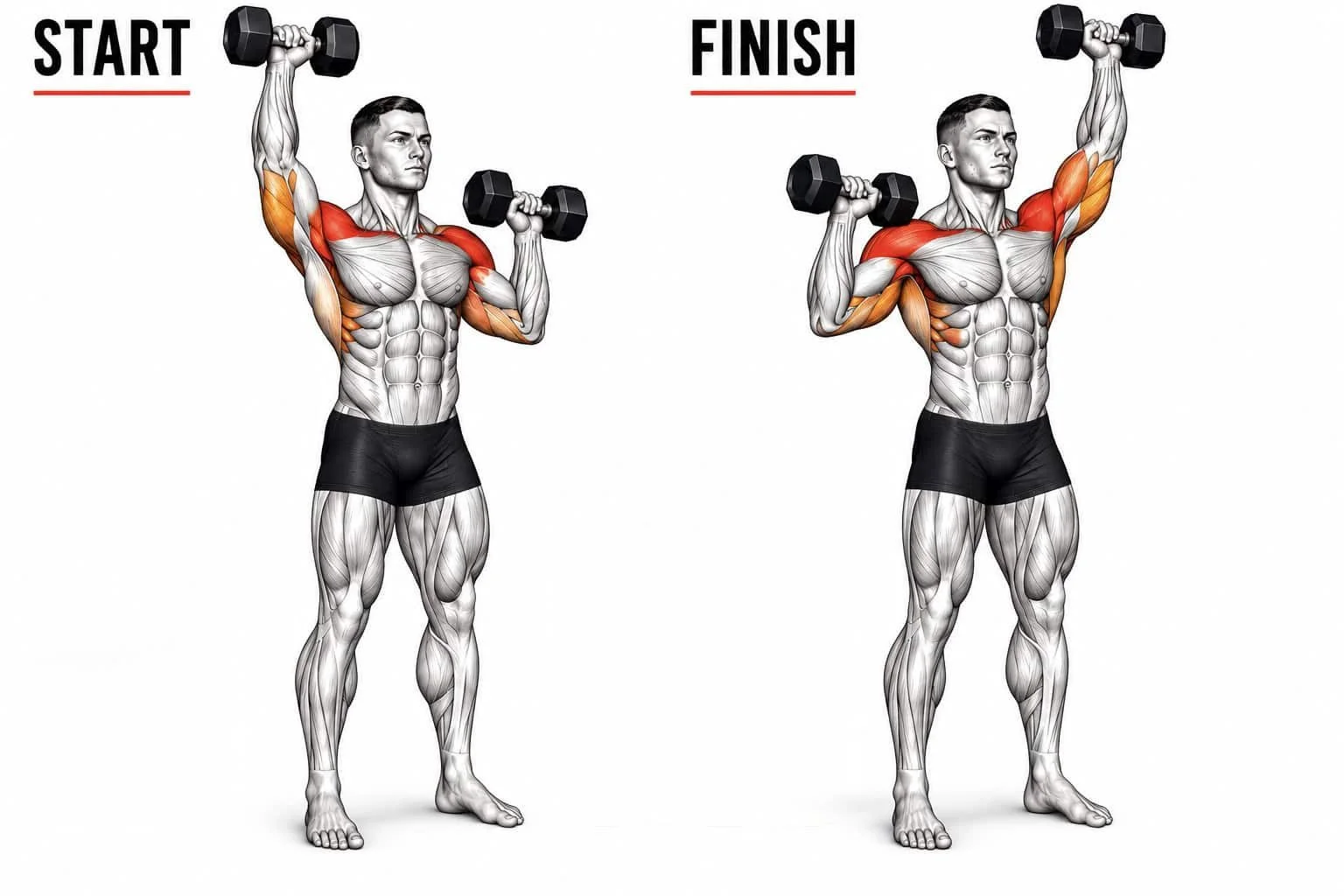
The Alternating Dumbbell Shoulder Press is a shoulder-strengthening exercise in which one dumbbell is pressed overhead while the opposite arm remains at shoulder level. This unilateral movement increases the demand on the core and shoulder stabilizers, helping to improve muscular balance, coordination, and overhead pressing strength. It is an excellent variation for building shoulder muscle while enhancing stability and control.
Primary Muscles Worked
Anterior Deltoids (Front Shoulders)
Lateral Deltoids (Side Shoulders)
Secondary Muscles Worked
Triceps Brachii
Upper Trapezius
Serratus Anterior
Upper Pectoralis Major
Rotator Cuff Muscles (Stabilizers)
Rectus Abdominis
Obliques
Erector Spinae (Lower Back Stabilizers)
How to Perform Correctly
Setup
Stand or sit upright holding a dumbbell in each hand at shoulder level.
Position your palms facing forward or slightly inward.
Keep your chest lifted and your shoulders pulled back.
Engage your core and maintain a neutral spine.
Keep both elbows positioned beneath the dumbbells.
Movement
Press one dumbbell overhead until your arm is nearly straight.
Keep the opposite dumbbell held at shoulder level without allowing it to drop.
Lower the raised dumbbell slowly back to the starting position.
Immediately press the opposite dumbbell overhead.
Continue alternating sides while maintaining control and proper posture.
Repeat for the desired number of repetitions.
Common Mistakes to Avoid
Arching the Lower Back
Excessive back extension reduces core engagement and places stress on the lumbar spine.
Allowing the Non-Working Arm to Drop
Keep the stationary dumbbell stable at shoulder level throughout the set.
Using Momentum
Avoid leaning or using body movement to help lift the weight.
Pressing Unevenly
Perform each repetition through the same range of motion on both sides.
Shrugging the Shoulders
Keep the shoulders stable and avoid elevating them toward the ears.
Using Excessive Weight
Heavy dumbbells often lead to poor form and reduced control.
Lowering the Weight Too Quickly
Control the lowering phase to maximize muscle activation and joint safety.