
Three focused sessions · Train at home
Dumbbell Push/Pull/Legs Workout
Organize your training around three simple sessions: press on push day, row and curl on pull day, then train your legs and core. Follow the sets, reps, and rest times below with dumbbells and a stable seat.
This three-day sample plan is for lifters who already know the basic movements and prefer training separate body regions each session. It gives each region one dedicated workout per week. Choose weights you can control and build up gradually.
Your plan at a glance
| Schedule | 3 training days per week, with rest days between sessions |
|---|---|
| Split | Push: chest, shoulders, triceps · Pull: back, rear shoulders, biceps · Legs: lower body and core |
| Equipment | Adjustable dumbbells or several pairs, clear floor space, a stable armless chair or exercise bench, an optional mat, and a sturdy low bench for Bulgarian split squats |
| Experience | Familiar with presses, rows, squats, and hip hinges |
| Session length | Allow roughly 30–60 minutes including warm-up; pull day is shorter and legs day is longer |
| Starting block | Repeat for 6–8 weeks, reviewing your training log and recovery |
Use a seat that cannot slide or tip. Presses are performed on the floor or standing. Bulgarian split squats need a sturdy rear-foot support; choose stationary split squats if you do not have one. For dumbbells with removable plates, check that the collars or locks are secure before every session.
Weekly push/pull/legs schedule
| Day | Training |
|---|---|
| Monday | Push |
| Tuesday | Rest or easy walking |
| Wednesday | Pull |
| Thursday | Rest or easy activity |
| Friday | Legs and core |
| Saturday | Optional easy activity |
| Sunday | Rest |
Move the sessions to suit your week while keeping the push → pull → legs order. If you miss a workout, resume the sequence; do not squeeze two sessions into one to catch up.
Before your first workout
Warm up for the session ahead
Spend 5–8 minutes walking or marching and practicing the day’s movements without heavy weights. Use controlled arm circles and light presses or rows on upper-body days; use bodyweight squats and unloaded hip hinges on legs day. Add 1–3 progressively heavier practice sets before the first demanding exercise. Warm-up sets do not count toward the working sets below.
Choose a weight you can repeat with control
For this plan, finish most working sets with about 1–3 good repetitions still available. If you cannot reach the bottom of the rep range with steady technique, reduce the weight. Lateral raises and reverse flys usually need much lighter weights than rows and squats.
Complete straight sets
Finish all sets of one exercise before moving to the next. Rest for the time listed, taking longer if necessary. For one-sided movements, complete both sides before the listed rest; take a brief pause between sides if needed. Two sets per side means two sets for each limb.
Day 1 · Push
Train your chest, shoulders, and triceps. Begin with the larger pressing movements, then finish with lighter shoulder and arm work.
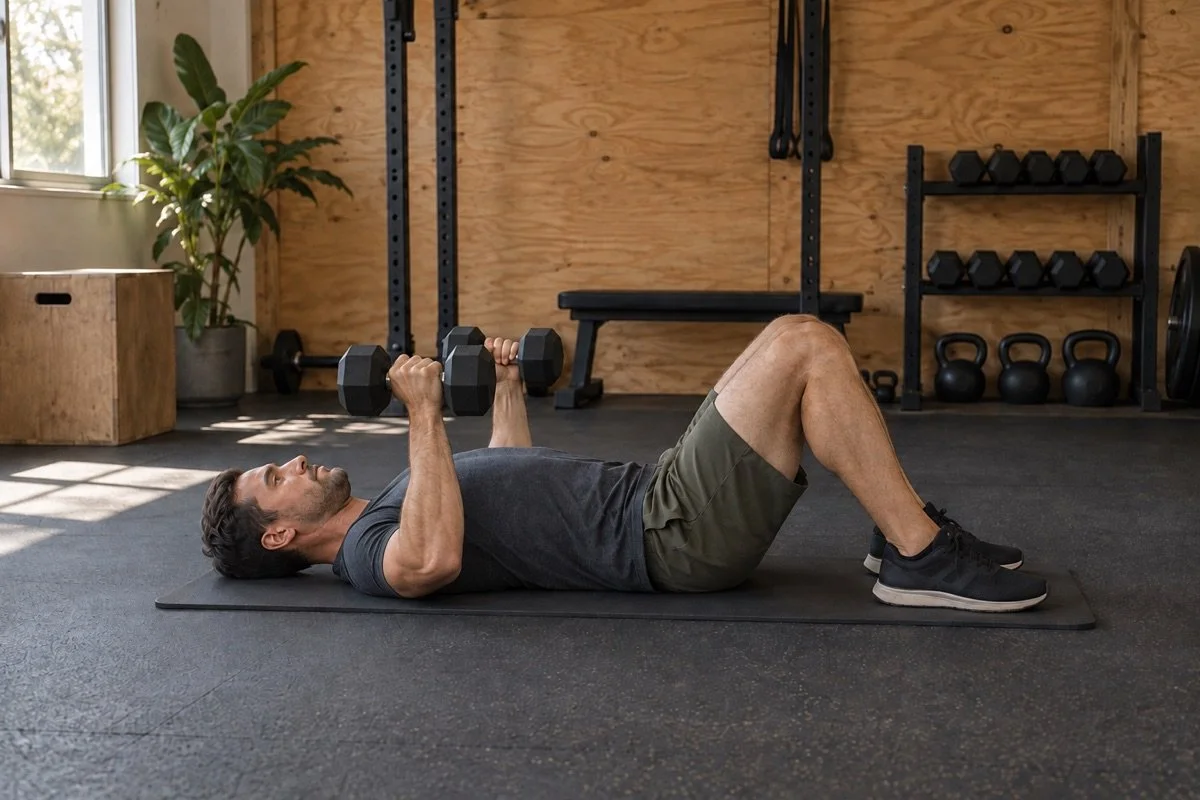
Dumbbell floor press
3 sets × 8–12 reps · Rest 2 minutes
Lie with knees bent. Lower until your upper arms gently meet the floor, then press up. Keep your wrists stacked over your elbows.
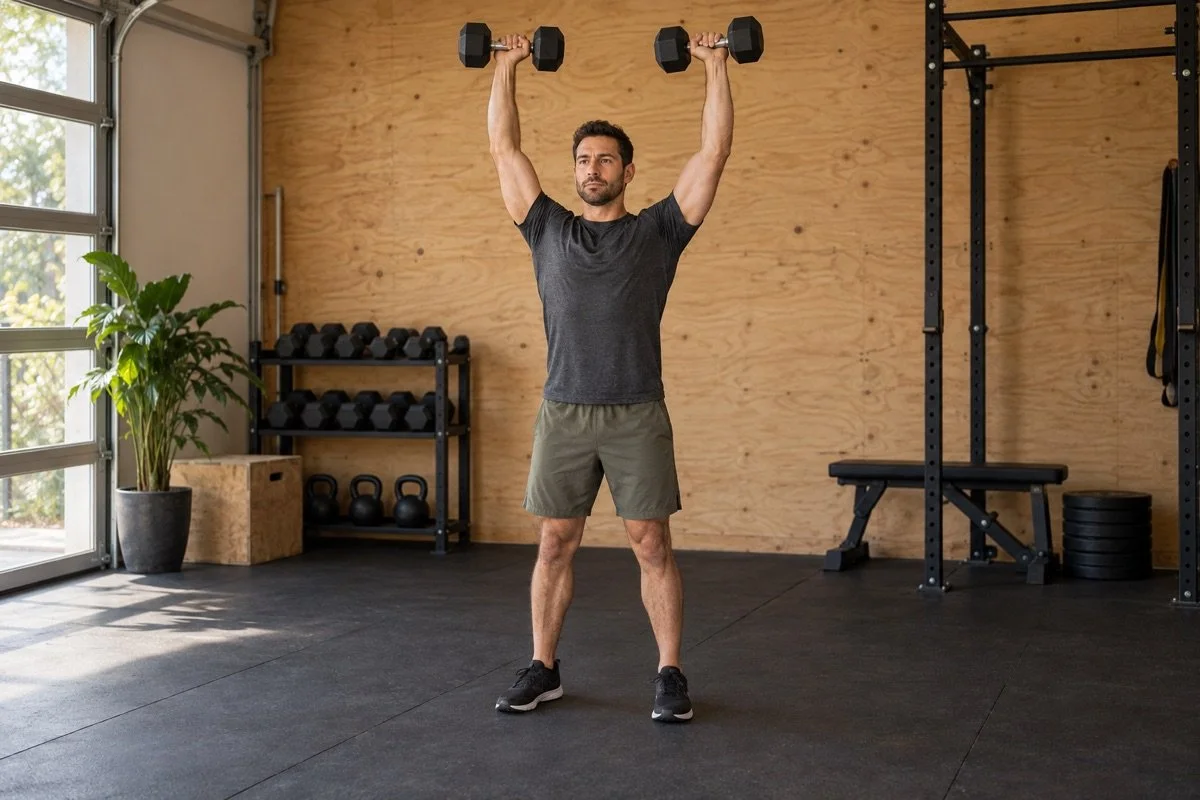
Standing dumbbell shoulder press
3 sets × 8–12 reps · Rest 2 minutes
Brace your torso and press overhead through a comfortable range. Avoid leaning back to finish a repetition.
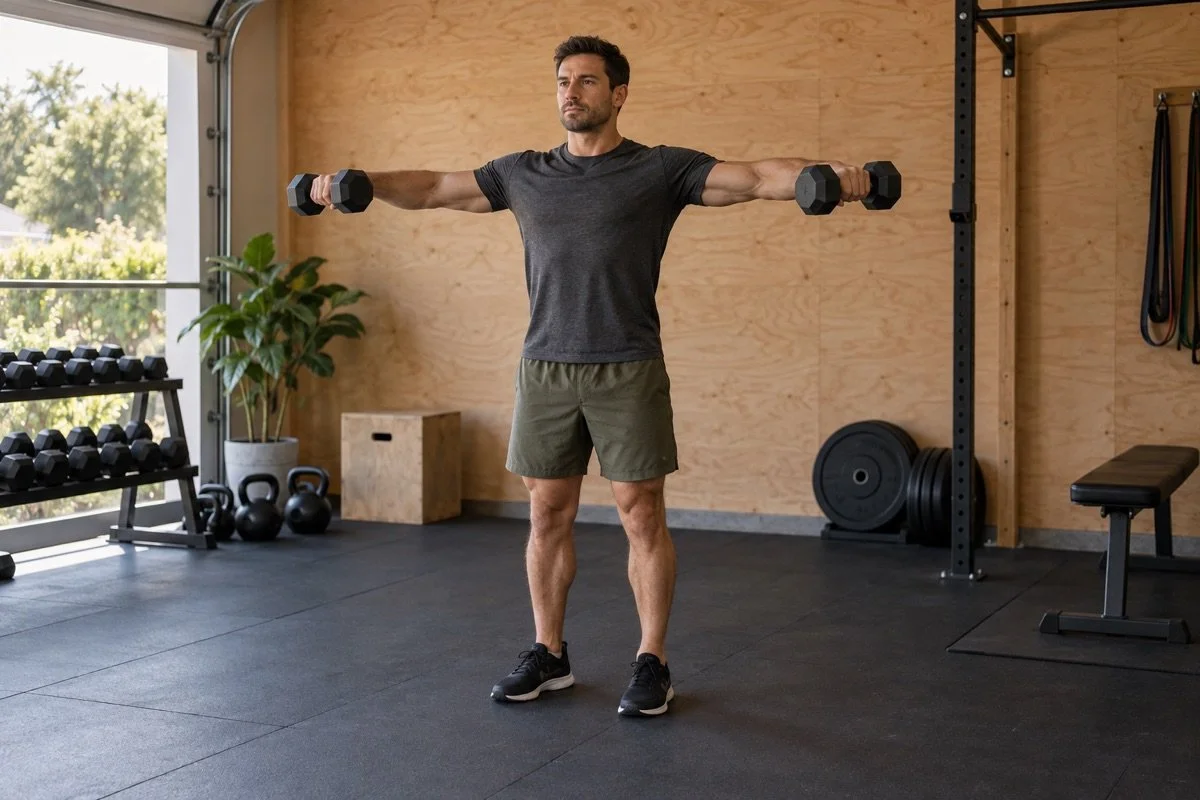
Dumbbell lateral raise
2 sets × 12–20 reps · Rest 60–90 seconds
Use light weights and softly bent elbows. Raise your arms out to the sides without swinging your torso.
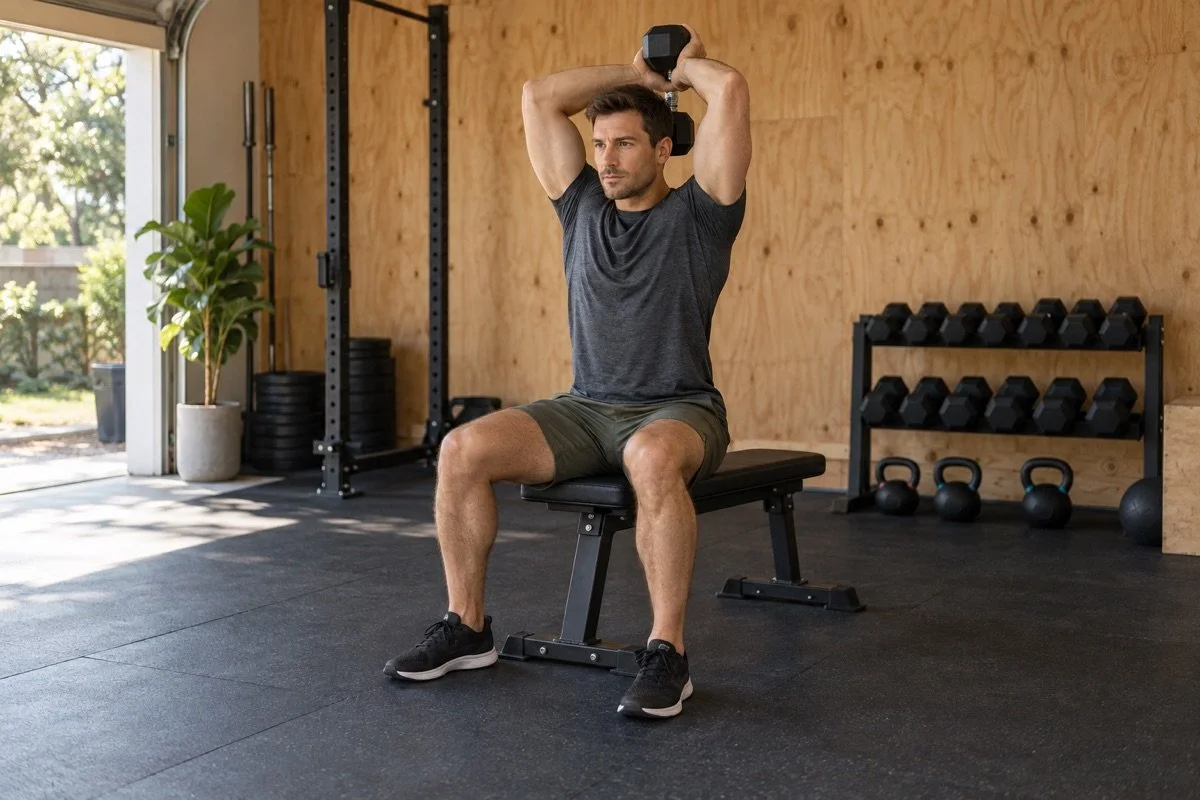
Seated dumbbell triceps extension
2 sets × 10–15 reps · Rest 60–90 seconds
Sit on a stable seat. Hold one securely assembled dumbbell with both hands overhead, bend your elbows to lower it behind your head, then extend with control. Use a light load you can safely position.
Day 2 · Pull
Focus on a controlled row, rear-shoulder work, and curls. This is deliberately the shortest session; you do not need to fill the time with extra exercises.
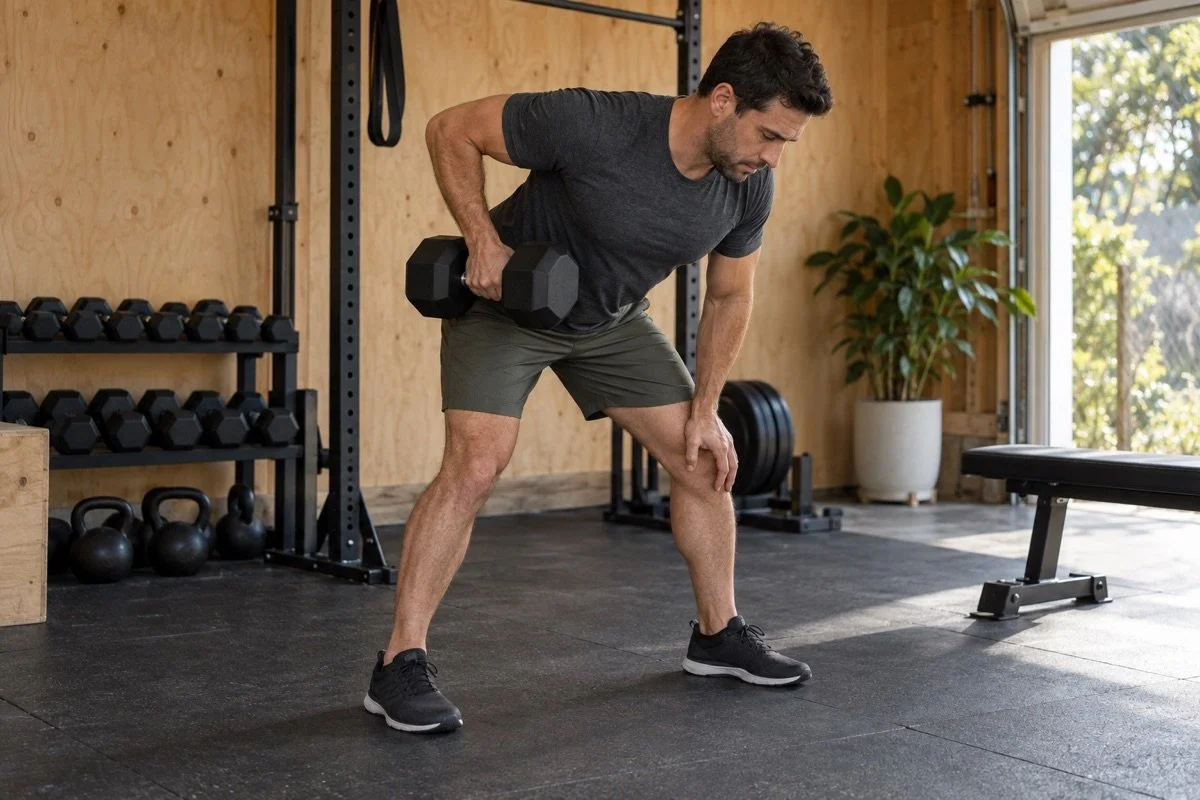
One-arm dumbbell row
3 sets × 8–12 reps per side · Rest 90–120 seconds
Brace your free hand on your thigh. Keep your back steady and pull toward your hip without twisting.
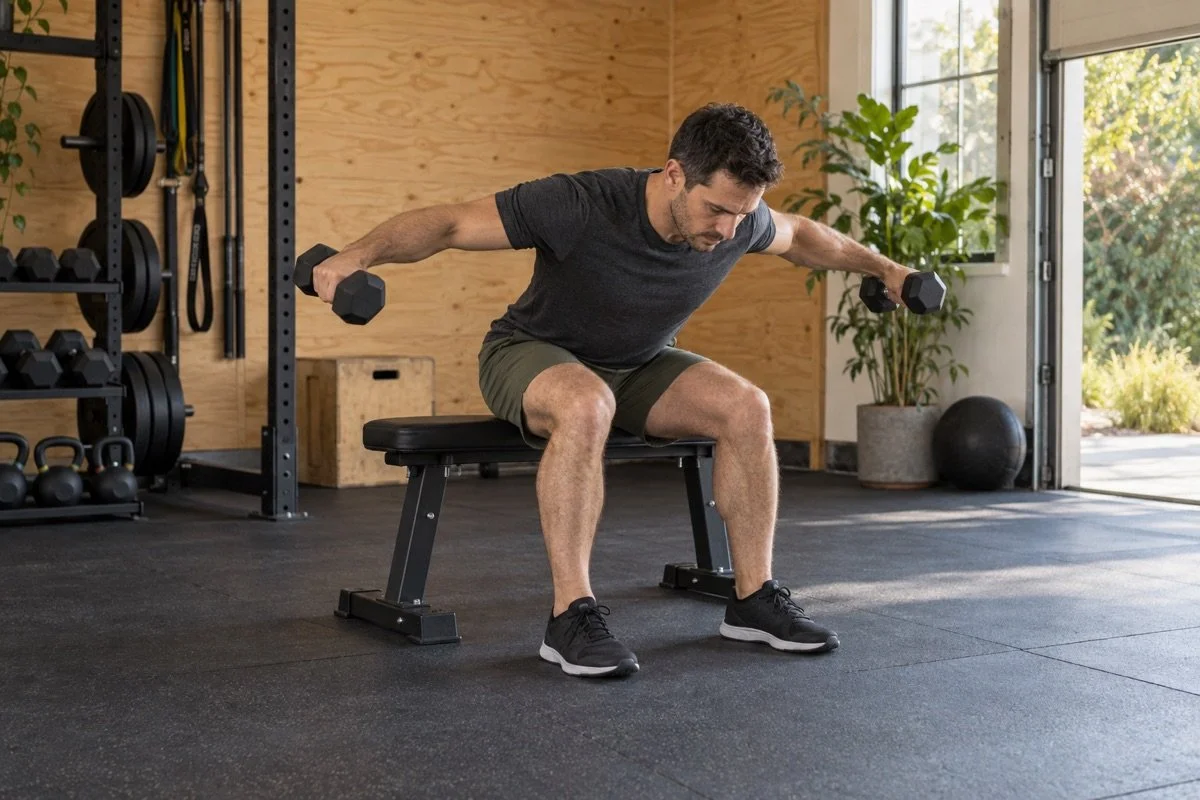
Seated bent-over reverse fly
3 sets × 12–20 reps · Rest 60–90 seconds
Sit on a stable seat and hinge forward. With light dumbbells and slightly bent elbows, raise your arms out to the sides, then lower slowly.
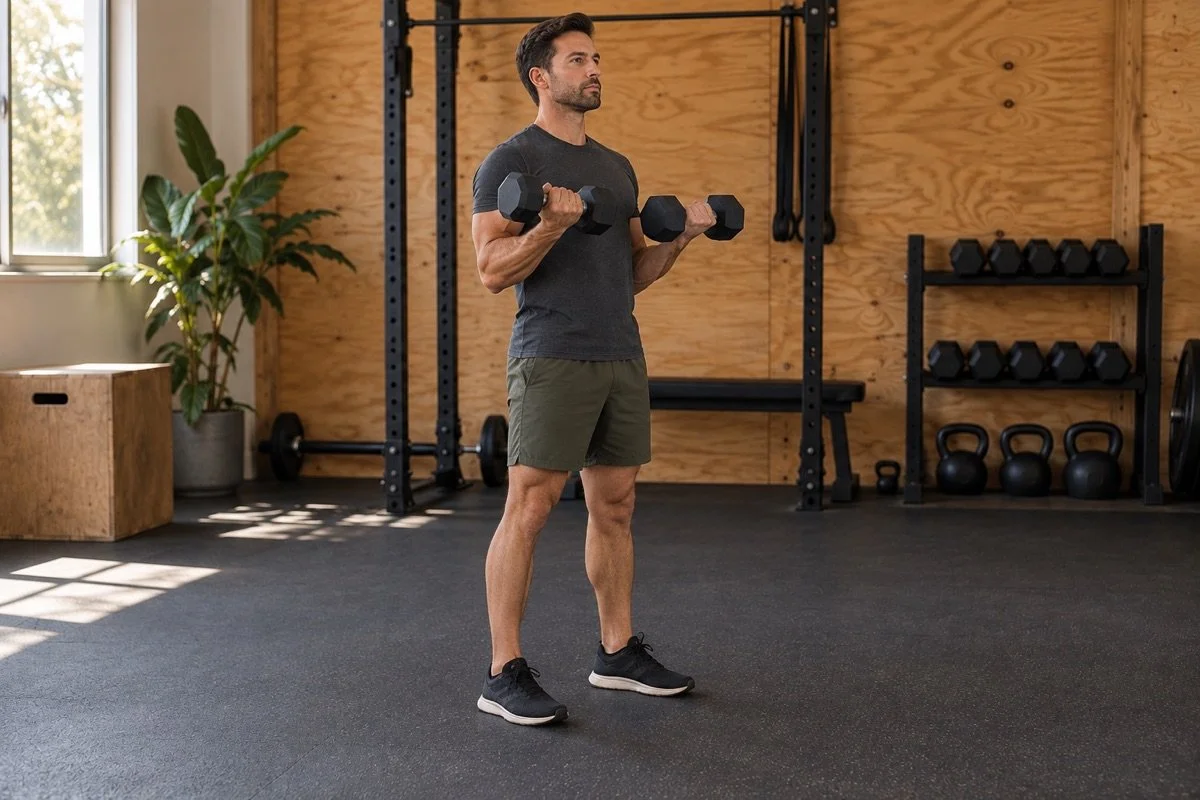
Standing dumbbell biceps curl
3 sets × 10–15 reps · Rest 60–90 seconds
Begin with your arms by your sides and palms facing forward. Keep your elbows close to your torso and wrists straight as you curl the weights up, palms facing upward. Lower slowly without swinging.
Day 3 · Legs and core
Work through a squat, hip hinge, and single-leg movement, then finish with calves and core. Choose either the stationary split squat or Bulgarian split squat below for your single-leg exercise. Take enough rest to keep your balance and technique consistent.
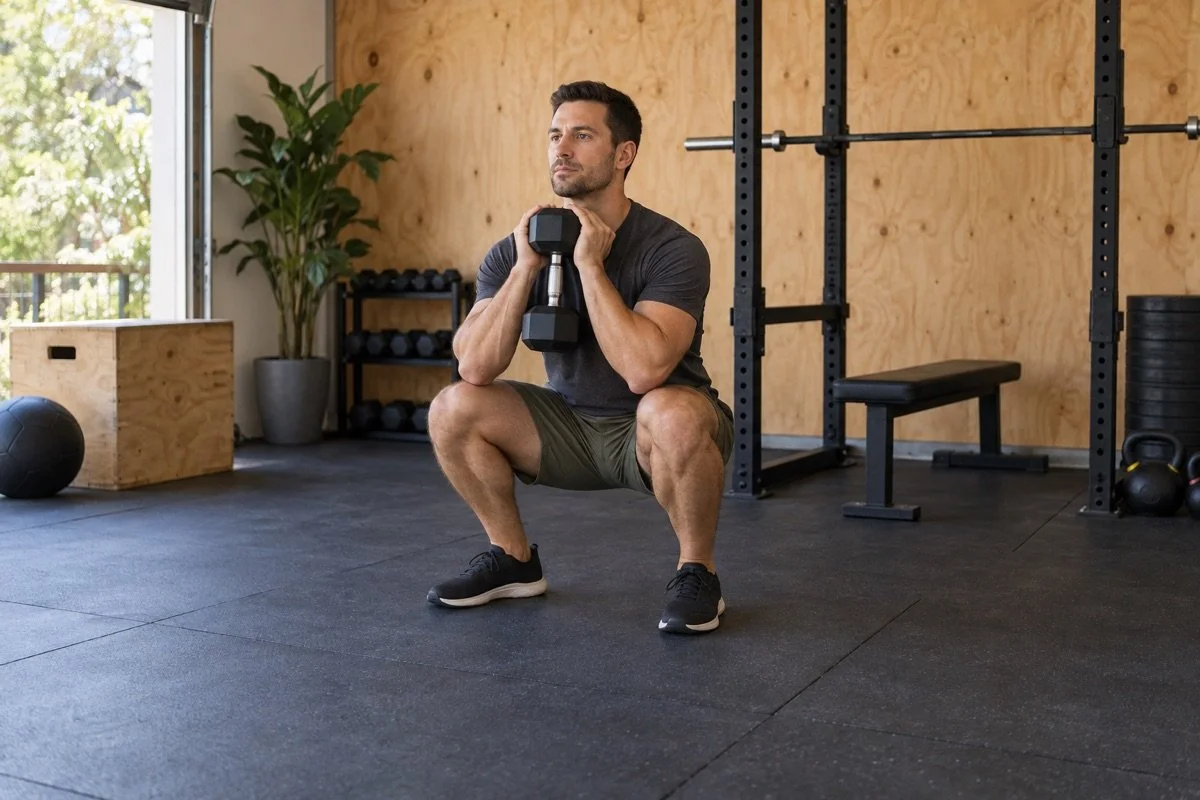
Dumbbell goblet squat
3 sets × 8–12 reps · Rest 2 minutes
Hold one dumbbell at your chest. Keep your whole foot planted and squat through a range you can control.
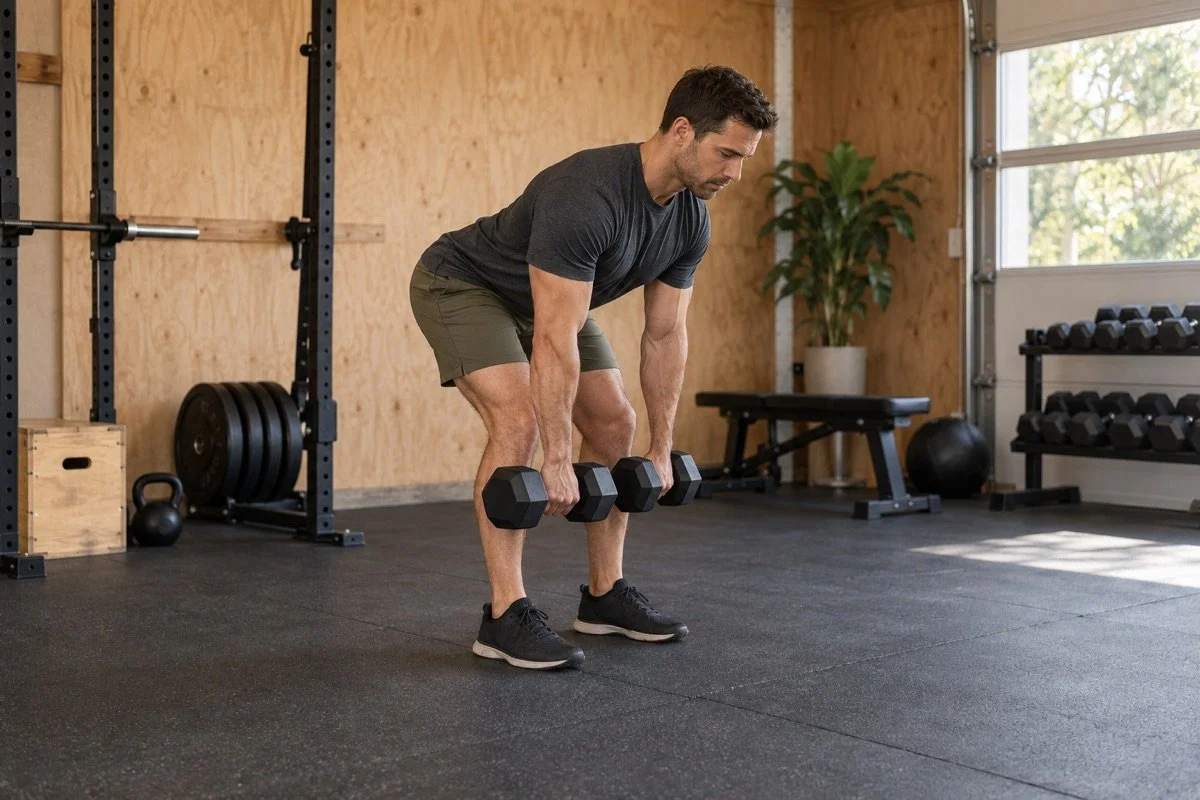
Dumbbell Romanian deadlift
3 sets × 8–12 reps · Rest 2 minutes
Keep your knees softly bent and move your hips backward. Keep the weights close to your legs and stop before your lower back rounds.
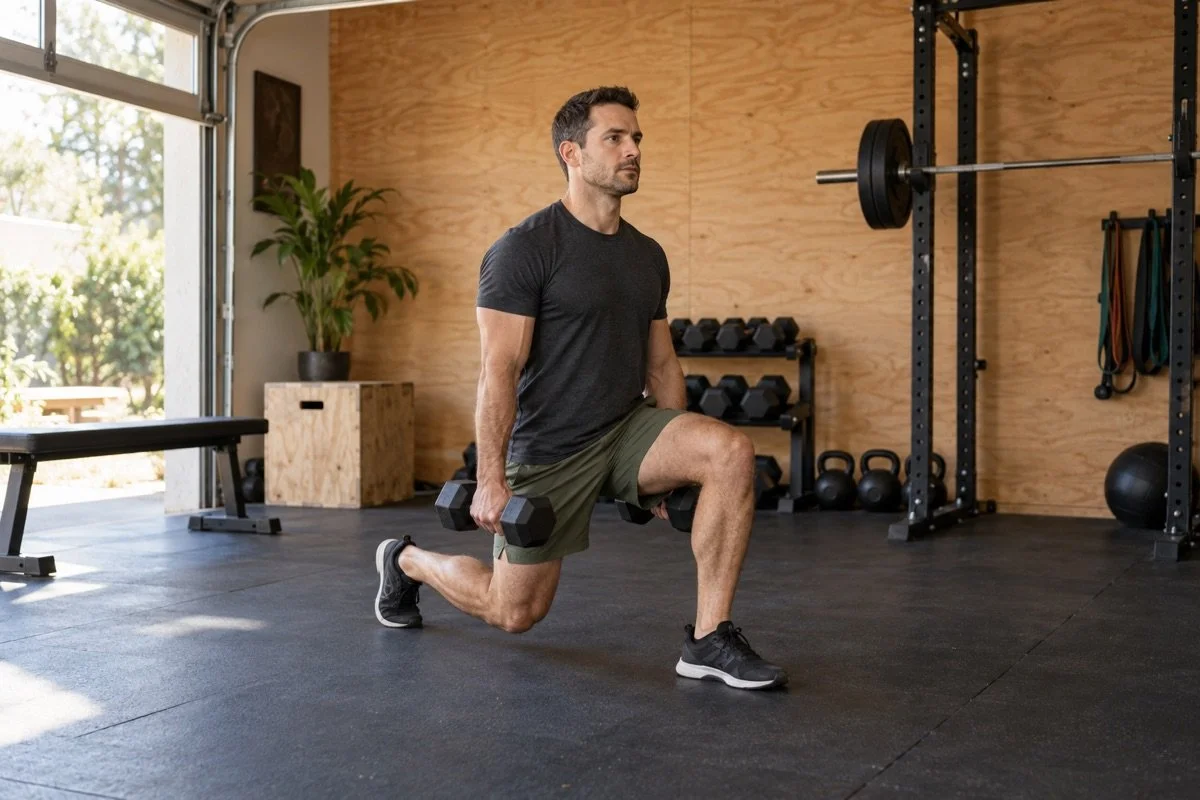
Stationary split squat
2 sets × 8–12 reps per side · Rest 90–120 seconds
Keep both feet on the floor in a staggered stance. Bend both knees, then push through the front foot to rise. Start without weights if balance is difficult.
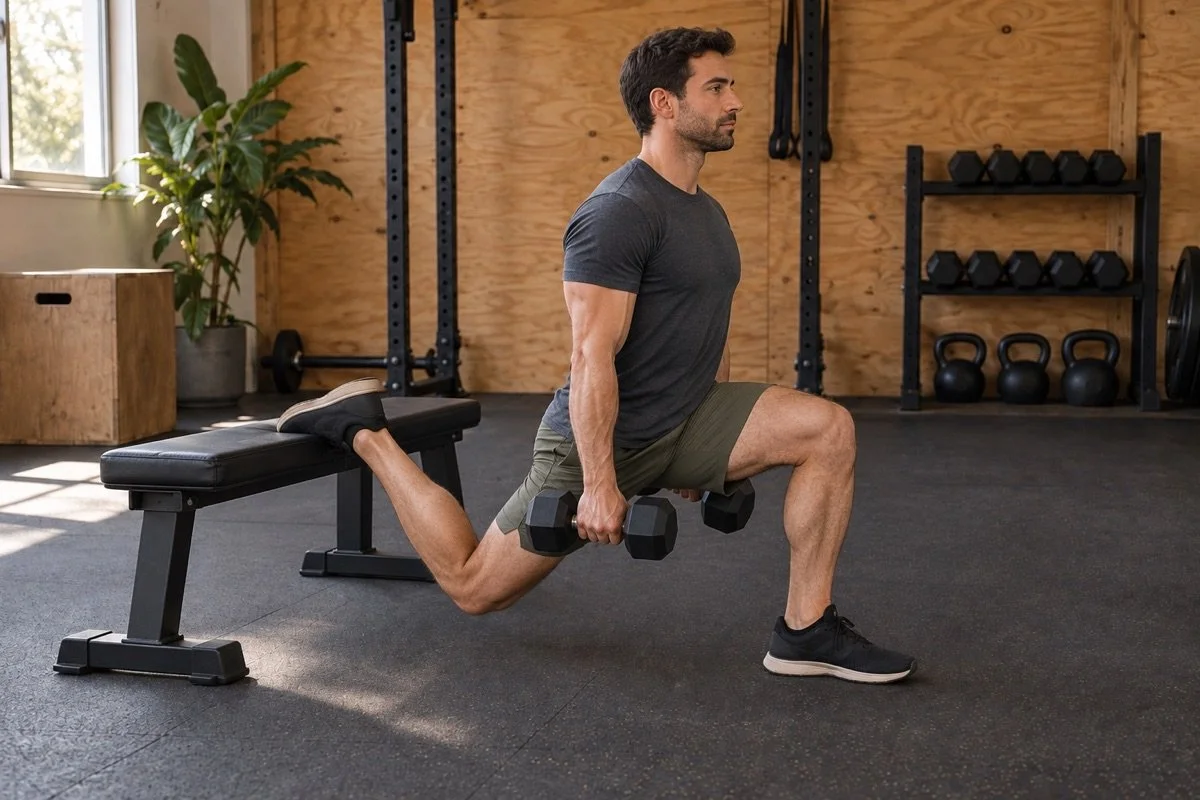
Bulgarian split squat
Single-leg option · 2 sets × 8–12 reps per side · Rest 90–120 seconds
Rest the top of your rear foot on a sturdy low bench. Plant your front foot far enough forward to lower comfortably, then bend your front knee and lower your rear knee toward the floor. Keep your front heel down and rise through the front leg. Start with bodyweight, adding dumbbells when steady. Choose this or the stationary split squat for the session.
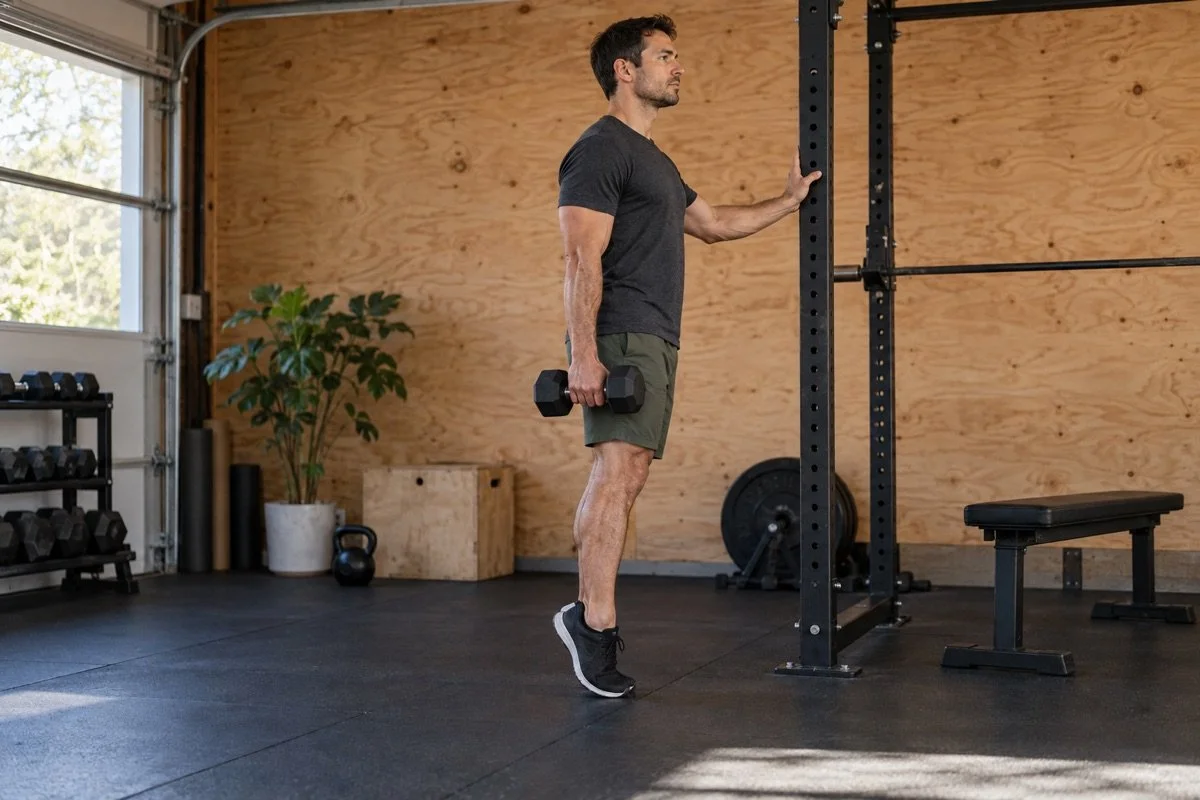
Single-leg dumbbell calf raise
2 sets × 12–20 reps per side · Rest 60–90 seconds
Start on level ground, using your free hand on a stable support. Raise your heel, pause, then lower without bouncing. A raised step is optional, not required.
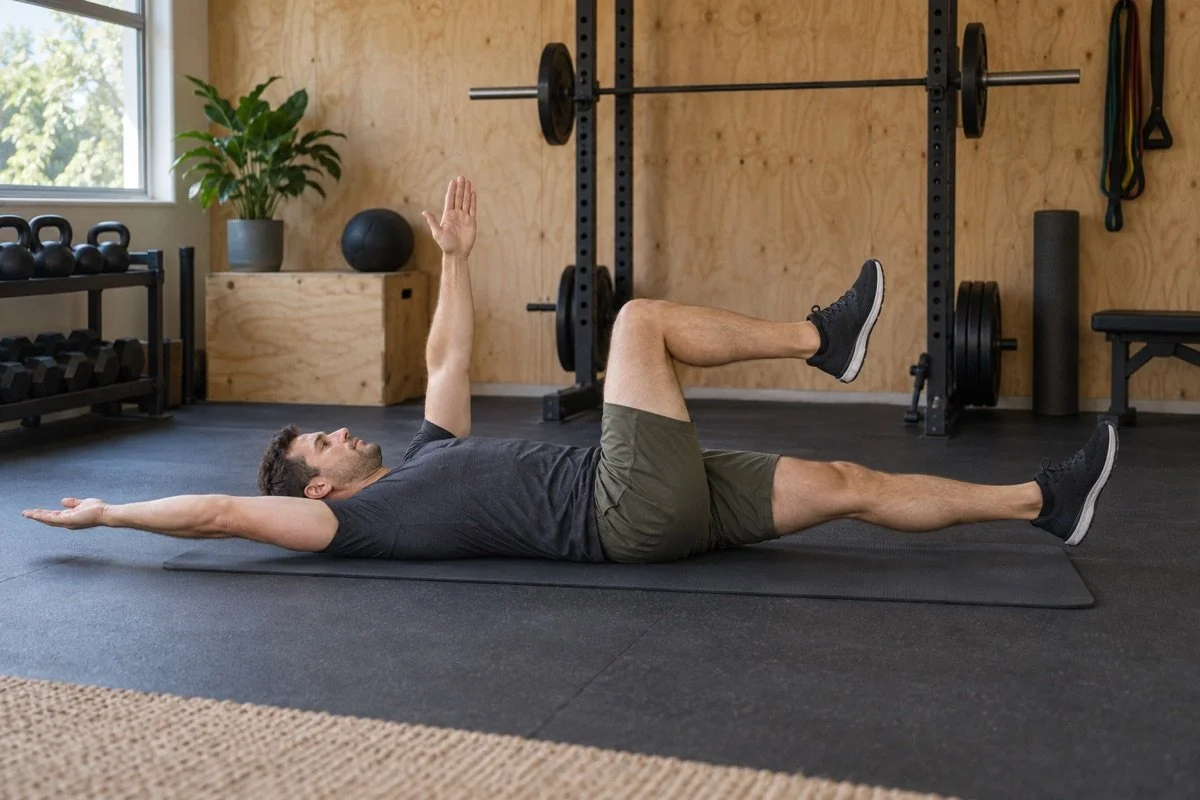
Dead bug
2 sets × 6–10 reps per side · Rest 60 seconds
Lie on your back with arms up and hips and knees bent. Slowly extend opposite arm and leg, keeping your torso still. Shorten the movement if your back arches.
How to progress each week
Write down your dumbbell weight and repetitions for every set. Keep the same weight while you build toward the upper end of the listed range. Once you can reach it on every set with 1–3 controlled reps still available, try the smallest weight increase and return toward the lower end of the range.
For example, a floor press prescribed for 3 × 8–12 might progress from 10, 9, 8 reps to 12, 12, 12 across several workouts. Increase only when those repetitions stay controlled. You do not need to add weight every week.
If fatigue builds or performance falls over several sessions, take extra recovery and temporarily reduce sets or load. Avoid adding more exercises simply because progress has slowed.
Adjustments and alternatives
- Returning after time off: begin with two working sets per exercise and lighter weights. Add the remaining sets when you are recovering comfortably.
- Split squats feel unstable: remove the dumbbells and use light fingertip support on a stable surface.
- Single-leg calf raises are too difficult: start with two feet and no added weight, then progress gradually.
- Only one fixed pair of dumbbells: use it only for movements you can control. Lighter weights may be necessary for shoulder isolation exercises.
- Still learning technique: start with our beginner training programs and use the linked exercise guides for demonstrations.
Dumbbell push/pull/legs questions
What does push/pull/legs mean?
Push day groups pressing movements for the chest, shoulders, and triceps. Pull day groups rows, rear-shoulder work, and curls. Legs day covers the lower body, with core work added in this routine.
Can I do this plan six days per week?
The sets and recovery days here are written for three sessions. Repeating the entire plan twice would double the weekly work. If you want a six-day routine, use a separately planned version that matches your experience and recovery rather than automatically doubling this one.
Is this better than full-body training?
It depends on your preferences and schedule. This version gives each region one dedicated session per week; the three-day full-body plan revisits the main movement patterns each session. For beginners seeking regular practice, start with the beginner options linked above.
Can dumbbells be effective for home training?
Resistance training can improve strength and muscle size, including in home-based routines. ACSM’s 2026 guidance emphasizes consistency and individualization, and highlights training major muscle groups at least twice weekly. If that frequency is your priority, choose our full-body or upper/lower option. Read the ACSM resistance-training guidance. This page presents a sample routine, not an ACSM-prescribed program.
Do I need to train to failure?
No. This plan uses 1–3 reps in reserve as a practical effort target. Stop a set when you can no longer maintain the intended technique instead of forcing the final repetition.
What if an exercise hurts?
Stop that movement. Do not push through pain or force an uncomfortable range; seek individualized guidance if you need help adapting an exercise.
Explore more home workout plans
4-day dumbbell upper/lower · 3-day full-body dumbbell plan · All workout categories