
Banded Shoulder Press
Exercise Description
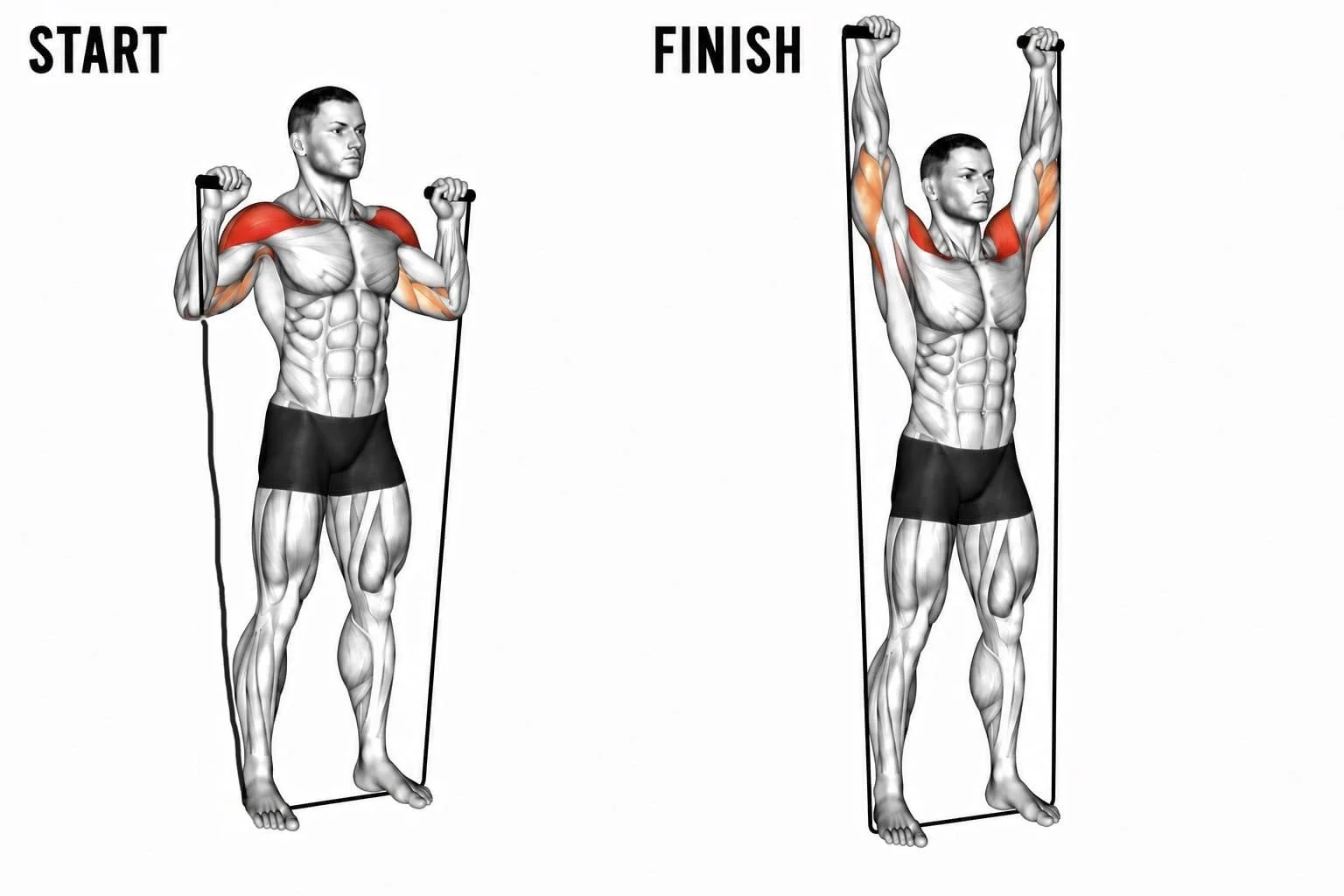
The Banded Shoulder Press is a compound upper-body exercise that strengthens the shoulders, triceps, and upper back using resistance bands. The exercise mimics the movement pattern of an overhead press while providing continuous tension throughout the range of motion. It is an effective and joint-friendly option for building shoulder strength, muscle endurance, and stability at home or in the gym.
Primary Muscles Worked
Anterior Deltoids (Front Shoulders)
Lateral Deltoids (Side Shoulders)
Secondary Muscles Worked
Triceps Brachii
Upper Trapezius
Serratus Anterior
Upper Pectoralis Major
Rotator Cuff Muscles (Stabilizers)
Rectus Abdominis
Obliques
Erector Spinae (Lower Back Stabilizers)
How to Perform Correctly
Setup
Stand on the center of a resistance band with your feet shoulder-width apart.
Hold one end or handle of the band in each hand.
Bring your hands to shoulder level with your palms facing forward or slightly inward.
Engage your core and keep your chest lifted.
Maintain a neutral spine and slight bend in the knees.
Movement
Press the band overhead until your arms are nearly straight.
Allow your head to move slightly forward as your hands pass overhead.
Finish with your hands aligned above your shoulders.
Pause briefly at the top position.
Slowly lower your hands back to shoulder level under control.
Maintain tension in the band throughout the movement.
Repeat for the desired number of repetitions.
Common Mistakes to Avoid
Arching the Lower Back Excessively
Leaning backward places unnecessary stress on the lumbar spine and often indicates poor core engagement.
Using Excessive Resistance
A band that is too heavy can compromise form and reduce range of motion.
Pressing the Hands Too Far Forward
Keep the resistance aligned over your shoulders at the top of the movement.
Incomplete Range of Motion
Lower the hands fully to shoulder level and press overhead through a complete range.
Shrugging the Shoulders Excessively
Avoid elevating the shoulders excessively toward the ears.
Allowing the Wrists to Collapse
Keep your wrists neutral and aligned with your forearms.
Rushing the Movement
Control both the pressing and lowering phases for better muscle activation and safety.