
Banded Push-Ups
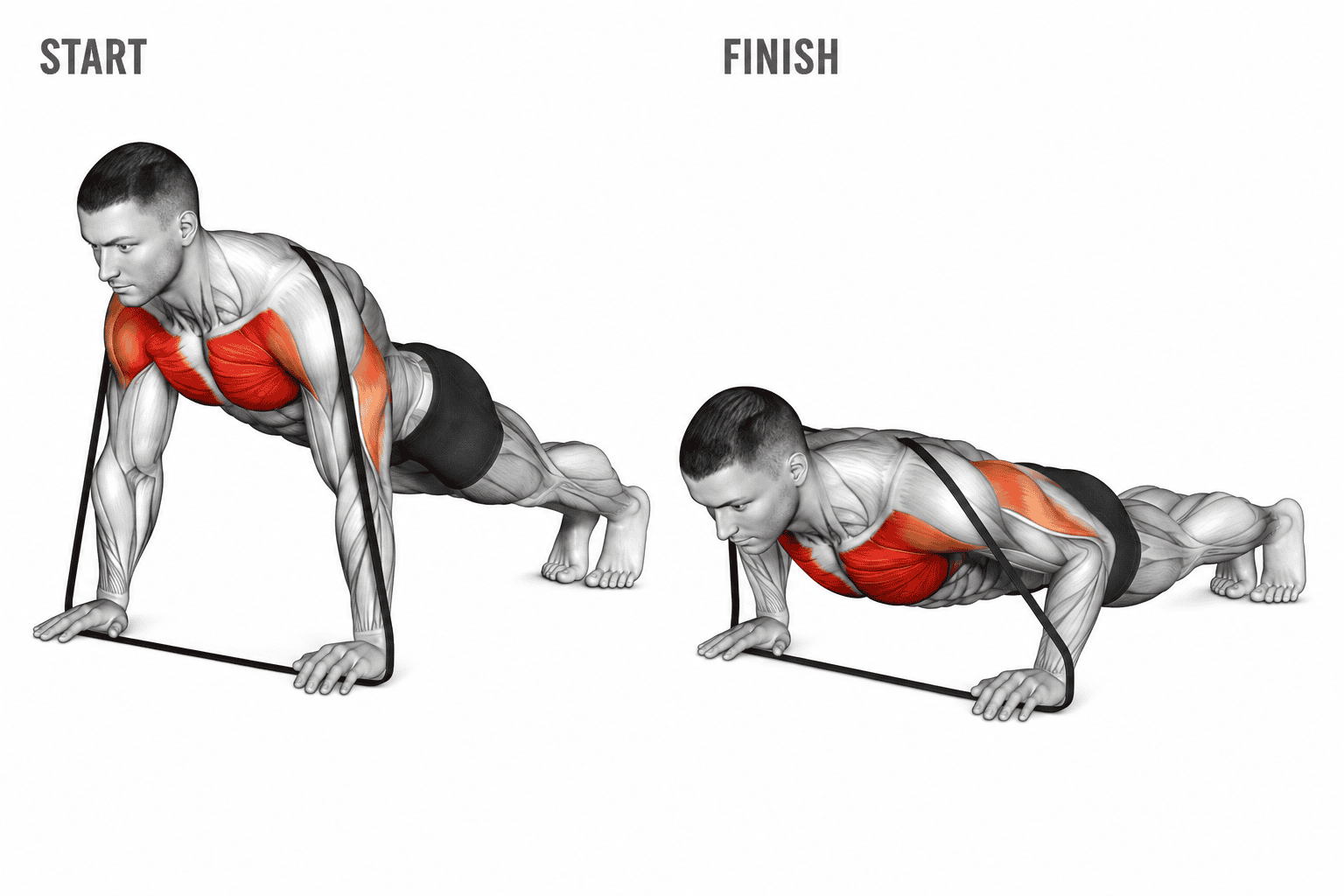
Exercise Description
Banded Push-Ups are an advanced variation of the traditional push-up that uses a resistance band to increase loading during the pressing phase. As the band stretches, resistance increases, making the top portion of the movement more challenging. This exercise is highly effective for developing chest, shoulder, and triceps strength while improving explosive pressing power and muscular endurance.
Primary Muscles Worked
Pectoralis Major (Chest)
Triceps Brachii
Secondary Muscles Worked
Anterior Deltoids (Front Shoulders)
Serratus Anterior
Rectus Abdominis (Abdominals)
Obliques
Transverse Abdominis
Gluteus Maximus
Lower Back Muscles (Stabilization)
How to Perform Correctly
Setup
Place a resistance band across your upper back.
Secure each end of the band under your palms on the floor.
Assume a standard push-up position with hands slightly wider than shoulder-width apart.
Position your shoulders directly above your hands.
Engage your core and glutes to maintain a straight line from head to heels.
Movement
Lower your body by bending your elbows while keeping them at approximately a 45° angle from your torso.
Continue lowering until your chest is just above the floor.
Pause briefly at the bottom position.
Push forcefully through your palms to extend your arms and return to the starting position.
Maintain full-body tension throughout the movement.
Repeat for the desired number of repetitions.
Common Mistakes to Avoid
Using a Band That Is Too Heavy
Excessive resistance can compromise technique and reduce range of motion.
Allowing the Band to Shift
Ensure the band remains securely positioned across the upper back throughout the set.
Letting the Hips Sag
Dropping the hips reduces core engagement and places stress on the lower back.
Raising the Hips Too High
This decreases chest involvement and changes the movement pattern.
Flaring the Elbows Excessively
Wide elbow positioning can increase shoulder stress.
Incomplete Range of Motion
Lower your chest fully under control to maximize muscle activation.
Relying on Momentum
Perform each repetition with control rather than bouncing or rushing.