
Banded Straight-Arm Pull-Down
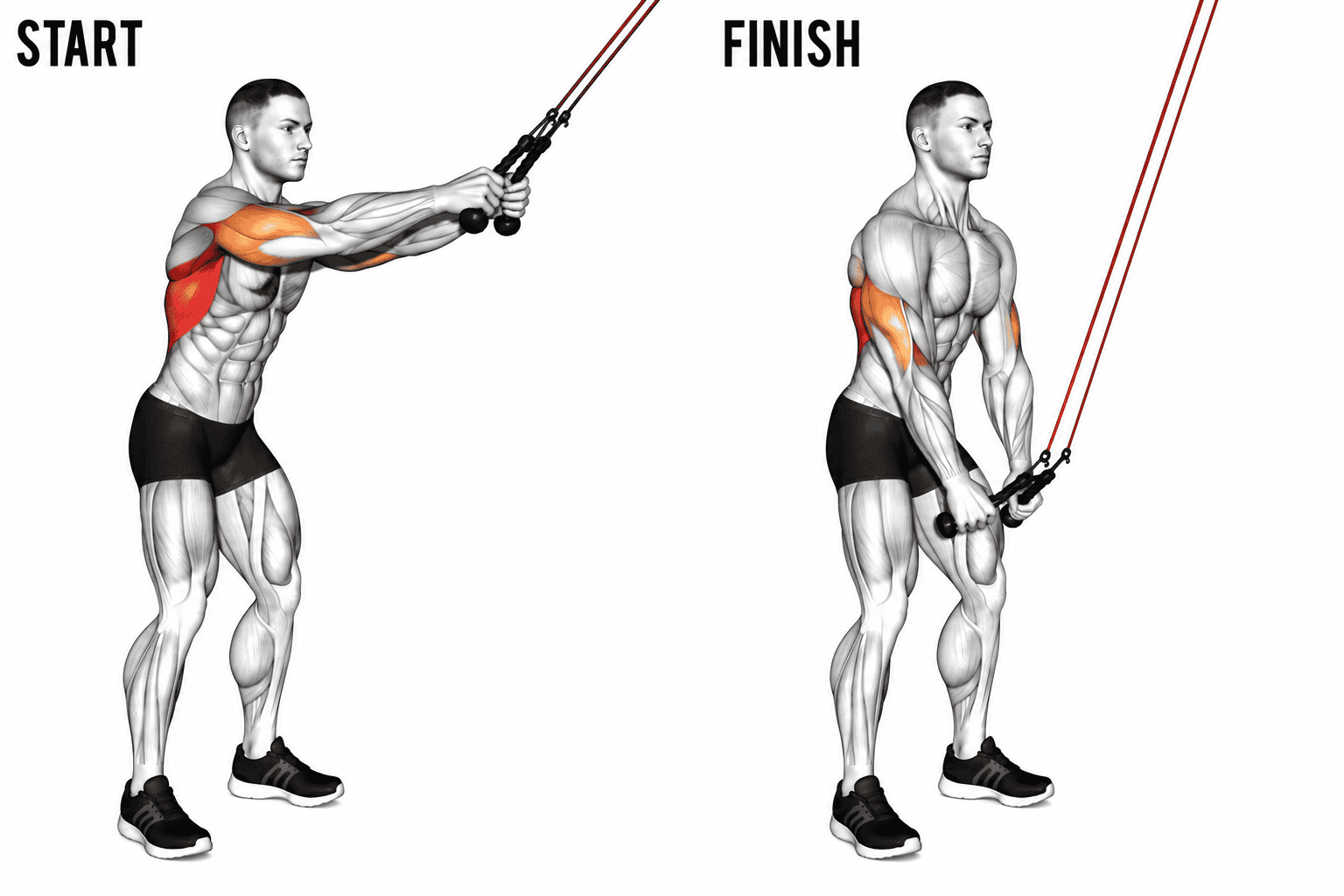
Exercise Description
The Banded Straight-Arm Pull-Down is an isolation exercise that primarily targets the latissimus dorsi through shoulder extension while minimizing elbow flexion. Unlike traditional pull-downs, the arms remain nearly straight throughout the movement, allowing greater emphasis on the back muscles rather than the biceps. This exercise is excellent for improving lat activation, developing back width, and enhancing the mind-muscle connection.
Primary Muscles Worked
Latissimus Dorsi
Secondary Muscles Worked
Teres Major
Posterior Deltoids (Rear Shoulders)
Long Head of the Triceps
Rhomboids
Lower Trapezius
Serratus Anterior
Core Muscles (Stabilization)
How to Perform Correctly
Setup
Secure a resistance band to a stable anchor point above head height.
Stand facing the anchor point and hold the band with both hands.
Step back until the band is under tension.
Position your feet shoulder-width apart and maintain a slight bend in your knees.
Extend your arms overhead with a slight bend in the elbows.
Engage your core, lift your chest, and maintain a neutral spine.
Movement
Pull the band downward in a wide arc while keeping your arms nearly straight.
Drive your hands toward your thighs or hips.
Focus on squeezing your lats as your arms move downward.
Pause briefly at the bottom position.
Slowly return your arms to the starting position under control.
Maintain tension in the band throughout the exercise.
Repeat for the desired number of repetitions.
Common Mistakes to Avoid
Bending the Elbows Excessively
Turning the movement into a pull-down reduces lat isolation and increases arm involvement.
Using Momentum
Avoid swinging your torso or using body weight to assist the movement.
Arching the Lower Back
Excessive back extension can place unnecessary stress on the lumbar spine.
Shrugging the Shoulders
Keep the shoulders down and away from the ears throughout the exercise.
Using Too Much Resistance
Excessive band tension can compromise form and limit range of motion.
Incomplete Range of Motion
Fully stretch the lats at the top and complete the pull at the bottom.
Allowing the Band to Snap Back
Control the return phase to maintain muscle tension and reduce injury risk.