
Parallel Leg Raise
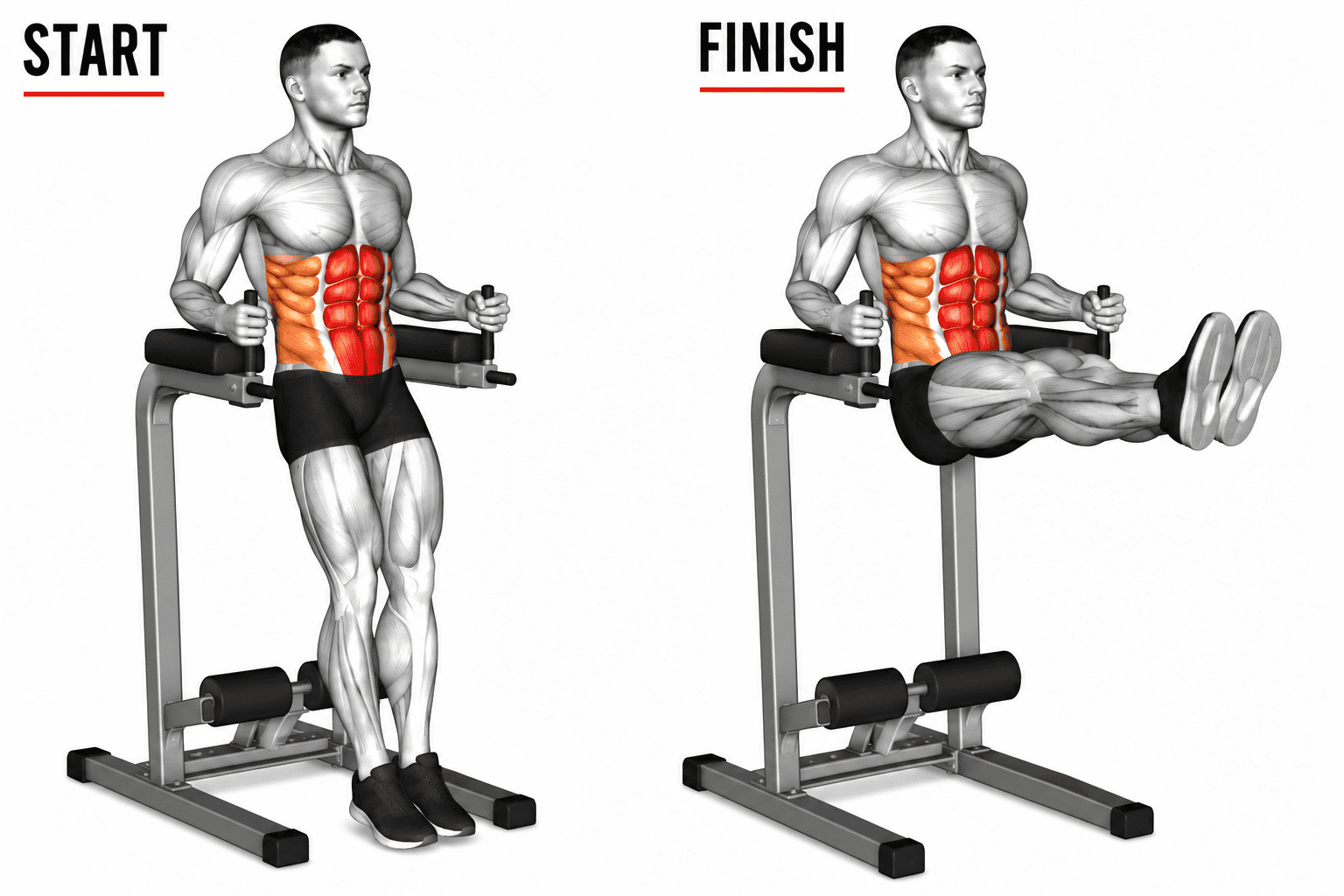
Exercise Description
The Parallel Leg Raise is a bodyweight core exercise performed using parallel bars, a captain’s chair, or a dip station. The movement involves raising the legs in front of the body while supporting yourself with your arms, placing significant emphasis on the abdominal muscles and hip flexors. Compared to floor-based leg raises, the parallel leg raise increases the demand on the core by eliminating support from the ground and requiring greater stabilization from the shoulders and upper body. The exercise can be performed with bent knees for beginners or straight legs for a more advanced challenge.
Primary Muscles Worked
Rectus Abdominis
Hip Flexors
Secondary Muscles Worked
External Obliques
Internal Obliques
Transverse Abdominis
Serratus Anterior
Quadriceps
Forearm Muscles (Grip and Support)
Deltoids (Shoulder Stabilization)
Trapezius (Stabilization)
How to Perform Correctly
Setup
Position yourself on a set of parallel bars or a captain’s chair.
Support your body weight with your arms fully extended or with your forearms resting on the pads, depending on the equipment used.
Keep your shoulders down and away from your ears.
Engage your core and maintain an upright torso.
Keep your legs together and your body stable before beginning the movement.
Movement
Contract your abdominal muscles and raise your legs in front of your body.
Lift your legs until they are approximately parallel to the floor or higher if mobility and strength allow.
Focus on curling your pelvis slightly upward at the top of the movement to maximize abdominal activation.
Pause briefly at the top position.
Slowly lower your legs back to the starting position under control.
Avoid excessive swinging between repetitions.
Repeat for the desired number of repetitions.
Common Mistakes to Avoid
Using Momentum
Avoid swinging the legs to generate movement.
Arching the Lower Back
Maintain core tension throughout the exercise.
Shrugging the Shoulders
Keep your shoulders depressed and stable during the movement.
Dropping the Legs Quickly
Control the lowering phase to maximize abdominal engagement.
Performing Partial Repetitions
Use a full range of motion while maintaining proper form.
Leaning Excessively Forward or Backward
Keep your torso stable and upright.
Holding the Breath
Maintain controlled breathing throughout the set.