
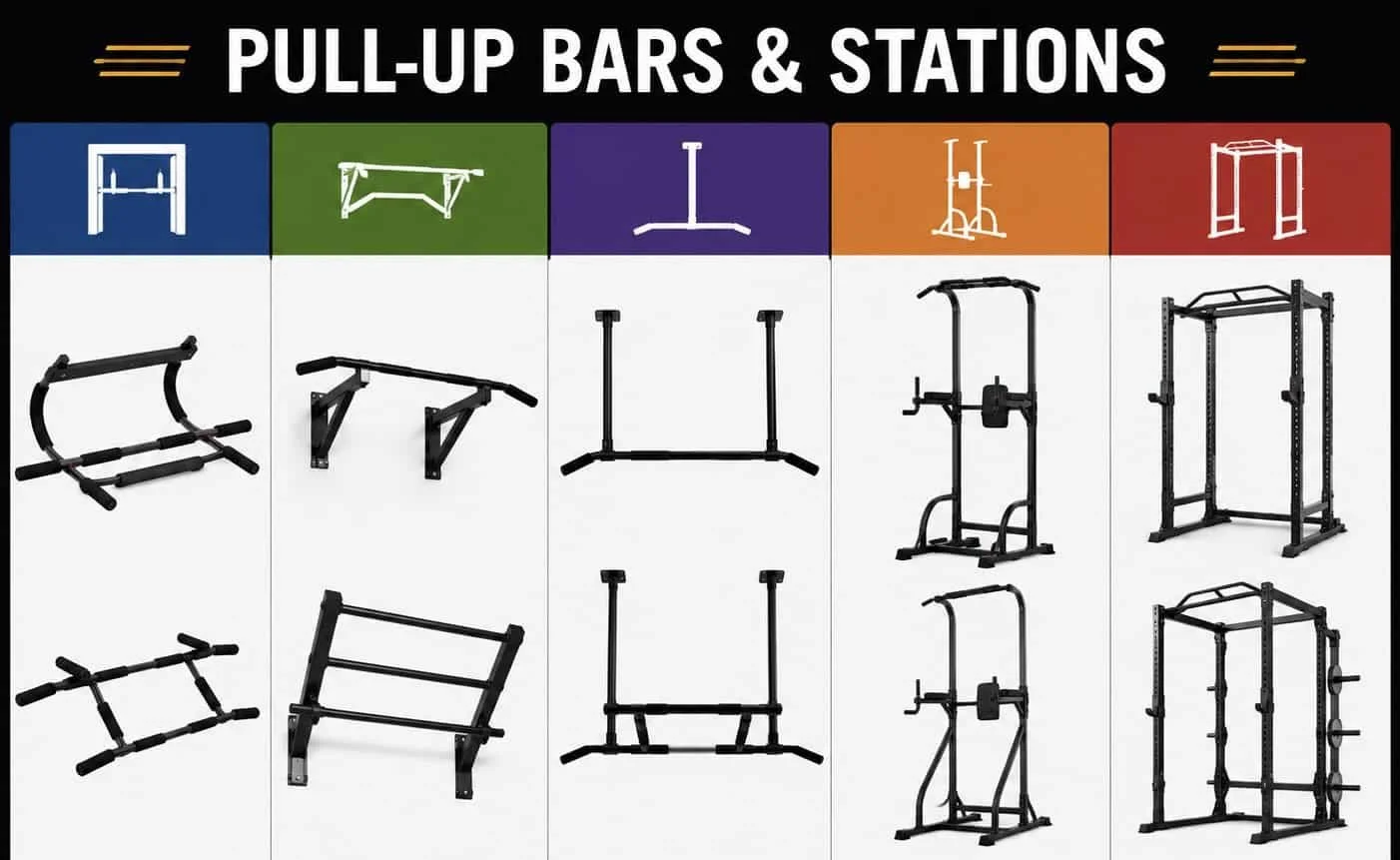
PULL-UPBARS &STATIONS
Five types. Doorframes to power towers. Everything you need to find the right pull-up setup for your home — your space, your walls, your budget.
FIVE TYPES.
ONE JOB DONE VERY DIFFERENTLY.
A pull-up bar is the simplest piece of home gym equipment that has the most variation in how it installs, how much it costs, how much space it needs, and how safe it is under load. The right choice depends on your home as much as your fitness goals.
INSTALLATION MATTERS MOST
Before anything else, know what kind of home you have. Renters can't bolt into walls. Doorframe bars need specific door dimensions. Freestanding units need floor space. This single factor narrows your options more than any other
WEIGHT CAPACITY VARIES WILDLY
Doorframe bars can hold 220–300 lbs. Quality wall-mounted bars handle 400–600 lbs. Freestanding towers range from 250–400 lbs. Always check capacity relative to your bodyweight plus any added load from weighted vests, kipping, or dynamic movement.
GRIP POSITIONS CHANGE THE MUSCLE
Wide overhand grips hit lats heavily. Neutral/parallel grips reduce shoulder strain. Underhand chin-up grips emphasise biceps. Multi-grip bars let you rotate between these; straight bars limit you to one. This affects which types of bars serve advanced training.
CLEARANCE YOU ACTUALLY NEED
You need at least 12–16 inches above your bar to reach a dead hang without your head hitting the ceiling. Measure from the bar height to ceiling — not just from the floor. This is the most commonly overlooked calculation when choosing bar placement.
PERMANENCE VS FLEXIBILITY
Wall and ceiling mounts are permanent but the most stable. Doorframe bars install and remove in seconds. Freestanding units can be moved between rooms. The more permanent the install, the more stable and higher the weight capacity — generally.
PRICE RANGE IS WIDE
Budget doorframe bars start at $15–$30. Quality wall-mounted rigs run $80–$300. Power towers can reach $400–$800. Higher prices typically buy more grip positions, higher weight limits, better materials, and additional exercise options like dip stations and leg raise platforms.
PERFORMANCE RATINGS
Stability5 / 10
Weight Capacity5 / 10
Ease of Install10 / 10
Versatility7 / 10
Space Efficiency10 / 10
Value9.5 / 10
DOORFRAME BAR
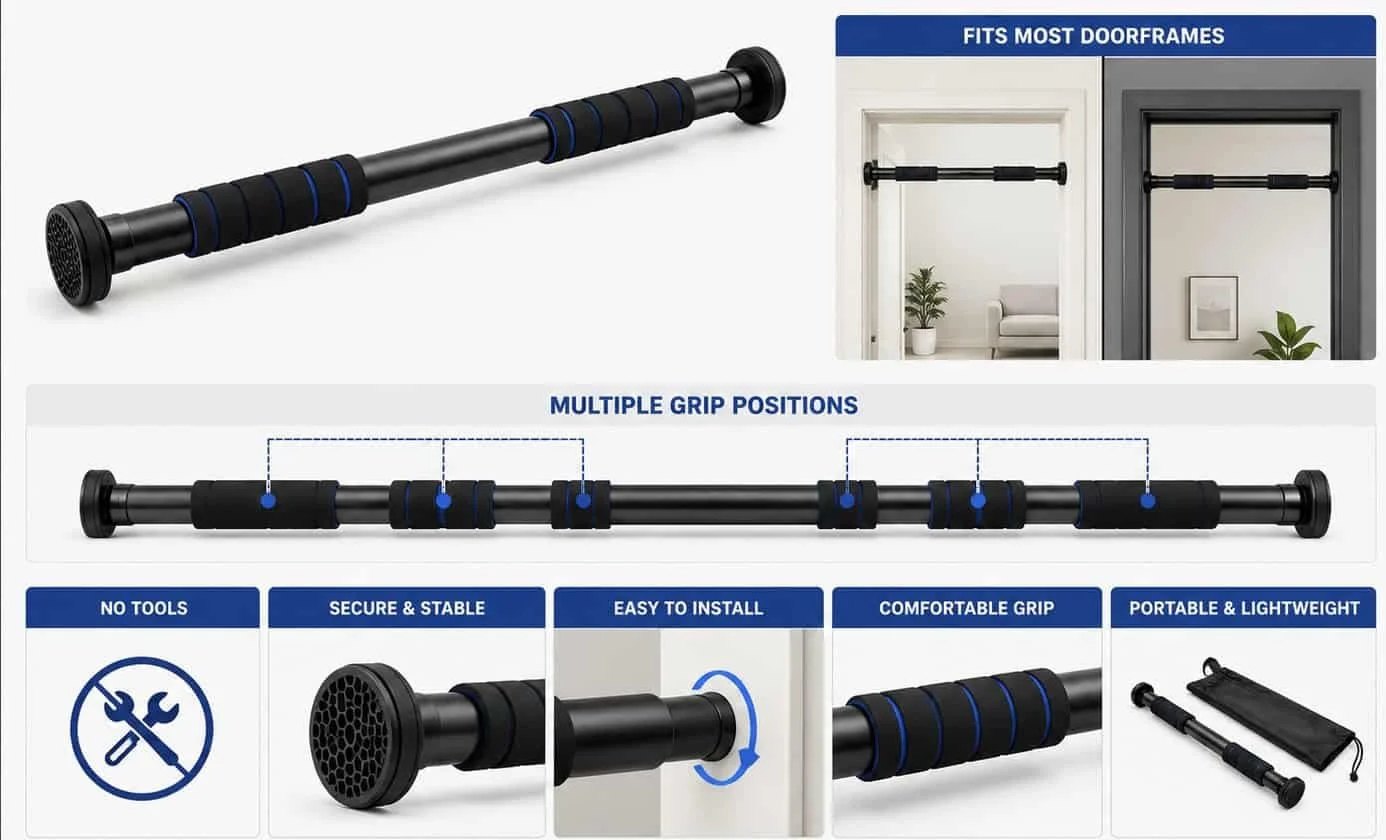
Doorframe bars are the entry point for pull-up training at home. They wedge into a standard doorframe using leverage and tension — no drilling, no permanent fixtures. Two foam-padded brackets press against the door trim while the bar itself sits in the frame opening, creating a mechanical lock that supports your weight. Removal takes five seconds; installation takes ten.
There are two main sub-types. The traditional over-door bar (Iron Gym style) hooks over the top of the door frame with two large rubber brackets and provides multiple grip positions — wide overhand, neutral/parallel, and close underhand — all on one bar. The second type is a straight tension bar that wedges inside the frame opening itself (no door trim contact) and is more minimal but typically offers only one grip position and lower clearance.
The trade-offs are real. Doorframe bars flex noticeably under dynamic loading — kipping pull-ups, muscle-ups, and aggressive movement put stress on both the bar and the door trim that can cause damage over time. Weight capacity is limited (~300 lbs, lower for cheaper models). Taller users often find the bar sits too low for a full dead hang. And the bar can slip or shift if brackets aren't seated properly, creating a genuine fall risk.
PROS
Zero installation — no drilling, no wall damage
Cheapest option — quality sets from $25
Portable and removable in seconds
Multiple grip positions on quality models
Works as floor bar for push-ups and sit-ups
Fits almost any standard interior doorframe
Ideal for renters and apartment dwellers
CONS
Flexes and shifts under heavy or dynamic load
Foam brackets can damage door trim paint and wood
Lower weight capacity than any fixed mount type
Can slip if not properly seated — fall risk
Height limited by door frame — too low for tall users
Not suitable for kipping, muscle-ups, or serious gymnastics
Some door frames are incompatible (very thin trim)
BEST FOR
🏠 Renters & apartment dwellers🔰 Pull-up beginners💲 Budget training ($25–$50)✈️ Portable setups📏 Small spaces
TOP MODELS
Iron Gym Total Upper Body Workout Bar
~$30 / bar
Perfect Fitness Multi-Gym Pro
~$40–$55
Garren Fitness Maximiza
~$25–$35
PERFORMANCE RATINGS
Stability9.5 / 10
Weight Capacity9 / 10
Ease of Install5 / 10
Versatility8 / 10
Space Efficiency9 / 10
Value9 / 10
WALL-MOUNTED BAR
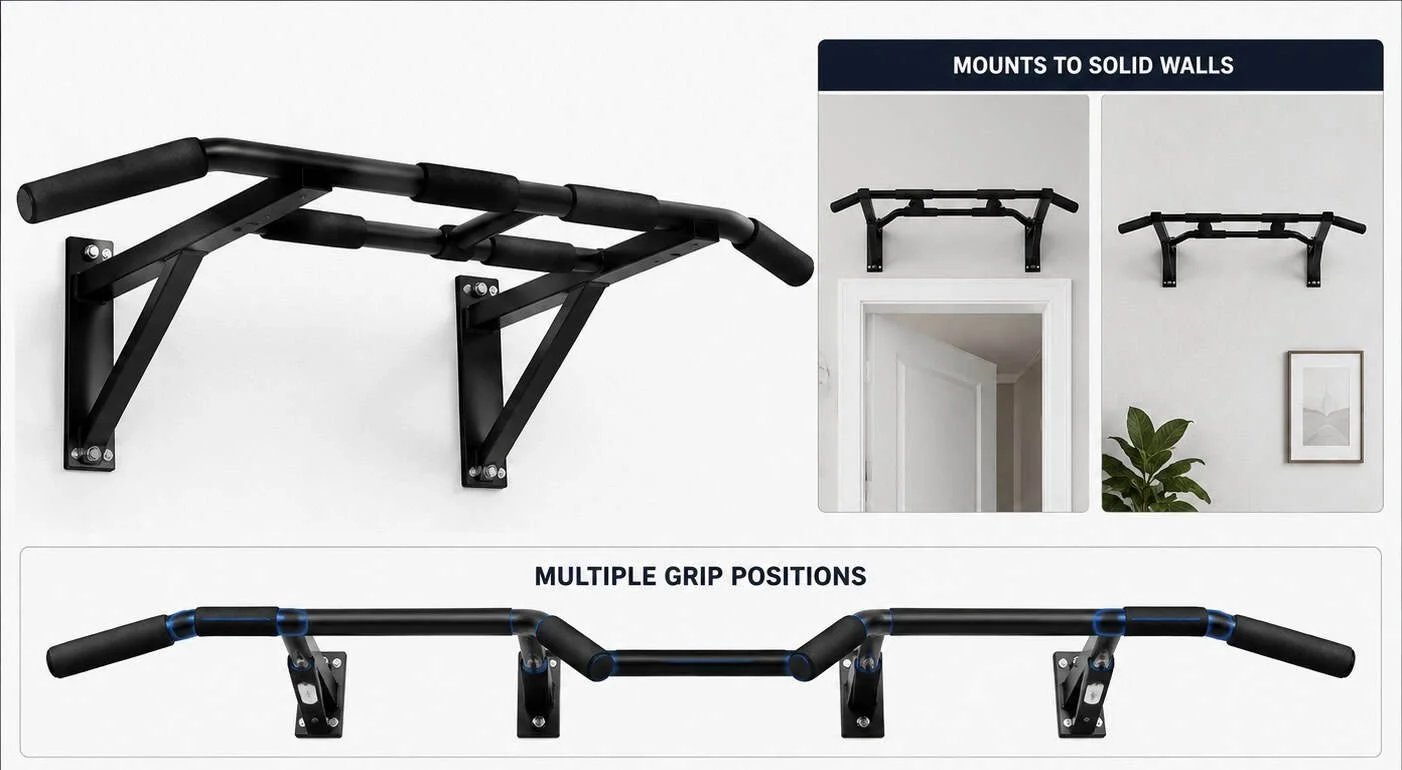
Wall-mounted pull-up bars are fixed brackets bolted directly into wall studs, providing the most stable and gym-authentic pull-up experience possible in a home setting. Two steel bracket arms extend from the wall and support a straight or multi-grip bar, holding it at a fixed height. There's no flex, no movement, and no compromise in feel compared to a commercial gym pull-up station.
They come in two configurations: close-mount (bar sits close to the wall, requiring you to pull up with your body angled slightly toward the wall), and extended-mount (bracket arms extend 16–24 inches from the wall, allowing a clean vertical pull). Extended mounts are significantly better for full dead-hang pull-ups and offer clearance for toes-to-bar and hanging leg raises without touching the wall. Always opt for extended if possible.
The installation requires drilling into wall studs (not just drywall) and is permanent. This makes wall bars unsuitable for renters or anyone who doesn't want holes in walls. However, for home gym owners, it's arguably the best pull-up option for money — $80–$180 for professional-grade stability that will outlast any other type of home pull-up bar.
PROS
Highest stability — feels identical to commercial gym bars
Very high weight capacity (400–600 lbs)
Safe for kipping, weighted pull-ups, and gymnastics
Long-term investment — decades of use
Bar height precisely set where you want it
Knurled bar grip is superior to foam-padded doorframe bars
Best price-to-performance after initial investment
CONS
Permanent installation — not suitable for renters
Requires drilling into studs — skill and tools needed
Wrong installation (drywall anchors only) is dangerous
Fixed height — can't adjust after installation
Higher upfront cost than doorframe bars
Close-mount versions limit exercise range of motion
Leaves wall holes if removed
BEST FOR
🏡 Home gym owners⚡ Kipping & gymnastics🏋️ Weighted pull-ups📐 Dedicated training spaces♾️ Long-term investment
TOP MODELS
Rogue Matador Pull-Up Bar
~$90–$145
Rep Fitness Pull-Up Bar
~$75–$110
Titan Fitness Wall Mount Pull-Up Bar
~$85–$130
PERFORMANCE RATINGS
Stability6.5 / 10
Weight Capacity6.5 / 10
Ease of Install8 / 10
Versatility7.5 / 10
Space Efficiency5.5 / 10
Value7 / 10
FREESTANDING BAR
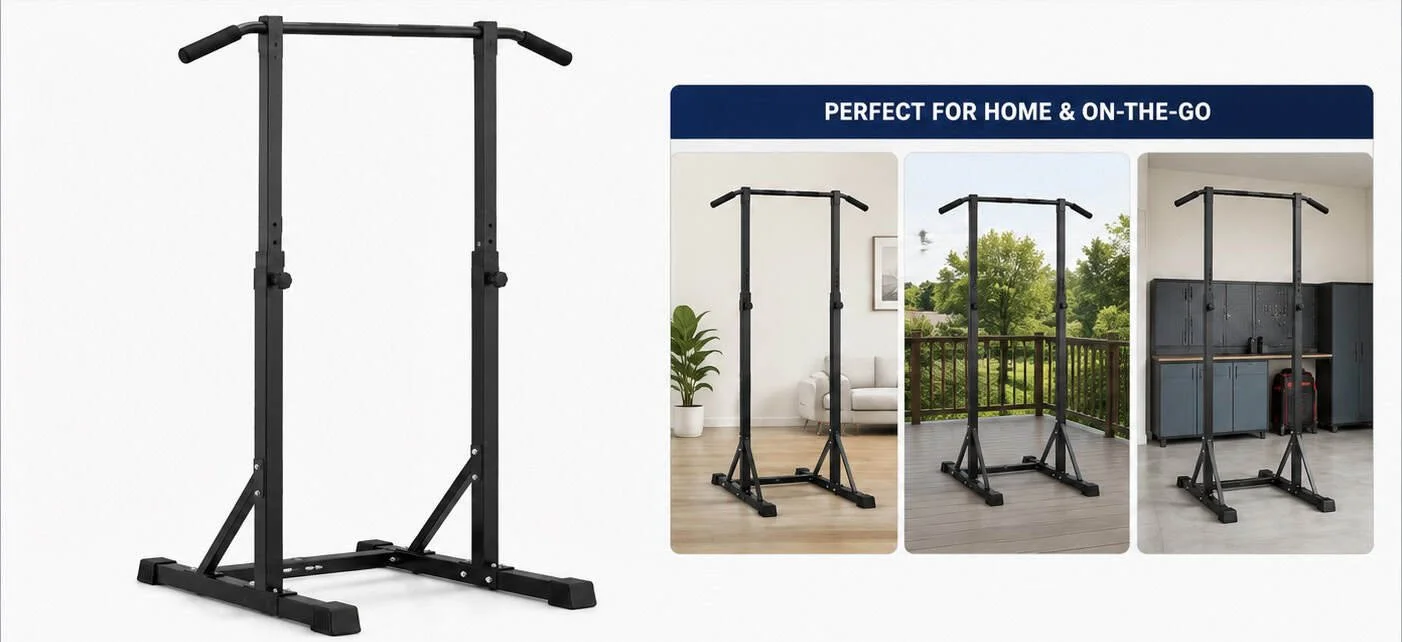
Freestanding pull-up bars stand independently on a wide base frame — usually an A-frame, T-frame, or H-frame design using steel tubing. They don't attach to walls or doors, making them the only truly drill-free option for users who want a dedicated pull-up station without any permanent installation. The wide base provides stability through weight distribution rather than anchor points.
They come in two categories: standalone pull-up bars (just the bar on a frame, 4–6 feet wide footprint), and multi-function pull-up stands that also include dip bars, push-up handles, and sometimes band peg attachments. The standalone versions are compact and purpose-built; the multi-function versions approach Power Tower territory but are typically lighter-duty.
The key limitation is tipping risk under dynamic loading. The base must be wide enough and heavy enough to counteract the pendulum effect of your body swinging during kipping, muscle-ups, or aggressive pull-up sets. Better models use very wide bases (5+ feet) and sometimes include weight plate posts where you can load additional mass onto the frame to increase stability. Cheaper models with narrow bases genuinely do tip, which is a serious safety issue.
PROS
No drilling — can be placed anywhere in the home
Movable — relocate between rooms or outdoors
More stable than doorframe bars
Can add dip bars and accessories on some models
Better height options than doorframe bars
Good for renters wanting a dedicated pull-up station
Some models accept weight plates to increase stability
CONS
Tipping risk under dynamic/kipping movement
Requires significant floor space (5–7 sq ft minimum)
Cheaper models wobble noticeably under load
Higher cost than doorframe bars
Not as stable as wall or ceiling mounted options
Assembly required (30–90 minutes)
Can scratch or damage flooring
BEST FOR
🏠 Renters wanting dedicated station🔄 Flexibility to relocate📦 No-drill requirement🎯 Strict pull-up training🧘 Garage & outdoor use
TOP MODELS
Archon Fitness Pull-Up Stand
~$130–$180
Valor Fitness CB-12 Pull-Up Stand
~$90–$140
Body-Solid PowerLine PPR200
~$150–$220
PERFORMANCE RATINGS
Stability10 / 10
Weight Capacity10 / 10
Ease of Install3 / 10
Versatility9.5 / 10
Space Efficiency10 / 10
Value8.5 / 10
CEILING-MOUNTED BAR
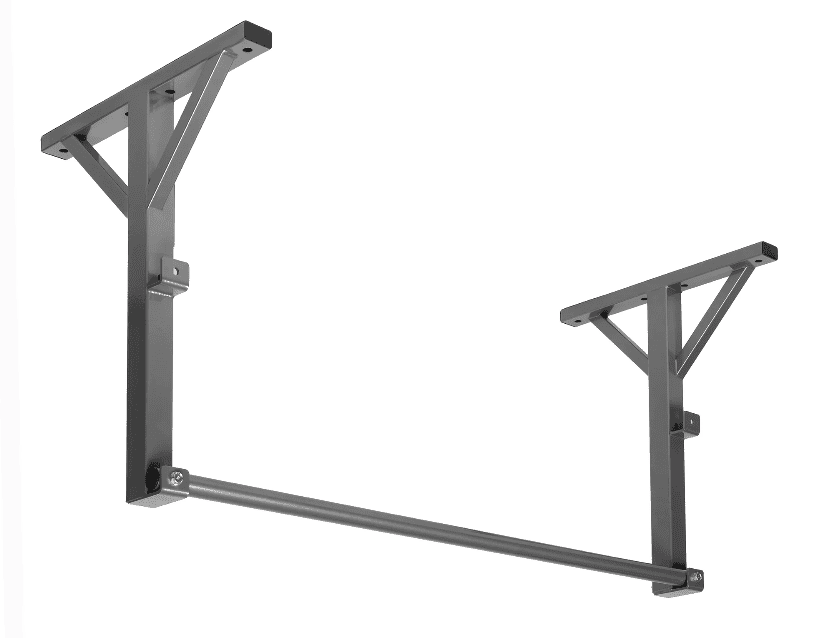
Ceiling-mounted bars bolt directly into ceiling joists or an overhead beam, hanging the bar down at whatever height gives full dead-hang clearance beneath. This creates a completely unobstructed pull-up environment — no wall proximity, no frame in the way, full 360-degree access to the bar from any angle. It's the closest thing to a free-hanging gymnastics bar in a home setting.
The ceiling mount is ideal for garage gyms with exposed joists or concrete garages with overhead steel beams. It's the preferred setup for competitive gymnasts, calisthenic athletes, and anyone doing muscle-ups, bar kips, or ring work — you can hang rings from the same mount points and transition between pull-up bar and gymnastic rings seamlessly.
The critical requirement is structural: ceiling joists must be accessible, load-rated, and properly engineered to support dynamic loads. A drywall ceiling without accessible joists cannot support a ceiling bar safely. In rooms with finished ceilings, installation may involve opening drywall to find joists or installing a structural header. Garage gyms with exposed rafters or beams are the natural home for this type.
PROS
Highest weight capacity of all types (600+ lbs)
Completely unobstructed — no wall proximity issues
Ideal for muscle-ups, kipping, and ring work
Can hang gymnastic rings from same mount points
Bar height optimally set for dead hang clearance
Zero floor footprint
Natural fit for garage gyms with exposed joists
CONS
Requires exposed joists or structural ceiling access
Most complex installation — may need professional help
Permanent — leaves ceiling holes if removed
Not viable in most finished home interiors
Ceiling height must be sufficient (min. 9–10 ft recommended)
Not suitable for renters or standard residential rooms
BEST FOR
🏗️ Garage gyms with exposed joists🤸 Gymnastics & muscle-ups⭕ Gymnastic rings💪 Advanced calisthenics♾️ Maximum clearance training
Rogue Ceiling Mount Bar
~$95–$165
REP Fitness Ceiling Mount Pull-Up Bar
~$75–$120
OneFitWonder Ceiling Mounted Bar
~$60–$100
PERFORMANCE RATINGS
Stability7.5 / 10
Weight Capacity7 / 10
Ease of Install7 / 10
Versatility10 / 10
Space Efficiency4 / 10
Value8.5 / 10
POWER TOWER
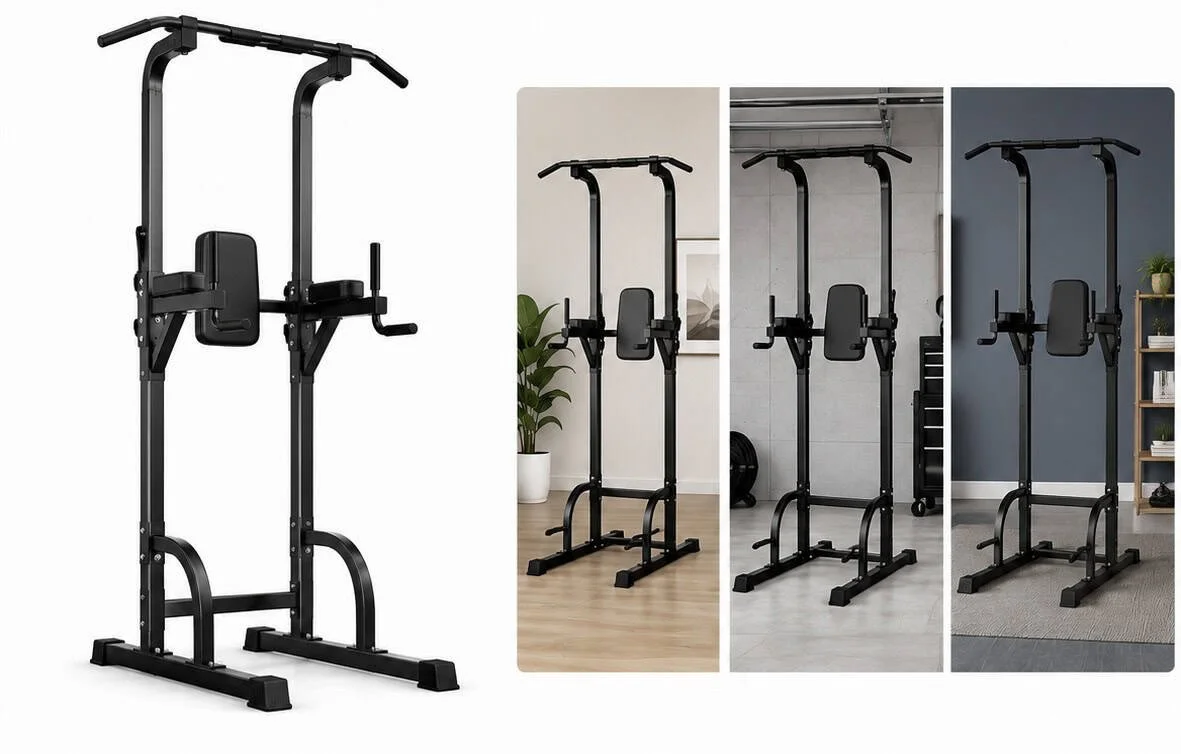
Power towers (also called VKR stations — Vertical Knee Raise) are multi-station freestanding units that combine a pull-up bar, dip bars, vertical knee raise / leg raise station, and often push-up handles into one self-contained structure. They're the most feature-rich home pull-up option, offering 4–6 distinct bodyweight exercises from a single piece of equipment.
The pull-up bar sits at the top of a tall vertical frame, dip bars extend from the sides, and a padded backrest with forearm supports allows vertical knee and leg raises — one of the most effective core exercises available. Premium towers (XMark, Bowflex, Body-Solid) add push-up handles, pull-up assist platforms, and multiple grip positions. The best towers feel genuinely gym-quality with minimal flex under load.
For anyone building a small home gym who wants pull-ups, dips, and leg raises in one unit without drilling, a quality power tower is the single best multi-exercise purchase available. The XMark Functional Trainer, Bowflex BodyTower, and Body-Solid PowerTower are the consistently top-rated units in this category.
PROS
Most exercises of any pull-up bar type in one unit
Pull-ups, dips, leg raises, push-ups — all covered
No drilling — self-contained freestanding unit
Quality models are very stable and gym-grade
Good for multiple users with different training needs
Often includes padded forearm rests for knee/leg raises
Best overall value for full upper body bodyweight training
CONS
Largest footprint of any option — needs 20–30 sq ft
Budget models wobble and have poor padding quality
Pull-up bar is typically not as high as wall/ceiling mounts
Not ideal for kipping or dynamic bar movements
Assembly takes 1–2 hours and can be complex
Heavy and difficult to move once assembled
Not suitable for small rooms or apartments
TOP MODELS
XMark Functional Trainer Power Tower
~$280–$360
Body-Solid PowerTower
~$350–$450
Bowflex BodyTower
~$200–$280
BEST FOR
🏠 Dedicated home gym rooms💪 Full upper body bodyweight🦵 Core & leg raises🤸 Dips training👥 Multiple users / family gym
DECISION GUIDE
WHICH TYPE SUITS YOUR HOME?
YOU RENT AND CAN'T DRILL
Doorframe bar is the obvious first step — zero damage, $25–$50, works immediately. If you want more, a freestanding bar or power tower gives you a dedicated station without any permanent installation.
YOU HAVE A GARAGE GYM AND WANT THE BEST PULL-UP EXPERIENCE
Wall-mounted bar into studs gives you gym-grade stability for under $150. If your garage has exposed joists, go ceiling-mounted for complete clearance and ring compatibility.
YOU WANT PULL-UPS, DIPS, AND LEG RAISES IN ONE UNIT
Power tower is the only single-unit solution covering all three. Don't buy the cheapest one — spend $250+ for stability that doesn't wobble under load. XMark is the consistent top pick at a reasonable price.
YOU DO CALISTHENICS, MUSCLE-UPS, OR GYMNASTIC RING WORK
Ceiling-mounted bar is the correct answer — complete overhead clearance, no wall proximity, ring-compatible anchor points. This needs exposed joists or a garage beam, but if you have it, don't use anything else.
YOU DO CALISTHENICS, MUSCLE-UPS, OR GYMNASTIC RING WORK
Ceiling-mounted bar is the correct answer — complete overhead clearance, no wall proximity, ring-compatible anchor points. This needs exposed joists or a garage beam, but if you have it, don't use anything else.
YOU WANT THE BEST POSSIBLE STABILITY ON A BUDGET
Wall-mounted into studs wins on stability-per-dollar. A $90 Rep Fitness wall bar bolted into studs will outperform any $400 freestanding bar for strict pull-up feel and safety. The only requirement: willingness to drill.
SAFETY FIRST
INSTALL & USE SAFELY
STUDS, NOT DRYWALL
Wall and ceiling bars must be anchored into wooden studs or structural joists — never into drywall alone. Drywall anchors rated for 50 lbs cannot handle 200 lbs of dynamic load. Use a stud finder, drill pilot holes, and use grade 8 lag screws.
KNOW YOUR WEIGHT
Always check your bodyweight against the bar's rated capacity — and account for dynamic load. Kipping generates 1.5–2x your static weight. If you weigh 180 lbs and kip, you need a bar rated for at least 360 lbs. Most doorframe bars cannot handle this safely.
INSPECT REGULARLY
Check bolts and welds on wall/ceiling bars every 2–3 months. Check doorframe bar brackets for cracking foam and loosening hardware before every session. Any bar that wobbles more than it used to should be inspected before further use.
MEASURE CLEARANCE FIRST
You need 12–18 inches of clearance above the bar in a dead hang for your head. Measure from intended bar height to ceiling before any purchase or installation. This is the most commonly overlooked measurement and causes the most buyer's remorse.