
Dumbbell Decline Bench Press
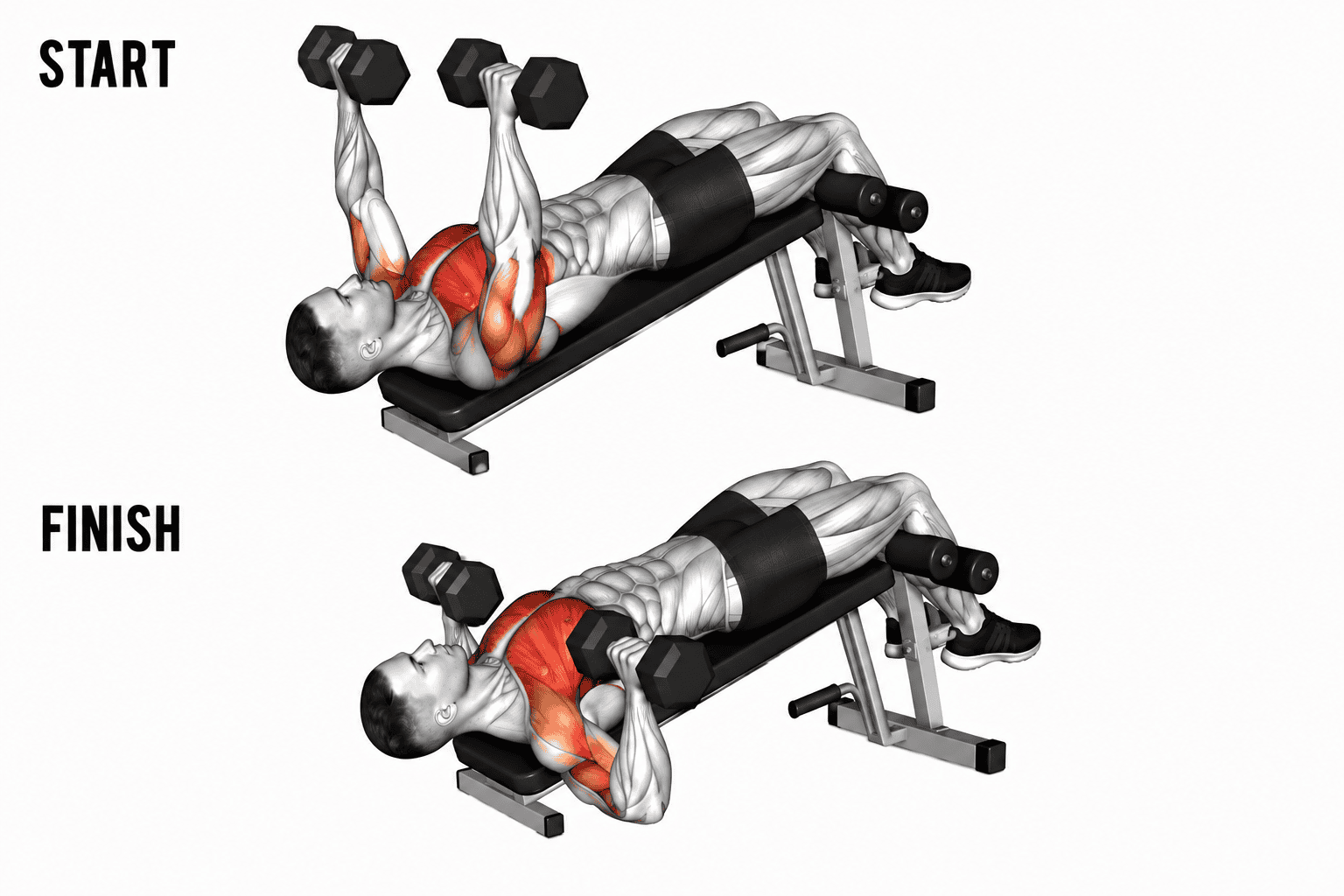
Dumbbell Decline Bench Press
Exercise Description
The Dumbbell Decline Bench Press is a compound upper-body exercise that emphasizes the lower portion of the chest while also developing strength in the shoulders and triceps. The decline angle changes the pressing path, placing greater emphasis on the sternal (lower) fibers of the pectoralis major. Using dumbbells allows for a greater range of motion and helps improve muscular balance between both sides of the body.
Primary Muscles Worked
Pectoralis Major (Lower Chest Emphasis)
Secondary Muscles Worked
Anterior Deltoids (Front Shoulders)
Triceps Brachii
Serratus Anterior
Rotator Cuff Muscles (Stabilizers)
Upper Back Muscles (Stabilization)
How to Perform Correctly
Setup
Secure your legs under the pads of a decline bench.
Hold a dumbbell in each hand and carefully lie back on the bench.
Position the dumbbells at chest level with palms facing forward.
Retract your shoulder blades and keep your chest lifted.
Maintain a stable position with your head, shoulders, and glutes in contact with the bench.
Movement
Press the dumbbells upward until your arms are nearly straight.
Bring the dumbbells slightly toward each other at the top without forcing them together.
Lower the weights slowly and under control until your elbows are slightly below chest level or as far as your shoulder mobility comfortably allows.
Pause briefly at the bottom position.
Press the dumbbells back to the starting position.
Repeat for the desired number of repetitions.
Common Mistakes to Avoid
Using Excessive Weight
Lifting too heavy can compromise control and increase injury risk.
Lowering the Dumbbells Too Quickly
A controlled descent improves muscle engagement and protects the shoulder joints.
Flaring the Elbows Excessively
Elbows positioned too far away from the body can place unnecessary stress on the shoulders.
Allowing the Wrists to Bend Backward
Keep wrists neutral and aligned with your forearms throughout the exercise.
Incomplete Range of Motion
Performing shallow repetitions reduces muscle activation and effectiveness.
Losing Bench Contact
Keep your body stable and maintain contact with the bench throughout the movement.
Uneven Pressing Path
Press both dumbbells evenly to promote balanced strength development.