
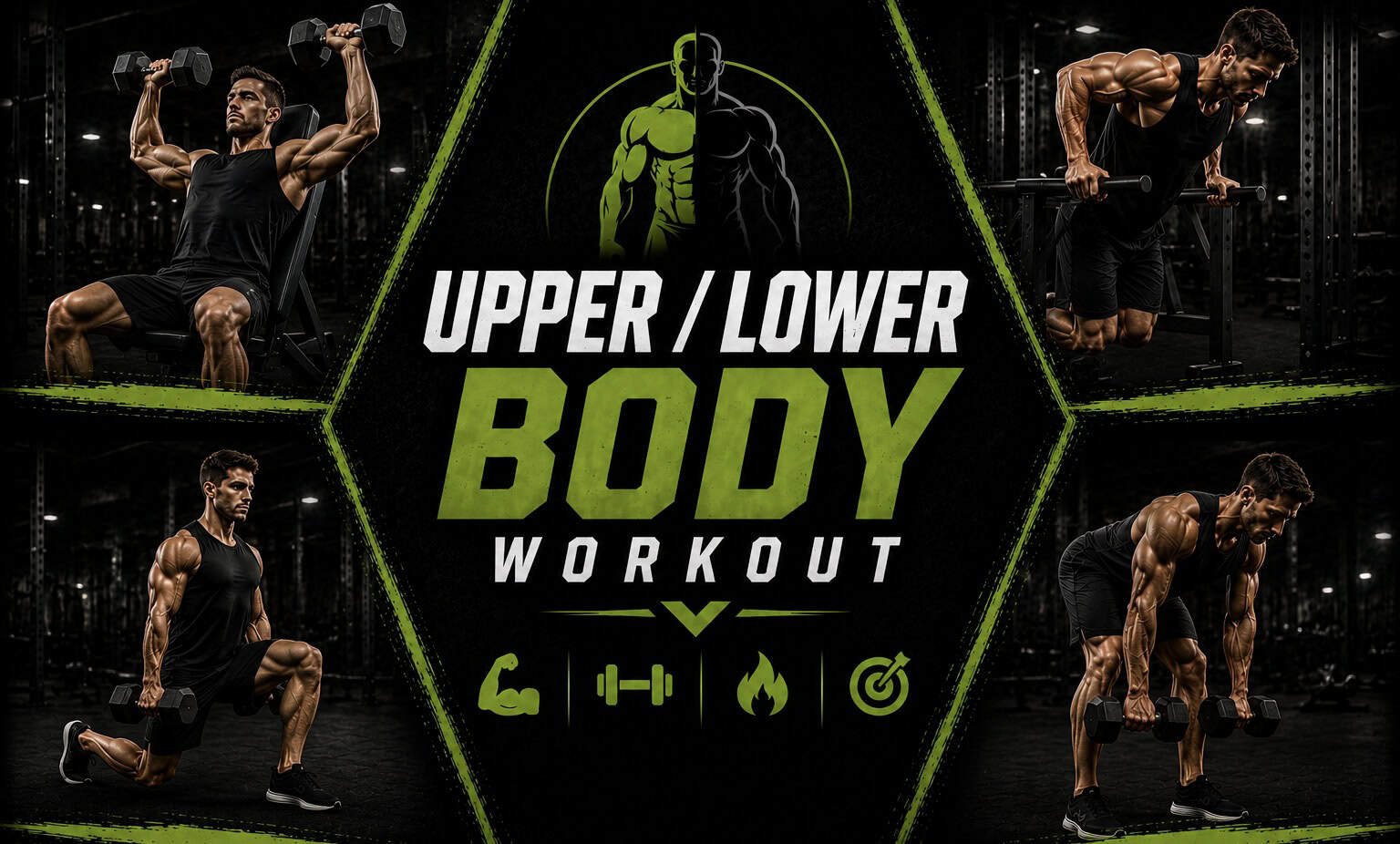
UPPER / LOWER PROGRAM
Barbell, Dumbbells, Resistance Band, Pull-up Dip Bar, Bench
The workout split below is the one that has worked best for me based on my goals, schedule, and recovery. While I personally find it effective, everyone is different, so feel free to follow it exactly as written or modify it to better suit your own needs, preferences, and training experience.
Learn the lifts · 3×/week
3 days / week
40–45 min
The upper/lower split trains each muscle group twice per week — the minimum effective frequency for beginners. Each session focuses on mastering one or two fundamental movement patterns before loading them heavy. Form first, weight second.
📅 Mon · Wed · Fri (alternate Upper/Lower/Upper)
UPPER A Push + Pull
LOWER A Quad + Posterior
Hip Circle + Leg Swing Warm-Up — 2 min
Barbell Back Squat — 4 sets × 8 reps
Romanian Deadlift (Dumbbell) — 3 sets × 10 reps
Dumbbell Walking Lunge — 3 sets × 12 steps each leg
Glute Bridge (Barbell) — 3 sets × 15 reps
4 days / Upper A · Upper B · Lower A · Lower B
4 days / week
45–55 min
The classic 4-day upper/lower split. Separates upper days into Push-dominant (A) and Pull-dominant (B), and lower days into Quad-dominant (A) and Posterior chain-dominant (B). Each muscle group trained twice per week at different angles and rep ranges.
📅 Mon (Upper A) · Tue (Lower A) · Thu (Upper B) · Fri (Lower B)
UPPER A Push Dominant
LOWER A Quad Dominant
LOWER B Posterior Chain
5 days / wave loading · Mon–Fri
5 days / week
50–65 min
Five-day upper/lower with a dedicated Power day on Friday. Uses wave loading on primary lifts (alternating heavy/moderate weeks), advanced accessory work, and technique refinements. Designed for lifters who have mastered all intermediate movements.
📅 Mon (Upper A) · Tue (Lower A) · Wed (Upper B) · Thu (Lower B) · Fri (Full Power)
UPPER A Horizontal Push/Pull
LOWER A Squat Focused
FRIDAY POWER Full Body · Compound Only
Power Clean or Hang Clean — 5 sets × 3 reps
Barbell Bench Press + Pull-Up Superset
4 supersets × 5 bench + 5 pull-up
Barbell Back Squat + Romanian Deadlift Superset
3 supersets × 5 squat + 8 RDL
Weighted Dip + Weighted Chin-Up
3 supersets × max dips + max chins
Band Mobility & Decompression
5 min
UPPER B Vertical Push/Pull
LOWER B Deadlift Focused
Upper Body Workouts: Building Strength, Muscle, and Function
Your upper body is involved in almost everything you do — lifting, carrying, pushing, pulling, and maintaining posture throughout the day.
A balanced upper body workout helps strengthen:
Chest
Back
Shoulders
Arms
Core stabilizers
Training these muscle groups consistently can improve both physical performance and long-term health.
Benefits of Upper Body Training
Increased Strength
Upper body workouts help improve pushing and pulling strength used in everyday activities and sports.
Better Posture
Strengthening the back and shoulders can help reduce poor posture caused by sitting for long periods.
Muscle Growth
Consistent resistance training stimulates muscle development and improves body composition.
Improved Athletic Performance
A stronger upper body supports better movement, coordination, and overall performance.
Greater Functional Fitness
Everyday tasks become easier when your upper body is stronger and more stable.
Key Components of an Upper Body Workout
A balanced upper body routine should include both pushing and pulling exercises.
Push Exercises
These movements target the chest, shoulders, and triceps.
Examples:
Pull Exercises
These movements strengthen the back and biceps.
Examples:
Shoulder and Stability Work
Strong shoulders improve posture and help support other upper body movements.
Examples:
Core Engagement
Many upper body exercises also require core stability for proper form and control.
Training Tips for Better Results
Focus on proper form before increasing weight
Train consistently each week
Include both push and pull exercises
Allow muscles time to recover
Gradually increase resistance over time
Small improvements made consistently often produce the best long-term results.