
Your space. Your schedule. Your strength.
Full Body Workouts at Home
Bring your training together with practical two- and three-day routines that combine legs, pushing, pulling, and core work in each session.
Choose one plan, adapt it to your equipment, and build a routine you can repeat. You’ll find clear sets and reps, links to exercise guides, and alternatives for training with or without a bench.
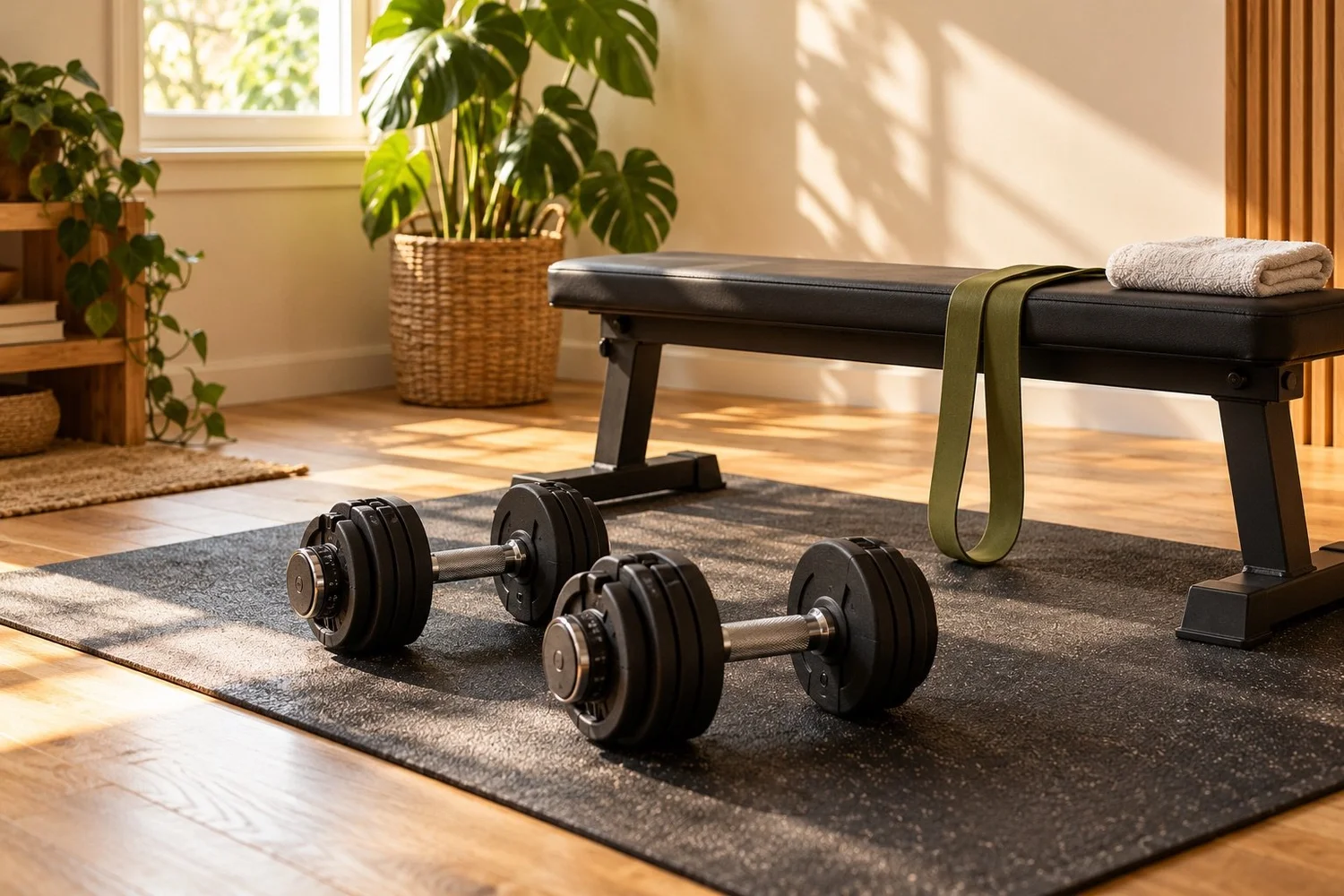
Start with your week
Choose the plan you can stick with
Two days a week
Train Day A and Day B—for example, Monday and Thursday. A flexible choice when other commitments fill the week.
See the two-day plan →A compact option
Prefer fewer exercises? Use the five-movement Day A and Day B sessions instead of the longer two-day plan.
See the compact plan →Three days a week
Train sessions A, B, and C—for example, Monday, Wednesday, and Friday—with recovery days between them.
See the three-day plan →Pick one schedule. These are alternative plans, not a checklist to complete in the same week. The listed sets are example working sets. Start with one or two sets while learning, and skip optional accessories when the main exercises are enough.
How to use the workouts
Prepare
Warm up with a few minutes of brisk walking or easy movement, then rehearse your first exercises with little or no resistance. Check the bar, bench, bands, and anchors before use.
Move with control
Complete the sets for one exercise before moving on. As a starting guide, rest 60–120 seconds between sets and longer when needed. Finish each set before technique breaks down.
Keep a record
Write down your weight, sets, and reps. When you can complete the top of a rep range comfortably with consistent form, increase resistance gradually.
Warm-up, technique, gradual resistance increases, and a full day of recovery between training the same muscles are supported by Mayo Clinic’s strength-training guidance. Stop any exercise that causes pain.
New to strength training? Start with our beginner training programs. Tap a linked exercise below to read its guide.
Train twice. Keep it consistent.
Two-day full-body workout plan
Use Day A early in the week and Day B after at least a full day of recovery. The main equipment is dumbbells, a loop band, and a secure pull-up bar, with bench-free and bar-free swaps below.
Two-day plan · Day AView session +
A squat, hinge, push, and pull session. Start with the main movements and add the final accessory exercise only if you have time and energy.
- Goblet squat
2–3 × 8–12
Choose a comfortable squat depth. - Pull-up or assisted pull-up
2–3 × 3–8
Use the pulling swaps below if needed. - Dumbbell bench press or dumbbell floor press
2–3 × 8–12
Choose one pressing option. - One-arm dumbbell row
2 × 10–12 per side
Keep your torso steady. - Dumbbell Romanian deadlift
2 × 8–12
Practice the hip hinge with light weights. - Plank
2 × 15–40 sec
Stop before your position changes. - Band face pull · optional
1–2 × 12–15
Use a secure, suitable anchor.
Two-day plan · Day BView session +
A second full-body session with single-leg work and a different pulling grip. A floor split squat is a useful alternative to the elevated version.
- Bulgarian split squat or floor split squat
2–3 × 8–10 per leg
Begin with bodyweight; use a fixed support if needed. - Dumbbell Romanian deadlift
2 × 8–12
Use the two-leg version before trying Single-leg Romanian deadlift. - Push-up or Dips
2–3 × 6–12
Choose push-ups unless you already control dips comfortably. - Chin-up or assisted chin-up
2–3 × 3–8
A row is another option when bar work is not suitable. - Dumbbell shoulder press
2 × 8–12
Use a comfortable range and manageable load. - Russian twist or dead bug
2 × 6–10 per side
Alternate slowly; use a dead bug if preferred. - Band lateral raise · optional
1–2 × 12–15
Keep the resistance light enough for control.
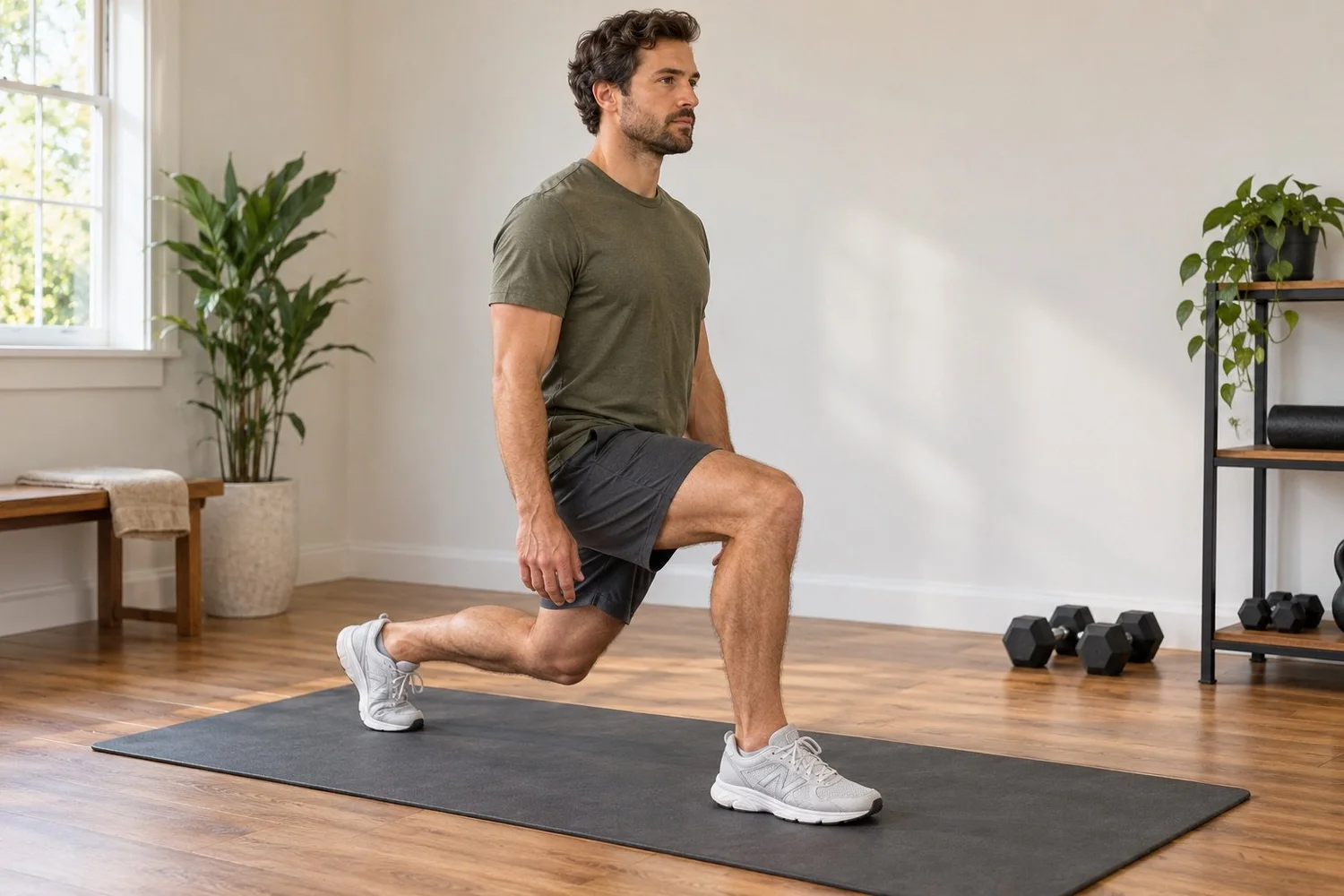
Make the exercise fit you
Build from a steady starting point
A floor split squat can replace a Bulgarian split squat. An incline push-up can replace a floor push-up. A supported dumbbell row can replace a more demanding renegade row.
Choose the version that lets you repeat good-quality movements. You do not need to progress to every harder variation to keep a useful training routine.
Find your equipment swaps →Compact two-day alternative
These shorter exercise lists keep the session focused. Use them instead of the longer Day A and Day B workouts, with the same recovery spacing.
Compact two-day plan · Day AView session +
Choose this five-exercise version instead of the longer two-day plan. It is not an extra workout to add on top.
- Goblet squat
2–3 × 8–12
Keep the weight close to your chest. - Pull-up or assisted pull-up
2–3 × 3–8
Substitute a row when needed. - Dumbbell incline press or dumbbell floor press
2–3 × 8–12
Use floor press if you do not have an adjustable bench. - Single-leg Romanian deadlift or two-leg RDL
2 × 8–12
For single-leg work, complete the reps on each side. - Plank
2 × 15–40 sec
Shorten the hold to keep good form.
Compact two-day plan · Day BView session +
Keep this session controlled, with enough rest to repeat each exercise well.
- Bulgarian split squat or floor split squat
2–3 × 8–10 per leg
Bodyweight is a valid starting point. - Chin-up or assisted chin-up
2–3 × 3–8
Use a row if no suitable bar is available. - Push-up or Dips
2–3 × 6–12
Use an incline push-up for an easier option. - Seated dumbbell shoulder press or standing dumbbell press
2 × 8–12
Choose the version your equipment supports. - Hanging knee raise or dead bug
2 × 6–10
For dead bugs, count reps per side.
A little more structure
Three-day full-body workout plan
Follow A, B, and C on nonconsecutive days. Keep the first week manageable, then adjust the sets and resistance to your experience and recovery. More sessions do not mean every set needs to be maximal.
Three-day plan · Session AView session +
Start the week with a lunge, a hinge, and upper-body pushing and pulling. The final band exercise is optional.
- Goblet lunge
2–3 × 8–10 per leg
Use bodyweight if needed. - Pull-up or assisted pull-up
2–3 × 3–8
Use the equipment swaps below. - Dips or Push-up
2–3 × 6–12
Choose the variation you can control. - Banded deadlift
2 × 10–12
Both feet stay on the floor; these are total reps. - Renegade row or One-arm dumbbell row
2 × 8–10 per side
Use a supported row if the plank position limits you. - Hanging knee raise or dead bug
2 × 6–10
Dead bug reps are counted per side. - Band face pull · optional
1–2 × 12–15
Check the band and anchor before use.
Three-day plan · Session BView session +
A steady middle-of-the-week session. Keep the shoulder accessory optional, especially if the pressing work is already demanding.
- Bulgarian split squat or floor split squat
2–3 × 8–12 per leg
Use a stable setup. - Chin-up or assisted chin-up
2–3 × 3–8
Stop before your grip or technique fails. - Dumbbell bench press or dumbbell floor press
2–3 × 8–12
No bench is needed for the floor option. - Dumbbell shoulder press
2 × 8–12
Use light enough dumbbells to avoid leaning back. - Resistance-band row
2 × 10–15
Use the secure anchor setup in the guide. - Plank
2 × 15–40 sec
Breathe normally and shorten the hold as needed. - Band lateral raise · optional
1–2 × 12–15
Keep the movement smooth.
Three-day plan · Session CView session +
Finish with a balanced session, keeping the same controlled pace as the rest of the week. There is no required burnout or race against the clock.
- Reverse lunge, bodyweight or dumbbells
2–3 × 8–12 per leg
Step back carefully and keep your front foot planted. - Pull-up or Banded pull-down
2–3 sets
Pull-up: 3–8 reps; band pull-down: 10–15 reps. - Push-up
2–3 × 6–15
Use an incline if floor push-ups are too difficult. - Banded deadlift
2 × 10–12
Use a secure underfoot setup; reps are not per leg. - One-arm dumbbell row
2 × 10–12 per side
Use support to keep your torso steady. - Plank or dead bug
2 sets
Plank: 15–40 sec; dead bug: 6–10 per side.
Pull with purpose
Give your back a place in the plan
Rows and pull-ups appear throughout these routines alongside your pressing and leg work. Use the exercise guide to check your setup, and choose a load you can move without jerking or twisting.
A bench-supported row is one option. If you have no bench, a standing bent-over dumbbell row can fill the pulling slot.
Read the dumbbell row guide →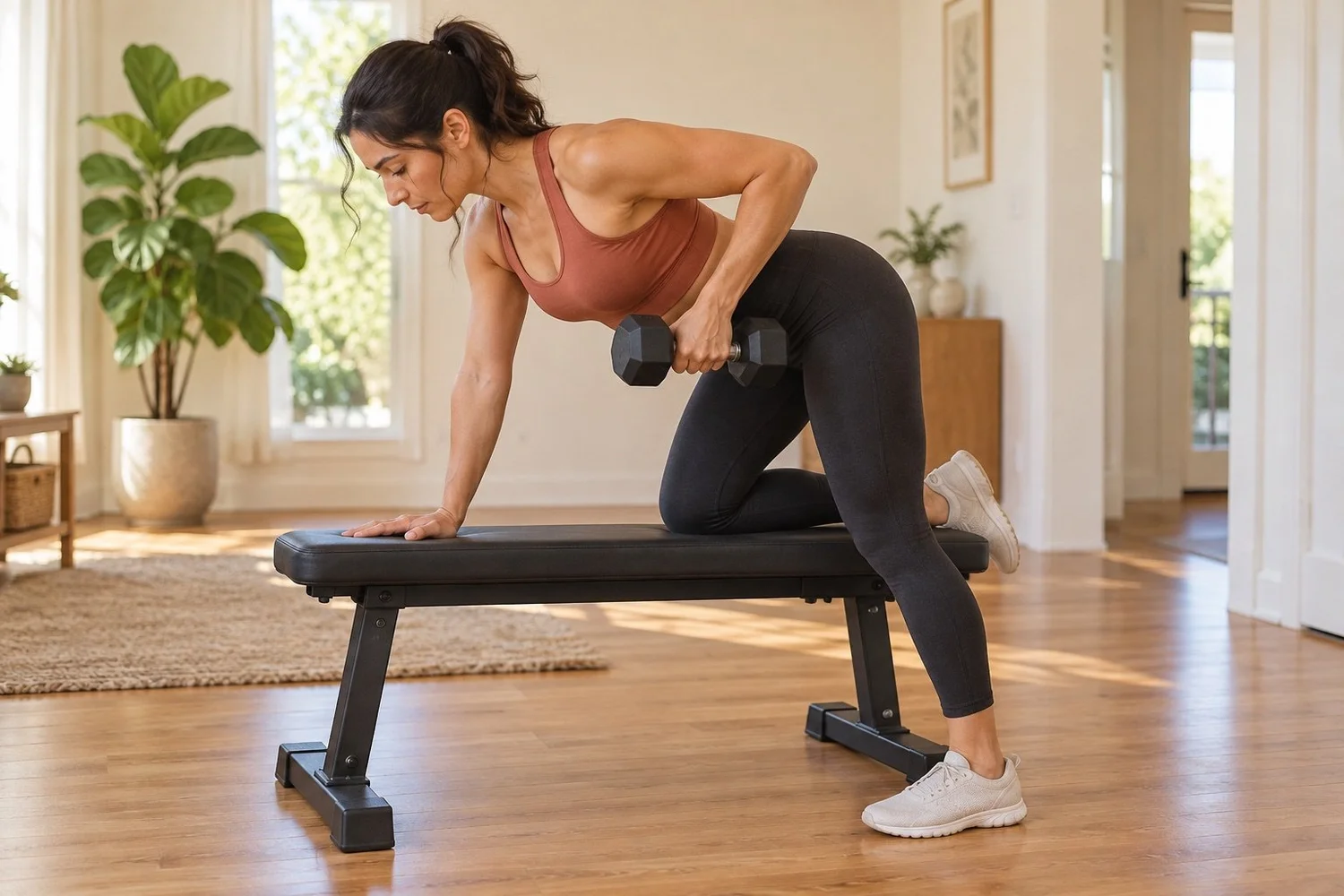
Work with what you have
Equipment swaps for home training
No bench?
Use dumbbell floor press in place of bench or incline press. Choose standing shoulder press and a floor split squat. For rows, use a standing bent-over position you can control.
No pull-up bar?
Replace the pull-up or chin-up slot with a dumbbell row for 8–12 reps per set. A band pull-down is another option when you have a suitable overhead anchor.
No resistance bands?
Use dumbbell RDLs instead of banded deadlifts and dumbbell rows instead of band rows. Skip the optional band accessories or use an appropriate light-dumbbell variation.
Bodyweight only?
Use squats, split squats, incline push-ups, and core work, then explore our dedicated pull-up and bodyweight routines. Pulling exercises still need a safe setup or suitable equipment.
Swaps fill a similar role in the session; they are not identical exercises. Do not add both versions unless the plan specifically calls for them. Use only supports and anchors suited to the load.
Progress without complicating the plan
Repeat your chosen schedule, track your sessions, and adjust one variable at a time. Start at the lower end of the rep range. Add repetitions as your control improves, then increase resistance slightly when you consistently reach the top of the range.
Keep the same exercise if it still suits your goal. A single-leg RDL or weighted pull-up is an option for later—not a required upgrade. Allow extra recovery when performance or technique drops.
Optional arm work: if you are recovering well and have time, add one or two sets of band curls or hammer curls, and one or two sets of band triceps pushdowns. Use about 10–15 controlled reps and keep these extras optional.
Before your next session
Full-body workout questions
Should I choose two or three full-body workouts a week?
Choose the schedule you can repeat and recover from. Two sessions leave more flexibility; three spread practice across the week. Start with the two-day or compact plan if you are unsure, and do not combine the plans.
Can beginners follow these workouts?
Use easier variations, light resistance, and one or two working sets while learning the movements. Pull-ups, dips, and renegade rows are optional choices, not entry requirements. Follow the exercise guides and ask a qualified trainer for help with unfamiliar technique.
Can I train without a bench?
Yes. Use dumbbell floor press instead of flat or incline bench press, standing shoulder press instead of seated press, and a floor split squat instead of a Bulgarian split squat. These are practical alternatives, though they are not identical exercises.
What if I cannot do pull-ups?
Choose an assisted variation using equipment designed for it, or substitute a dumbbell row. A band pull-down is another option if you have a suitable secure overhead anchor. Never improvise a load-bearing anchor.
How long should I rest between sets?
For these example plans, start with roughly 60–120 seconds, allowing more time after demanding leg exercises, pull-ups, or dips. Begin the next set when you can repeat the movement with control; shorten the exercise list rather than rushing your rest.
Can I do full-body strength training every day?
These plans use nonconsecutive training days. Allow at least a full day between strength sessions for the same muscle groups, and take more recovery if needed. Walking and gentle movement can fit between sessions.
How do I progress with limited weights?
Record the repetitions and resistance you use. When all sets reach the top of the range with consistent form, increase the weight slightly if possible. With fixed weights, add controlled repetitions within the range or choose an appropriate harder variation. Change one thing at a time.
Explore more ways to train at home
Dumbbell workouts
Find routines organized around your dumbbells and weekly schedule.
Explore dumbbell workouts →Short on time?
Choose a quick session for days when a longer workout does not fit.
Explore quick workouts →Browse all workout categories · Explore split workout routines