
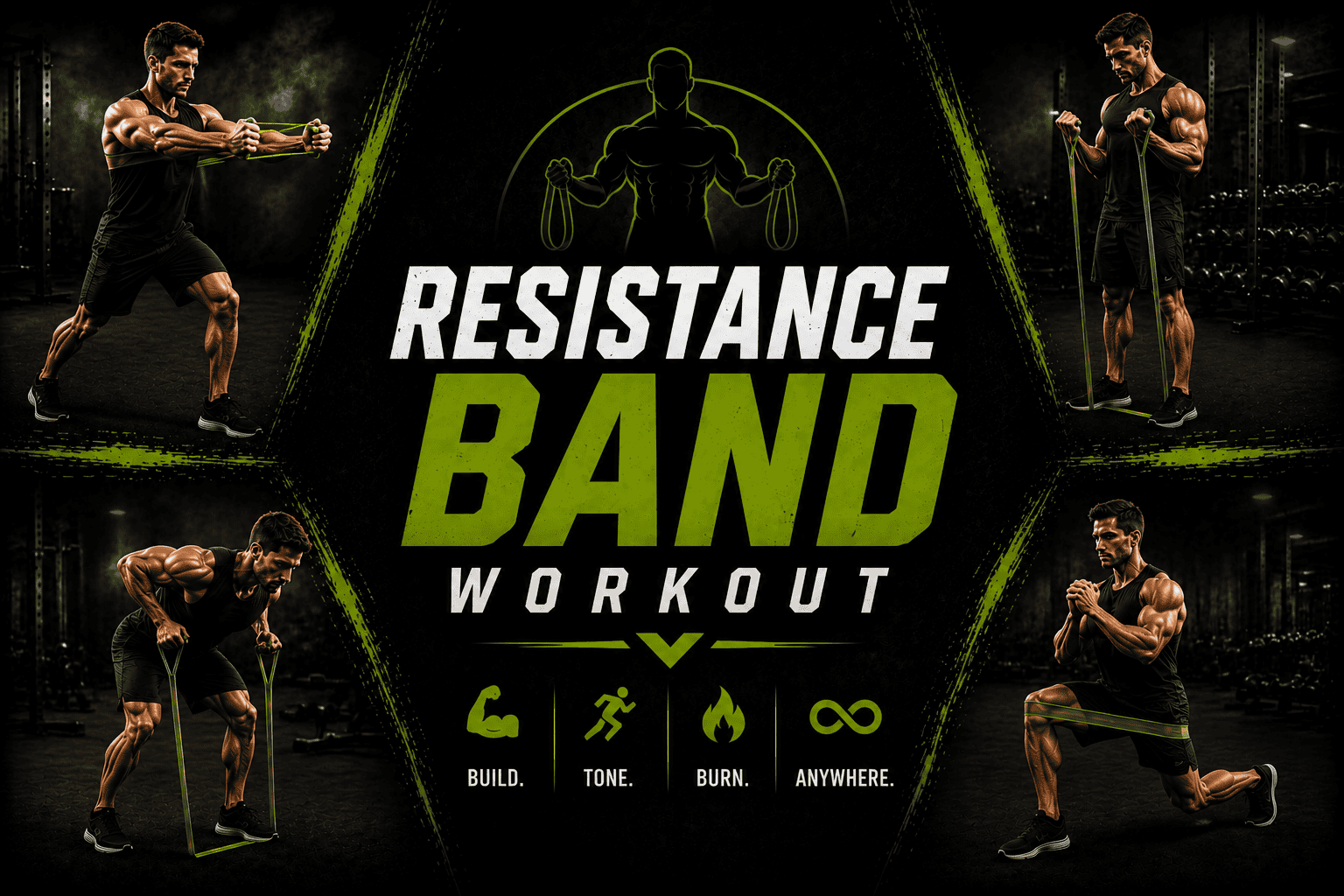
Resistance Band Training: Simple, Effective, and Perfect for Home Workouts
Resistance band training has become one of the most popular ways to exercise at home. While resistance bands have existed for many years, their popularity grew massively during the COVID-19 pandemic when people began searching for effective home workout solutions without access to commercial gyms.
During lockdowns, many people discovered that resistance bands could provide challenging workouts without requiring large amounts of space or expensive equipment. What started as a temporary solution quickly became a long-term training method for many fitness enthusiasts.
Today, resistance bands are used by beginners, athletes, personal trainers, and even professional rehabilitation specialists.
What Are Resistance Bands?
Resistance bands are elastic bands designed to create tension during exercise. Unlike traditional weights, bands provide continuous resistance throughout the movement, helping activate muscles differently compared to dumbbells or barbells.
They come in different styles and resistance levels, including:
Loop bands
Tube bands with handles
Mini bands
Therapy bands
Heavy-duty power bands
Because they are lightweight and portable, resistance bands are ideal for home gyms, travel workouts, and small training spaces.
Why Resistance Band Training Is So Popular
One of the biggest reasons resistance bands became so popular during COVID was convenience. People needed equipment that was affordable, easy to store, and versatile enough for full body training at home.
Resistance bands offered exactly that.
Benefits of Resistance Band Training
Home Gym Friendly
Resistance bands require very little space and can be used almost anywhere.
Joint-Friendly Resistance
Bands create smoother resistance with less impact on the joints compared to some heavy free-weight exercises.
Full Body Training
You can train nearly every muscle group using resistance bands.
Portable and Lightweight
Perfect for home use, outdoor workouts, or traveling.
Great for Beginners and Advanced Users
Resistance levels can be adjusted depending on fitness level and exercise selection.
Improved Muscle Control
Bands create constant tension, helping improve stability and muscle activation.
Resistance Bands Can Build Strength
Some people underestimate resistance bands because they are lightweight and simple, but they can still provide highly effective strength training when used correctly.
Resistance bands can be used for:
Muscle building
Strength training
Mobility work
Warm-ups
Recovery sessions
Athletic training
Many experienced lifters even combine resistance bands with barbells and dumbbells to increase workout intensity.
Effective Resistance Band Exercises
Upper Body Exercises
Band rows
Shoulder press
Chest press
Face pulls
Bicep curls
Lower Body Exercises
Squats
Glute bridges
Lateral walks
Romanian deadlifts
Kickbacks
Core Exercises
Pallof press
Standing rotations
Band crunches
Great for Beginners
Resistance bands are excellent for people starting their fitness journey because they allow controlled movement patterns and adjustable resistance levels.
They can also help improve confidence before moving into heavier free-weight training.
Ideal for Recovery and Mobility
Resistance bands are often used in rehabilitation programs because they provide controlled resistance with lower joint stress.
Many people also use bands for:
Stretching
Mobility work
Injury prevention
Activation exercises before workouts
Home Gym Focus
For now, the focus remains on practical home gym training methods, and resistance bands are one of the best tools available for that purpose. They are affordable, versatile, and highly effective for full body workouts at home.
Resistance Bands Only Workout Plans
Heavy-Duty Loop Bands Only, (Optional Resistance Band Bar, Foot Board Plate)
Simple, effective training plans using loop resistance bands. Some resistance band exercises can also be performed using a resistance band bar and foot plate system. These accessories help create a setup that feels more similar to traditional free weights while still using loop resistance bands.
A resistance band bar allows you to attach the bands to a bar, improving grip comfort and exercise stability during movements such as:
Squats
Deadlifts
Romanian Deadlifts
Bent-Over Rows
Chest Press
Shoulder Press
Biceps Curls
A foot plate helps secure the bands to the floor and creates a more stable resistance point for lower body and pulling exercises.
These accessories are optional, but they can:
Improve exercise comfort
Allow heavier loading
Create a more natural lifting feel
Increase exercise variety
Make progressive overload easier to manage
However, the workouts can still be performed effectively using loop resistance bands alone.
2-Day Split
Day 1 — Full Body A
Legs
Banded Squat — 3–4 × 8–15
Romanian Deadlift — 3 × 10–15
Push
Standing Chest Press — 3 × 10–15
Overhead Shoulder Press — 3 × 8–12
Overhead Triceps Extension — 2–3 × 12–15
Pull
Bent-Over Row — 3 × 10–15
Face Pull — 2–3 × 12–20
Biceps Curl — 2–3 × 10–15
Core
Pallof Press — 3 × 10–15/side
Day 2 — Full Body B
Legs
Split Squat — 3 × 8–12/leg
Banded Hip Thrust — 3 × 10–20
Push
Push-Ups with Band — 3 × AMRAP
Lateral Raise — 3 × 12–20
Pull
Lat Pulldown (anchor high) — 3 × 10–15
Seated Row — 3 × 10–15
Hammer Curl — 2–3 × 10–15
Core
Band Crunch — 3 × 15–20
3-Day Split
Day 1 — Push
Chest
Standing Chest Press — 4 × 8–15
Low-to-High Chest Fly — 3 × 12–15
Shoulders
Overhead Press — 4 × 8–12
Lateral Raise — 3 × 12–20
Triceps
Pushdowns — 3 × 10–15
Overhead Extensions — 2–3 × 12–15
Day 2 — Pull
Back
Lat Pulldown — 4 × 8–15
Bent-Over Row — 4 × 10–15
Straight-Arm Pulldown — 3 × 12–15
Rear Delts
Face Pull — 3 × 12–20
Biceps
Standard Curl — 3 × 10–15
Hammer Curl — 3 × 10–15
Day 3 — Legs + Core
Quads
Banded Squat — 4 × 8–15
Split Squat — 3 × 8–12/leg
Hamstrings/Glutes
Romanian Deadlift — 4 × 10–15
Hip Thrust — 3 × 12–20
Calves
Standing Calf Raise — 4 × 15–25
Core
Pallof Press — 3 × 12–15
Band Crunch — 3 × 15–20
4-Day Split
Day 1 — Upper A
Chest
Standing Chest Press — 4 × 8–15
Chest Fly — 3 × 12–15
Back
Bent-Over Row — 4 × 10–15
Lat Pulldown — 3 × 10–15
Shoulders
Overhead Press — 3 × 8–12
Lateral Raise — 3 × 12–20
Arms
Curl — 2–3 × 10–15
Pushdown — 2–3 × 10–15
Day 2 — Lower A
Quads
Squat — 4 × 8–15
Split Squat — 3 × 10–12
Posterior Chain
Romanian Deadlift — 4 × 10–15
Hip Thrust — 3 × 12–20
Core
Pallof Press — 3 × 12–15
Day 3 — Upper B
Back Focus
Seated Row — 4 × 10–15
Straight-Arm Pulldown — 3 × 12–15
Chest/Shoulders
Push-Ups with Band — 3 × AMRAP
Arnold Press — 3 × 10–12
Face Pull — 3 × 15–20
Arms
Hammer Curl — 3 × 10–15
Overhead Triceps Extension — 3 × 10–15
Day 4 — Lower B
Quads/Glutes
Front Squat Variation — 4 × 8–15
Reverse Lunge — 3 × 10–12/leg
Hamstrings
Good Morning — 3 × 10–15
Glute Bridge — 3 × 15–20
Calves/Core
Calf Raise — 4 × 15–25
Band Crunch — 3 × 15–20
Progressive Overload With Resistance Bands
With resistance bands, overload works slightly differently than traditional weights, but the principle remains the same: increase the difficulty gradually while maintaining proper form and control.
Resistance bands provide accommodating resistance, meaning tension increases as the band stretches. This keeps muscles under constant tension throughout the movement and can be highly effective for building muscle and strength.
Increase band tension gradually
Squeeze, Squeeze, Squeeze
Add reps within the target range
Slow down the eccentric (lowering phase)
Add pauses at peak contraction
Increase total sets over time
Example:
Week 1 → 3 × 10
Week 2 → 3 × 12
Week 3 → stronger band for 3 × 8–10
Key Principles
Train close to failure
Control the eccentric
Full range of motion
Prioritize consistency
Use stable anchors
Focus on tension, not just reps