
Banded Leg Curl
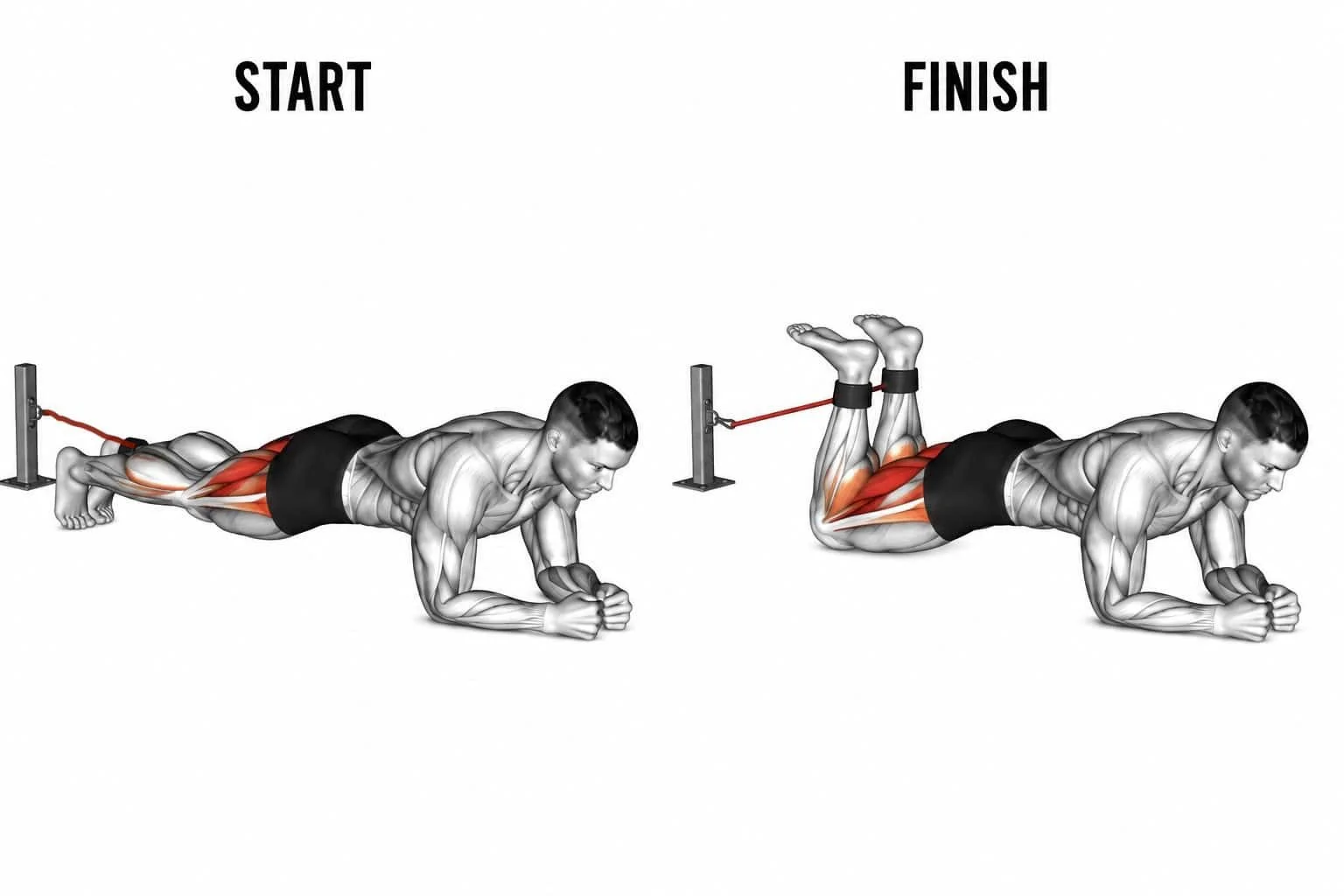
Exercise Description
The Banded Leg Curl is an isolation exercise that targets the hamstrings by flexing the knees against the resistance of a band. It is commonly performed lying face down or standing with the band anchored securely in front of the body. The resistance band provides continuous tension throughout the movement, making it an effective alternative to machine leg curls for building hamstring strength, muscle endurance, and knee stability. Its minimal equipment requirements make it ideal for home workouts and travel training.
Primary Muscles Worked
Hamstrings (Biceps Femoris, Semitendinosus, Semimembranosus)
Secondary Muscles Worked
Gastrocnemius (Calves)
Gluteus Maximus (Stabilization)
Hip Stabilizers
Core Muscles (Stabilization)
Erector Spinae (Stabilization)
How to Perform Correctly
Setup
Secure a resistance band to a sturdy anchor point near floor level.
Attach the other end of the band around your ankles or one ankle, depending on the variation.
Lie face down on a bench or the floor, or stand facing the anchor point if performing a standing variation.
Position yourself so there is light tension in the band at the starting position.
Engage your core and maintain a neutral spine.
Movement
Bend your knee and pull your heel toward your glutes.
Keep your upper leg as still as possible throughout the exercise.
Continue until you achieve a strong hamstring contraction.
Pause briefly at the top position.
Slowly extend your leg back to the starting position under control.
Maintain tension in the band throughout the movement.
Repeat for the desired number of repetitions.
Common Mistakes to Avoid
Using Excessive Resistance
A band that is too strong can compromise technique and reduce range of motion.
Moving the Hips Excessively
Keep your hips stable to ensure the hamstrings perform the work.
Allowing the Band to Snap Back
Control the lowering phase rather than letting the band pull your leg back.
Incomplete Range of Motion
Fully extend and flex the knee through a comfortable range.
Using Momentum
Avoid jerking the leg to complete the movement.
Poor Band Placement
Ensure the band is securely attached and positioned correctly.
Arching the Lower Back
Maintain a neutral spine and engaged core throughout the exercise.