
Standing Dumbbell Shoulder Press
Exercise Description
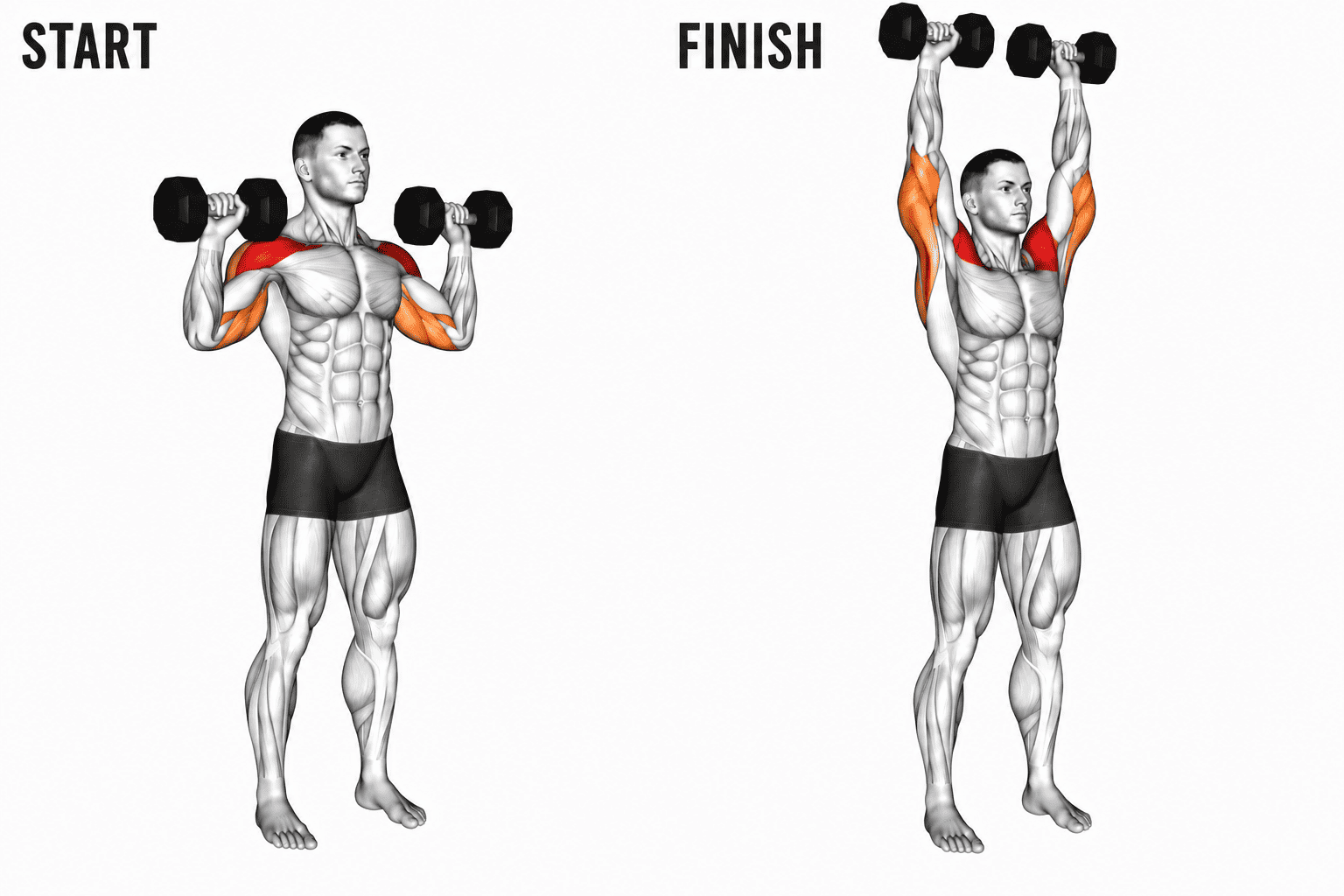
The Standing Dumbbell Shoulder Press is a compound upper-body exercise that develops shoulder strength, muscle mass, and stability. By pressing dumbbells overhead from a standing position, each arm works independently, helping to improve muscular balance and coordination. The standing position also increases core activation, making the exercise effective for building both upper-body and functional strength.
Primary Muscles Worked
Anterior Deltoids (Front Shoulders)
Lateral Deltoids (Side Shoulders)
Secondary Muscles Worked
Triceps Brachii
Upper Trapezius
Serratus Anterior
Upper Pectoralis Major
Rotator Cuff Muscles (Stabilizers)
Rectus Abdominis
Obliques
Erector Spinae (Lower Back Stabilizers)
Gluteus Maximus
How to Perform Correctly
Setup
Stand upright holding a dumbbell in each hand at shoulder level.
Position your palms facing forward or slightly inward.
Place your feet approximately shoulder-width apart.
Engage your core and glutes to stabilize your body.
Keep your chest lifted and maintain a neutral spine.
Movement
Press the dumbbells upward until your arms are nearly straight overhead.
Allow the dumbbells to move naturally while maintaining control.
Bring your head slightly forward as the dumbbells pass overhead so they finish aligned above your shoulders.
Pause briefly at the top position.
Lower the dumbbells slowly and under control back to shoulder level.
Repeat for the desired number of repetitions.
Common Mistakes to Avoid
Arching the Lower Back Excessively
Excessive leaning backward places unnecessary stress on the lumbar spine.
Using Momentum
Avoid using leg drive or body sway to lift the weights.
Pressing the Dumbbells Too Far Forward
Keep the weights aligned over your shoulders at the top of the movement.
Incomplete Range of Motion
Lower the dumbbells fully to shoulder level and press them overhead through a complete range.
Shrugging the Shoulders Excessively
Keep the shoulders stable and avoid excessive elevation during the press.
Allowing the Wrists to Bend Backward
Maintain neutral wrists aligned with your forearms.