
Short on time. Ready to move.
Quick Home Workouts
Make room for movement with six practical routines for busy days. Pick your equipment, set a realistic time limit, and focus on controlled repetitions.
These 20-minute sessions include time to warm up and finish gently. Choose full-body strength, upper body, legs and core, or a low-impact workout—with shorter options when your schedule is especially tight.
Make the minutes count
Choose the time you have
For the five-station timed circuits below, one round takes five minutes. Keep the warm-up and an easy finish in your schedule, and shorten the main session when needed.
10 minutes
3-minute warm-up
1 circuit round · 5 minutes
2-minute easy finish
15 minutes
3-minute warm-up
2 circuit rounds · 10 minutes
2-minute easy finish
20 minutes
3-minute warm-up
15-minute main session
2-minute easy finish
Start gently. March in place, move your shoulders and hips comfortably, then rehearse the first exercises without added weight. Three minutes is a starting allowance; take longer if you need it and reduce the main session. Finish with easy walking and relaxed breathing.
A simple approach
Less rushing. Better repetitions.
Choose one routine for today. Read the equipment list, clear your space, and practice unfamiliar movements before the timer starts.
The work interval is a maximum, not a requirement to keep going. Stop a set before your technique breaks down and rest for the remaining time.
Check your pull-up bar, bands, and any anchor before use. Follow the equipment maker’s setup instructions, and stop an exercise if it causes pain.
Six ways to get moving
Pick your quick workout
Each option has a 15-minute main session. Add your warm-up and easy finish for a roughly 20-minute workout. Open a routine for the exercises, equipment, and easier options.
1 · Full-body strengthView workout +
Equipment: Dumbbells + long loop band + mat
Use the 15-minute circuit format: five stations, 40 seconds of controlled work and 20 seconds to rest or change position. Complete three rounds.
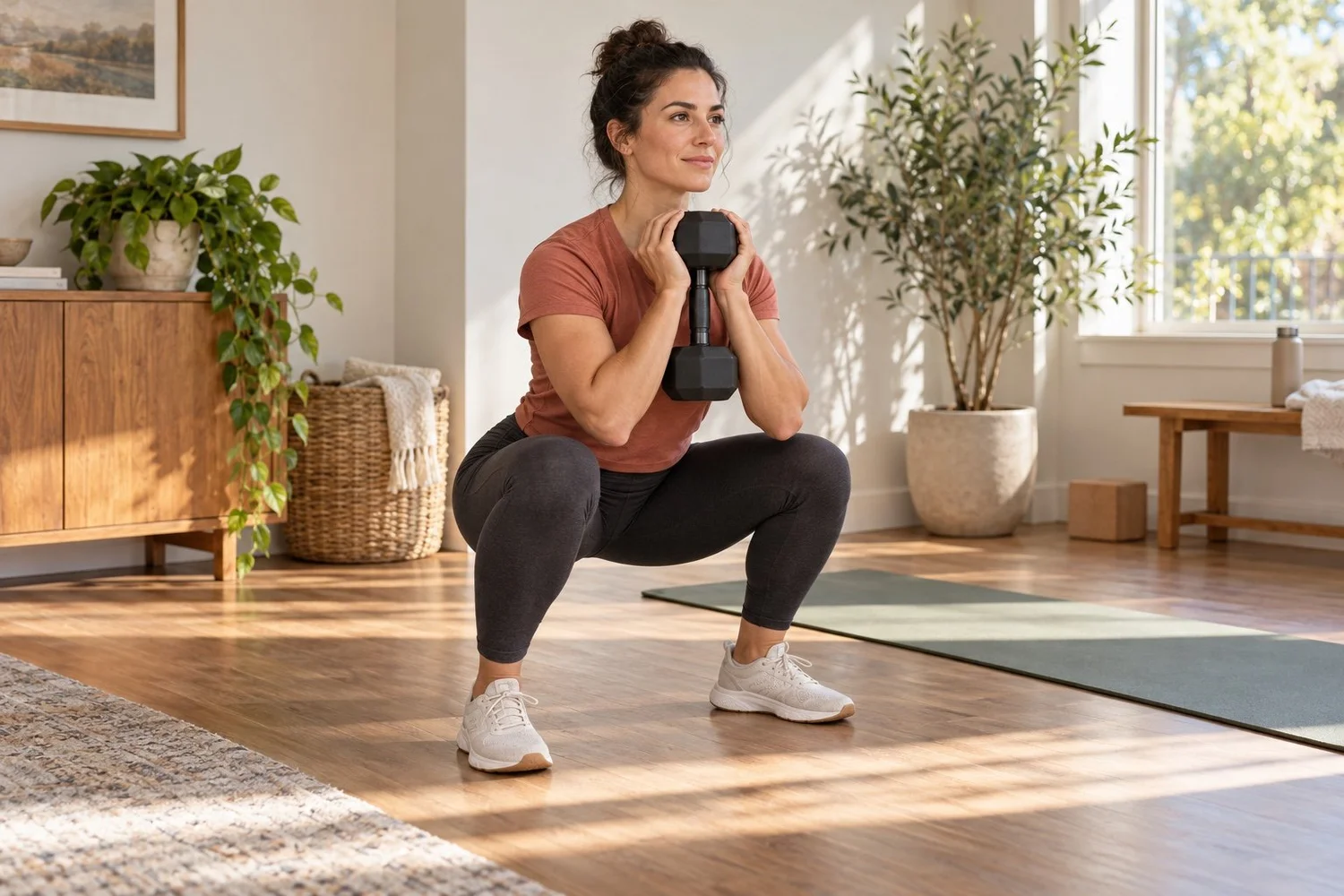
- Goblet squat — keep the dumbbell close to your chest.
- Incline or floor push-up — choose a version you can control.
- Bent-over band row — use a secure underfoot setup designed for your band.
- Dumbbell shoulder press — use a manageable weight and a comfortable range.
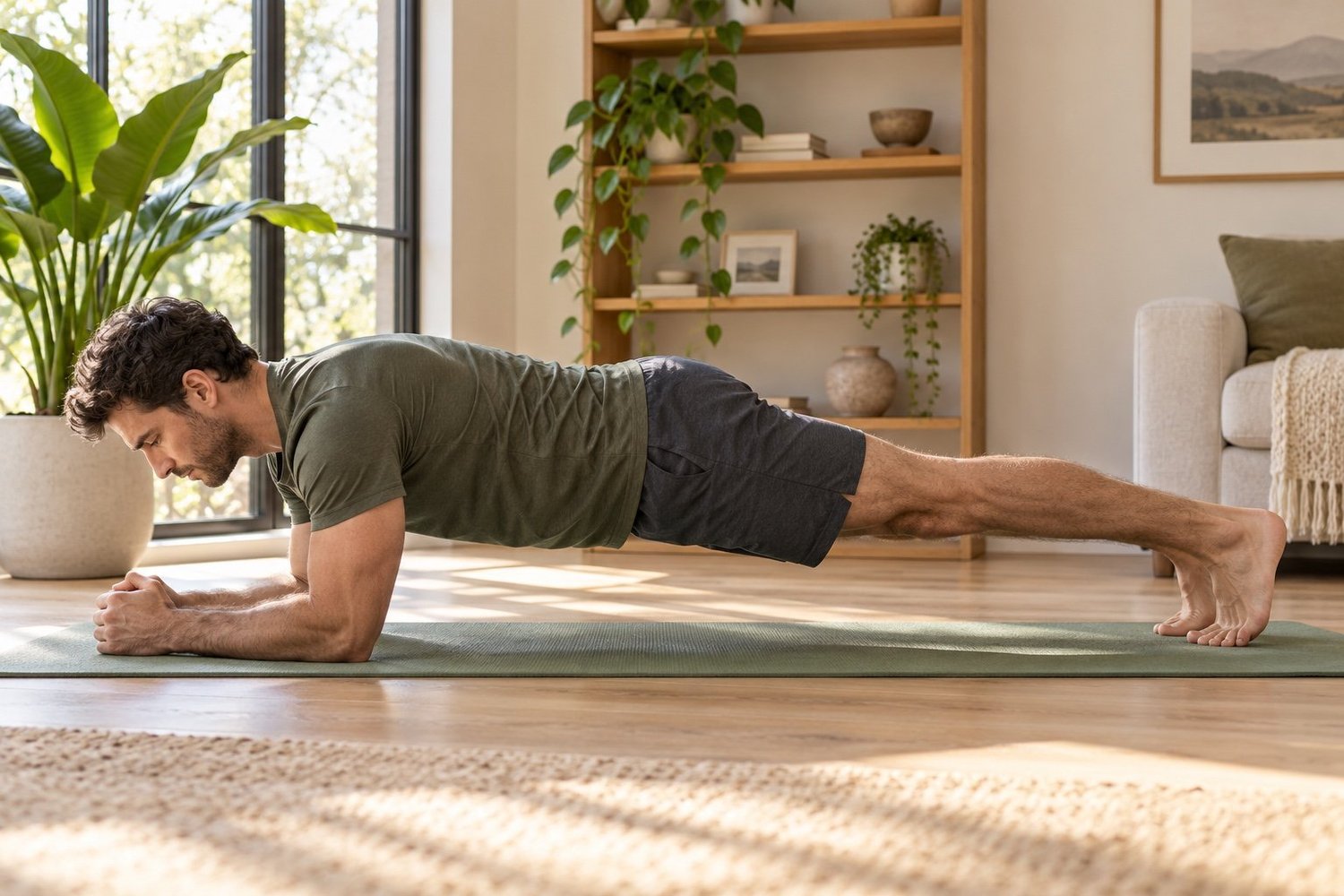
- Forearm plank — stop the hold before your hips sag.
Beginner option: use bodyweight squats and shorter work periods. Rest for the remainder of each minute.
2 · Pull-ups & upper bodyView workout +
Equipment: Secure pull-up bar + dumbbells + long band and suitable anchor
Set a 15-minute main-work timer. Move through the exercises at a controlled pace, resting as needed. Repeat only while your technique stays consistent; there is no required number of rounds.
- Pull-ups, chin-ups, or an assisted version — 3–6 clean reps.
- Dumbbell bent-over row — 8–12 reps.
- Incline or floor push-up — 6–12 reps.
- Band face pull — 10–15 reps using a securely fitted anchor.
- Plank shoulder taps — 6–10 per side, alternating slowly.
Allow extra rest around pull-ups. A timer is a stopping point, not a reason to rush bar work.
3 · Lower body & coreView workout +
Equipment: Dumbbells + mini loop band + mat
Use five stations: 40 seconds of work and 20 seconds of rest. Three rounds make a 15-minute main session.
- Alternating reverse lunge — bodyweight or dumbbells; alternate sides evenly.
- Glute bridge — lift without overextending your back.
- Mini-band lateral walk — small controlled steps in each direction.
- Bodyweight squat — feet planted, comfortable depth.
- Dead bug or slow bicycle crunch — alternate sides with control.
Choose bodyweight lunges if balance is difficult. You can also hold a fixed support.
4 · Low-impact conditioningView workout +
Equipment: Clear floor space; mat optional
Use five stations: 30 seconds of movement and 30 seconds of easy recovery. Repeat three rounds for a 15-minute main session.
- Brisk march — comfortable arm swing and pace.
- Step jacks — step one foot out at a time instead of jumping.
- Bodyweight squat — keep repetitions controlled.
- Standing alternating knee drive — remain upright and balanced.
- Side steps with arm reaches — use a comfortable range.
No jumping is required. Adjust the pace to your ability; this is not an all-out test.
5 · Push/pull circuitView workout +
Equipment: Secure pull-up bar + dumbbells + long loop band + mat
Work steadily for up to 15 minutes. Rest between movements and rounds as needed, and stop early if you cannot keep good form.
- Pull-up or assisted pull-up — 3–6 reps.
- Dumbbell floor press — 8–12 reps.
- Bent-over band row — 10–15 reps with a secure underfoot setup.
- Incline or floor push-up — 6–10 reps.
- Tucked hollow hold or dead bug — 15–25 seconds.
If the two pressing movements are too much, omit the push-up. Quality matters more than completing another round.
6 · Minimal-equipment circuitView workout +
Equipment: Long loop resistance band + mat
Six stations at 30 seconds of work and 30 seconds of rest. Complete two rounds (12 minutes), then walk or march easily for three minutes.
- Bent-over band row — secure the band under your feet.
- Incline or floor push-up — use a stable surface for the incline.
- Bodyweight squat — control the lowering phase.
- Band pull-apart — use a light band and comfortable range.
- Forearm plank — use shorter holds when needed.
- Alternating reverse lunge — use a fixed support if helpful.
Keep resistance and effort modest for an easier day. Minimal equipment does not automatically make a session a recovery workout.
Make it work for your level
Start small
Use bodyweight or light resistance. In a 40-second station, try 20–30 seconds of controlled work and rest for the remainder of the minute.
Build gradually
Repeat a routine until the movements feel familiar. Then adjust one thing at a time: resistance, repetitions, or exercise difficulty.
Plan the week
Try two or three nonconsecutive sessions, choosing a mix that trains your whole body across the week. Add walking or other activity you enjoy.
Short sessions are part of the bigger picture. CDC guidance recommends at least 150 minutes of moderate aerobic activity (or 75 minutes vigorous) each week, plus muscle-strengthening activity on at least two days covering all major muscle groups. Activity can be spread into smaller chunks; one short routine does not automatically cover every recommendation.
Keep it practical
Quick workout questions
Are short workouts worth doing?
Short sessions can help you build a consistent routine and contribute to your weekly activity. Results depend on the exercises, effort, progression, and what you do across the week—not simply the number of minutes on a timer.
Can I do a quick workout without equipment?
Yes. Choose the low-impact conditioning routine, or combine bodyweight squats, incline push-ups, reverse lunges, and a dead bug. Use a stable surface for incline push-ups and select movements you can control.
How much should I rest?
Treat the listed rest periods as a starting point. Pause longer whenever you need to regain control or set up equipment safely. For pull-ups and the repetition-based circuits, rest as needed and accept fewer rounds.
Does a quick workout have to be HIIT?
No. A short session can be steady strength work, low-impact movement, or a simple circuit. There is no need to turn every workout into an all-out effort.
How often should I use these routines?
Start with two or three manageable sessions per week, leaving recovery time between demanding workouts for the same muscles. Alternate the focus, and consider your other training when planning the week.
How do I make a short workout harder?
First improve control and consistency. Then change one variable at a time: slightly more resistance, a harder exercise variation, or a few more repetitions within the same work period. Keep enough rest to maintain good technique.
Find your next workout
Ready for more structure or a different way to train? Explore these related guides.
Dumbbell workouts
Build a more structured home routine around a pair of dumbbells.
Explore dumbbell workouts →Loop band training
Discover more resistance-band exercises and workout options.
Explore resistance bands →Bodyweight training
Practice pull-ups and find bodyweight routines for home.
Explore bodyweight workouts →