
Russian Twist
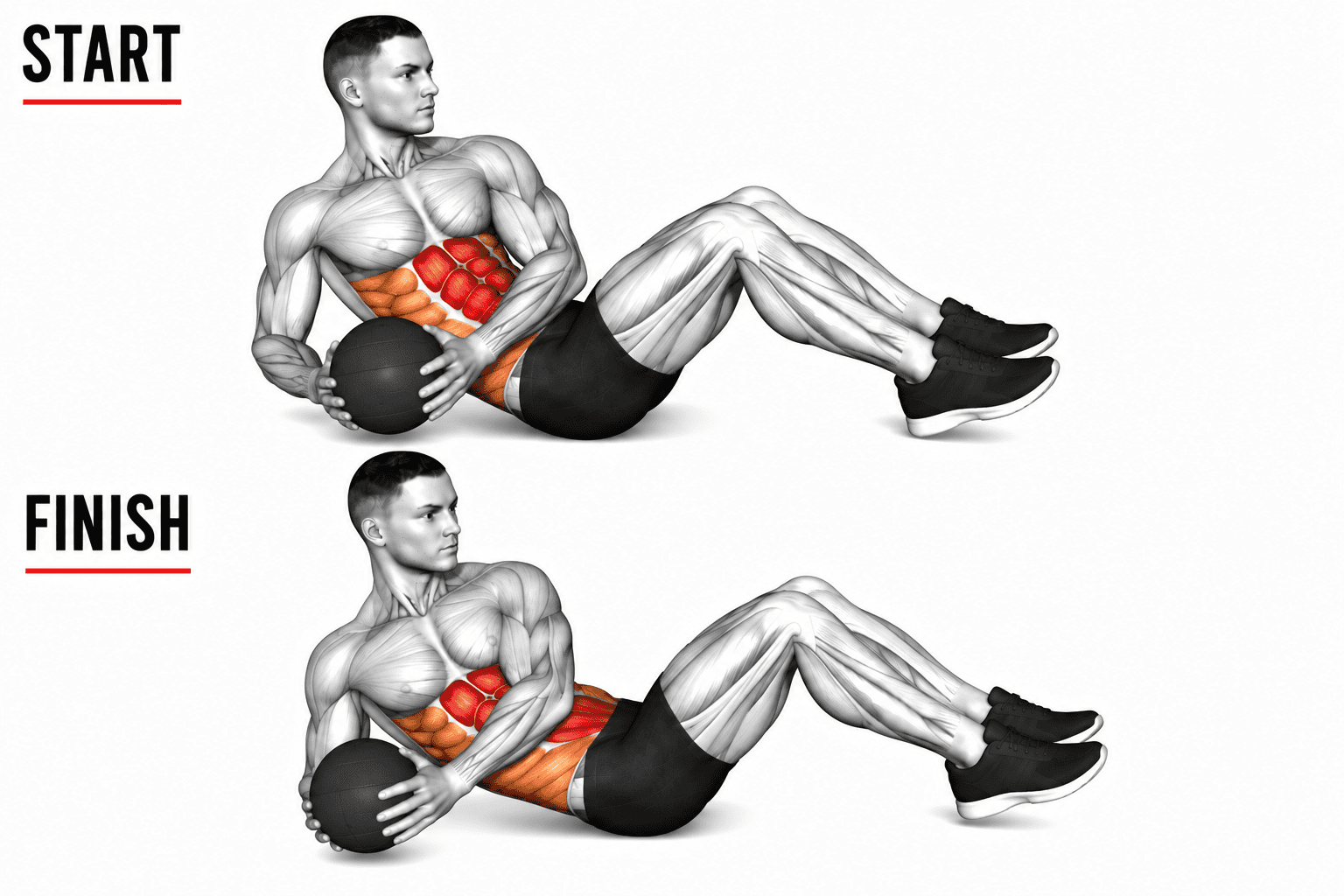
Exercise Description
The Russian Twist is a core exercise that targets the abdominal muscles through controlled rotational movement of the torso. Performed while seated with the feet on the floor or elevated, the exercise challenges the obliques, abdominal muscles, and core stabilizers to resist and control rotation. Russian Twists are commonly used to improve rotational strength, core endurance, balance, and overall athletic performance.
Primary Muscles Worked
External Obliques
Internal Obliques
Secondary Muscles Worked
Rectus Abdominis
Transverse Abdominis
Hip Flexors
Erector Spinae
Serratus Anterior
Shoulders (When Holding Resistance)
Forearm Muscles (Grip Stabilization)
How to Perform Correctly
Setup
Sit on the floor with your knees bent and feet flat on the ground.
Lean your torso backward slightly while maintaining a neutral spine.
Engage your core and lift your chest.
Clasp your hands together or hold a weight in front of your torso.
For a greater challenge, lift your feet slightly off the floor while maintaining balance.
Movement
Rotate your torso to one side while keeping your hips relatively stable.
Move your hands or the weight toward the floor beside your hip.
Contract your obliques as you rotate.
Return through the center under control.
Rotate to the opposite side.
Continue alternating sides for the desired number of repetitions.
Focus on controlled torso rotation rather than moving only the arms.
Common Mistakes to Avoid
Rounding the Lower Back
Maintain a neutral spine and lifted chest throughout the exercise.
Moving Only the Arms
Rotate the torso rather than simply swinging the hands side to side.
Using Excessive Momentum
Perform each repetition slowly and under control.
Leaning Too Far Back
Maintain a position that challenges the core without straining the lower back.
Holding the Breath
Breathe continuously throughout the exercise.
Rotating Too Quickly
Fast repetitions often reduce muscle activation and increase injury risk.
Using Excessive Weight
Heavy resistance can compromise technique and spinal positioning.