
Goblet Lunge
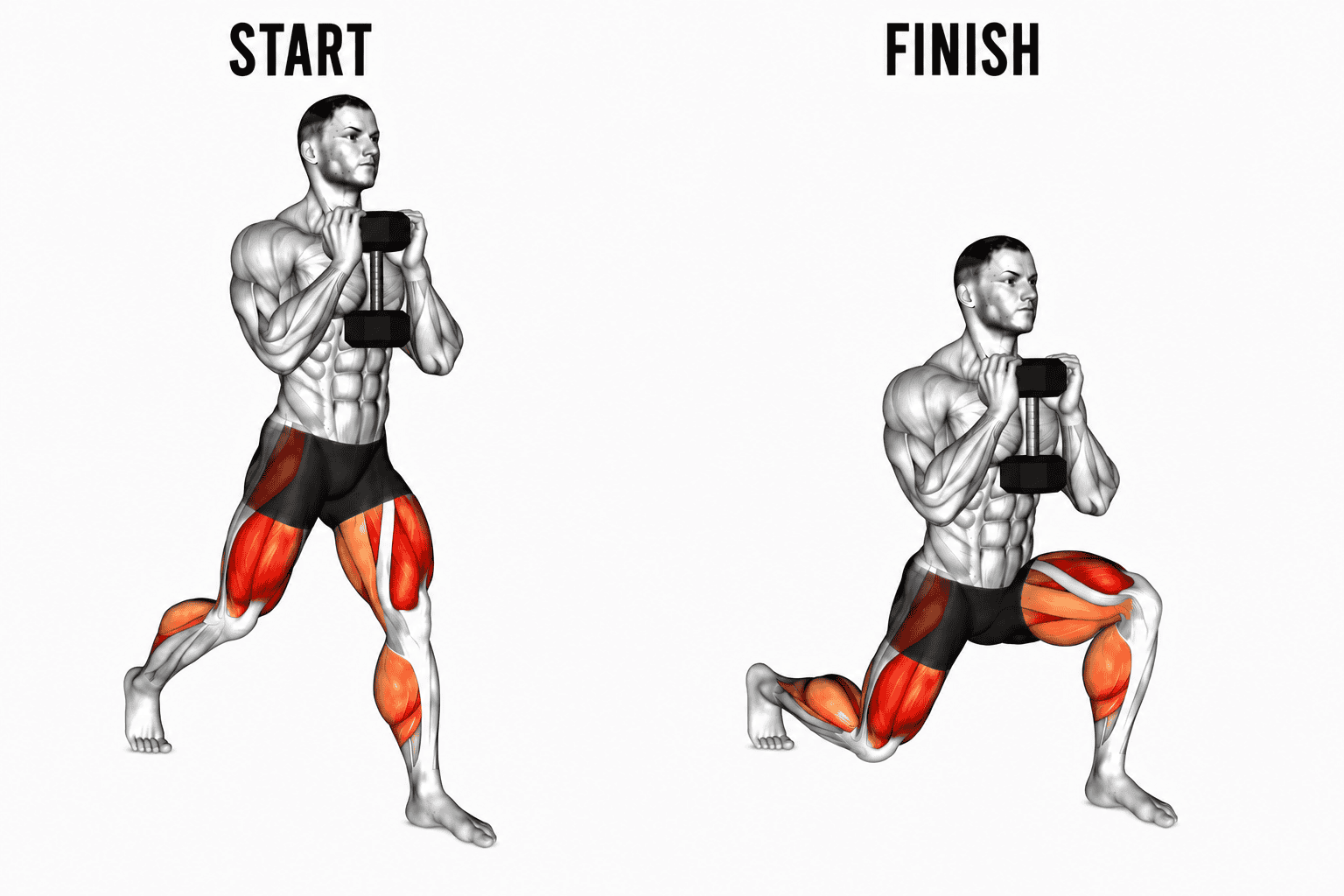
Exercise Description
The Goblet Lunge is a lower-body exercise performed while holding a dumbbell or kettlebell close to the chest in a goblet position. This exercise develops leg strength, glute development, balance, coordination, and core stability while encouraging an upright posture throughout the movement. It can be performed in several variations, including the Forward Lunge, Reverse Lunge, and Walking Lunge.
Primary Muscles Worked
Quadriceps
Gluteus Maximus
Secondary Muscles Worked
Hamstrings
Adductor Magnus
Gluteus Medius
Calves (Gastrocnemius and Soleus)
Rectus Abdominis
Obliques
Erector Spinae
Hip Stabilizers
Upper Back Muscles (Postural Stabilization)
How to Perform Correctly
Setup
Hold a dumbbell or kettlebell vertically against your chest with both hands.
Stand upright with your feet hip-width apart.
Keep your chest lifted and shoulders pulled back.
Engage your core and maintain a neutral spine.
Keep your head and neck in a natural position.
Movement
Forward Lunge
Step forward with one leg.
Lower your body until both knees are bent at approximately 90 degrees.
Keep your front foot flat and your rear knee just above the floor.
Push through the front foot to return to the starting position.
Alternate legs or complete all repetitions on one side.
Reverse Lunge
Step backward with one leg.
Lower your body until both knees reach approximately 90 degrees.
Keep your torso upright throughout the movement.
Drive through the front heel to return to standing.
Repeat on the opposite side.
Walking Lunge
Step forward into a lunge.
Instead of returning to the starting position, bring the rear foot forward and continue directly into the next lunge.
Continue alternating legs while moving forward.
Common Mistakes to Avoid
Allowing the Front Knee to Collapse Inward
Keep the knee aligned with the toes throughout the movement.
Taking Steps That Are Too Short
Short steps can place excessive stress on the knees and limit glute involvement.
Leaning the Torso Forward Excessively
Maintain an upright posture and keep the weight close to your chest.
Pushing Off the Toes Instead of the Heel
Drive through the heel and midfoot of the working leg.
Allowing the Front Heel to Lift
Keep the entire foot planted firmly on the ground.
Using Excessive Weight
Prioritize balance, stability, and proper form before increasing resistance.
Rushing the Movement
Perform each repetition under control to improve stability and muscle activation.