
Bench Dip
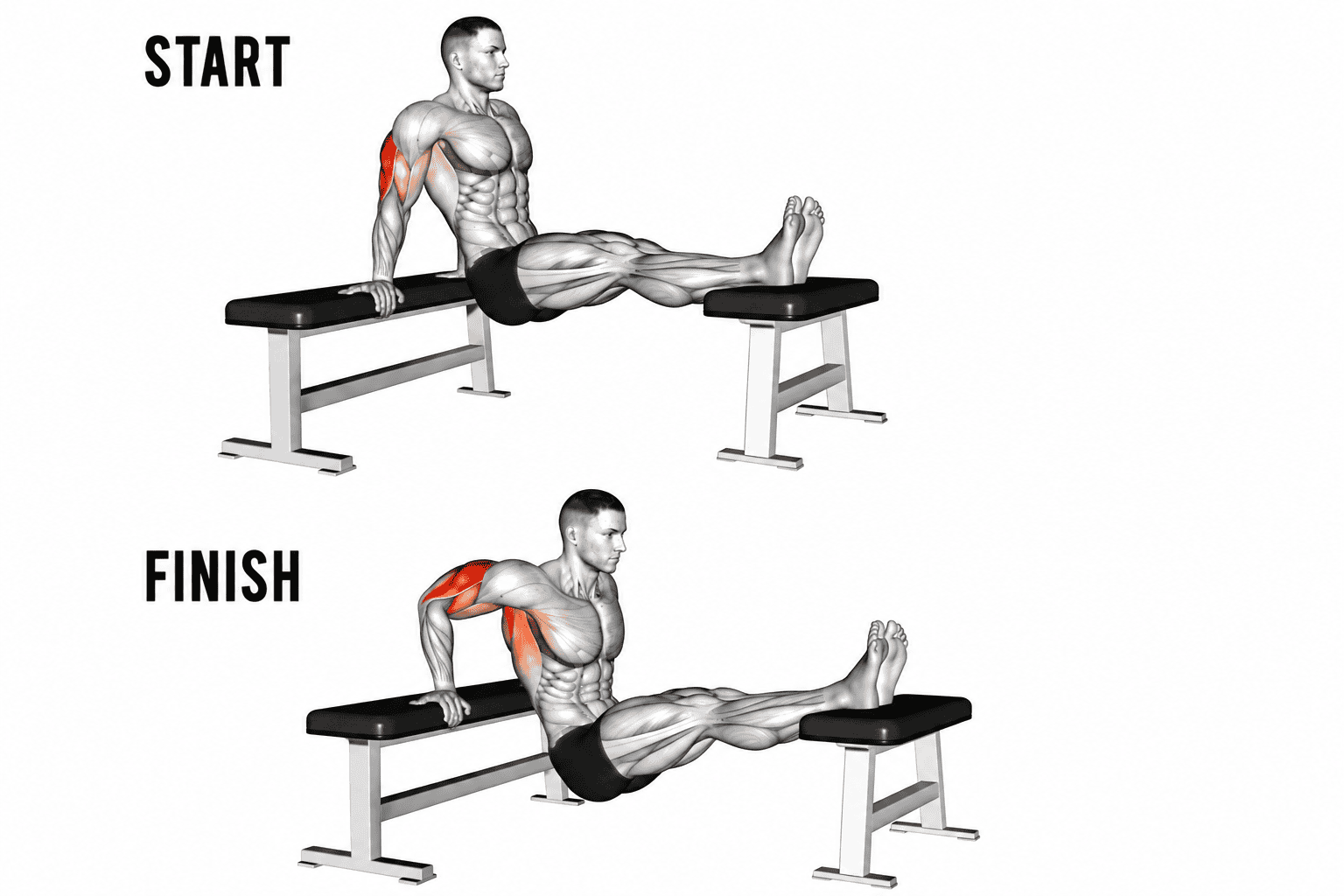
Exercise Description
The Bench Dip is a bodyweight exercise that primarily targets the triceps while also engaging the chest and shoulders. Performed using a bench, chair, or other elevated surface, it is a convenient exercise for building arm strength and muscle endurance with minimal equipment. The difficulty can be adjusted by changing leg position or adding external resistance.
Primary Muscles Worked
Triceps Brachii
Secondary Muscles Worked
Anterior Deltoids (Front Shoulders)
Pectoralis Major (Chest)
Serratus Anterior
Forearm Muscles (Grip Stabilization)
Core Muscles (Stabilization)
How to Perform Correctly
Setup
Sit on the edge of a sturdy bench or platform.
Place your hands beside your hips with your fingers pointing forward.
Slide your hips off the edge of the bench.
Extend your legs in front of you with your heels on the floor, or keep your knees bent for an easier variation.
Keep your chest lifted and shoulders pulled back.
Movement
Slowly lower your body by bending your elbows.
Keep your elbows pointing backward and close to your body.
Lower until your elbows reach approximately a 90-degree angle or a comfortable depth.
Pause briefly at the bottom position.
Press through your palms and extend your elbows to return to the starting position.
Squeeze your triceps at the top of the movement.
Repeat for the desired number of repetitions.
Common Mistakes to Avoid
Descending Too Deep
Excessive depth can place significant stress on the shoulder joints and connective tissues.
Allowing the Shoulders to Roll Forward
Keep your chest up and shoulders back throughout the exercise.
Flaring the Elbows
Keep the elbows pointed backward rather than out to the sides.
Moving Too Far Away from the Bench
Stay close to the bench to maintain proper mechanics and reduce shoulder strain.
Using Momentum
Perform the movement slowly and under control.
Incomplete Range of Motion
Lower and raise your body through a full, comfortable range of motion.
Locking Out Aggressively
Fully extend the elbows without forcefully snapping them into lockout.