
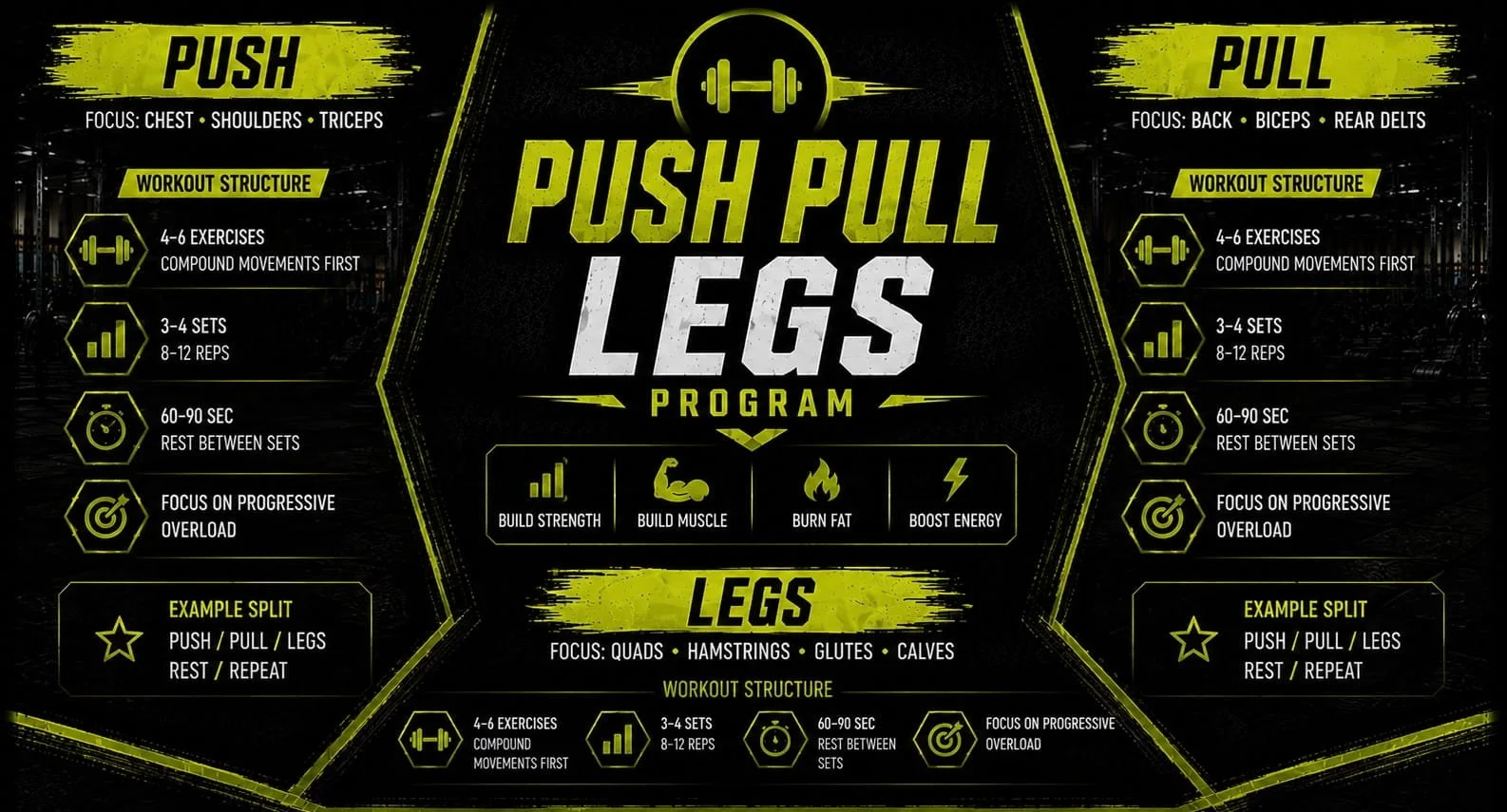
Push / Pull / Legs Workout Program
Push/Pull/Legs is the most popular training split among intermediate and advanced natural lifters — and for good reason. It balances volume, frequency, and recovery better than almost any other approach.
The PPL split has been a staple of serious natural bodybuilding for decades. It organises your training around movement patterns rather than individual muscles — grouping exercises that share the same joint actions. The result is a clean, logical structure that minimises overlap, maximises recovery, and trains every muscle twice per week when run as a 6-day programme.
2× weekly frequency per muscle group in a 6-day PPL split
6 sessions per week — 3 training days repeated across the week
#1 most used split among intermediate natural lifters worldwide
What Is Push / Pull / Legs?
The PPL split divides training into three session types, each targeting a different set of muscles based on the movements they perform:
Push
Chest
Front Deltoids
Side Deltoids
Triceps
Any movement where you push the weight away from your body — bench press, overhead press, dips, lateral raises.
Pull
Lats
Mid / Upper Back
Rear Deltoids
Biceps
Any movement where you pull the weight toward your body — pull-ups, rows, lat pulldowns, curls.
Legs
Quads
Hamstrings
Glutes
Calves
All lower body work — squats, deadlifts, lunges, leg press, leg curl, calf raises.
Why it works: Because each session type uses completely different muscle groups, there's minimal overlap between consecutive days. You can train Push on Monday, Pull on Tuesday, and Legs on Wednesday without any muscle group being fatigued from the session before.
The 6-Day Weekly Schedule
Run twice per week, the PPL split delivers two sessions per muscle group — the research-backed optimal frequency for hypertrophy:
MON Push — TUE Pull — WED Legs — THU Rest — FRI Push — SAT Pull — SUN Legs
Can only train 3 days per week? Run Push, Pull, Legs once — each muscle group gets one session instead of two. Less optimal for hypertrophy but still highly effective, especially for beginners and intermediates. Can train 5 days? Drop one session from your weaker day.
The Complete PPL Programme
Pull Day
Back · Rear Delts · Biceps
Legs Day
Quads · Hamstrings · Glutes · Calves
How to Get the Most from PPL
Alternate A and B sessions. On the intermediate and advanced programmes, don't repeat the same Push A twice in a row. Alternate Push A → Pull A → Legs A → (rest) → Push B → Pull B → Legs B. This distributes volume and variation across the week.
Lead each session with the compound lift. Your heaviest, most technically demanding exercise should come first when you're freshest. Never do isolation work before your bench press, squat, or deadlift.
Track every session. The PPL split is only as good as the progressive overload you apply to it. Write down your sets, reps, and weights. Add reps or weight every week — even a little. Stagnant training produces stagnant results.
Don't skip legs. Leg day is the session most people cut when life gets busy — and the one that returns the most in terms of total muscle mass, hormonal response, and overall athletic development. Protect it.
Use the rest day wisely. Thursday rest day in the 6-day split is deliberate. Don't replace it with cardio or extra training. Walk, stretch, sleep well, eat protein. This is when your body adapts to the first three days before repeating them.
Run the programme for at least 12 weeks. PPL is a long-game split. The first 2–3 weeks are adaptation. Weeks 4–8 are where visible changes begin. Weeks 8–12 are where serious progress compounds. Don't jump ship before then.
The Bottom Line
Push. Pull. Legs. Three sessions, three or six days, every muscle trained twice. It's not complicated — it's just consistently one of the most effective ways to build a complete physique.