
Mike Mentzer's Approach to Training
The thinking man's bodybuilder" — and the man who dared to tell the world it was training too much.
In an era defined by volume, frequency, and more-is-more mentality, Mike Mentzer stood alone — arguing that most bodybuilders were training far too much, far too often, and getting far less than their potential as a result.
Mike Mentzer was not just a bodybuilder. He was a philosopher of training — a man who applied rigorous logical thinking to what was largely a field dominated by instinct, dogma, and the habits of whoever happened to be the biggest guy in the gym. The system he developed, Heavy Duty, was — and remains — one of the most polarising and intellectually serious approaches to building muscle ever devised.
Whether you end up adopting his methods or not, understanding them will change how you think about training forever.
1× per week per muscle — Mentzer's prescribed training frequency
1–3 sets per exercise — total volume per session in Heavy Duty
280 points — perfect score Mentzer earned at the 1978 Mr. Universe
Who Was Mike Mentzer?
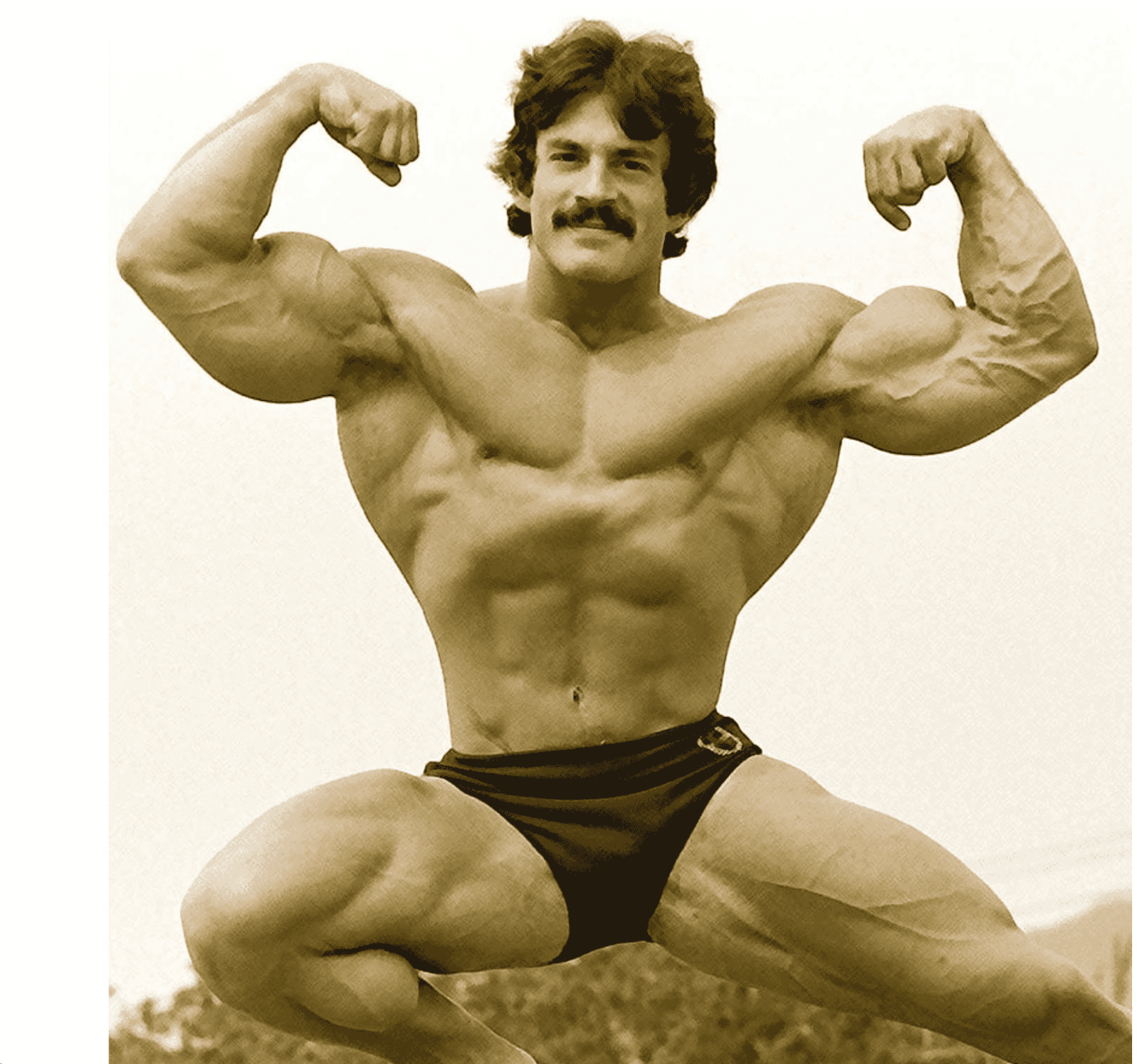
Born in 1951, Mike Mentzer turned professional bodybuilder and built one of the most aesthetically impressive physiques of the golden era — dense, symmetrical, and extraordinarily proportioned. In 1978, he became the first person in history to achieve a perfect score at a major IFBB competition, winning the heavyweight class at the Mr. Universe with a score of 300 out of 300.
But Mentzer's real legacy isn't his trophy cabinet. It's the intellectual framework he built around training. Deeply influenced by the philosopher Ayn Rand and the rational objectivism movement, Mentzer brought a deductive, systematic approach to bodybuilding — insisting that training principles should follow from logic and evidence, not tradition or anecdote.
The body does not want to build muscle. Muscle is metabolically expensive, and the body builds it only as a last resort — when it has been forced to do so by an overwhelming stimulus.
— MIKE MENTZER
Mentzer was heavily influenced by Arthur Jones, inventor of the Nautilus machines and the original proponent of High Intensity Training. But Mentzer took those ideas further — stripping training down to its absolute essentials, extending rest periods dramatically, and insisting that the quality of each set mattered infinitely more than the quantity.
The Core Principles of Heavy Duty
01
Train to Absolute Failure
Every working set must be taken to the point of momentary muscular failure — the moment where completing another rep with good form is physically impossible. Mentzer considered anything short of this insufficient stimulus. Not close to failure. Not one rep shy. Complete, total failure.
02
Minimal Volume — One to Three Sets
Once true failure has been reached, Mentzer argued that additional sets serve no productive purpose — they only deepen fatigue and extend recovery time. One brutally hard set, done properly, provides the complete growth stimulus. More sets are not more effective; they are counterproductive.
03
Maximum Rest Between Sessions
Recovery — not training — is when the body actually builds muscle. Mentzer prescribed rest periods of 4 to 7 days between training sessions for the same muscle group. In his most extreme later protocols, he recommended full body workouts once every 4–7 days. Most people, he argued, are overtrained and don't know it.
04
Progressive Overload on Every Session
Because sessions are infrequent and volume is low, Mentzer expected meaningful progression at every session — more weight, more reps, or both. If you aren't stronger than last time, recovery was insufficient. The training log is not optional; it is the entire point.
05
Pre-Exhaustion Supersets
To ensure the target muscle — not a supporting muscle — reaches failure first, Mentzer popularised pre-exhaustion: an isolation exercise immediately followed by a compound movement. For chest: dumbbell flyes immediately into bench press. The pec is pre-fatigued so it fails before the triceps do.
06
Slow, Controlled Repetitions
Momentum is the enemy of muscle. Mentzer prescribed a 4-second positive phase and a 4-second negative (lowering) phase — keeping constant tension on the muscle and eliminating the use of momentum or joint lockout. Each rep should feel like a controlled, deliberate battle.
The Heavy Duty Workout
In practice, a Heavy Duty session is short — typically 30–45 minutes — but brutally intense. Here is how Mentzer structured the upper/lower split from his Heavy Duty IIprogramme:
The following is the original Mike Mentzer’s split and a (modified) split for home workouts:
Workout 1 — Chest & Back
Exercise — Dumbbell Flys. Sets — 1-2. Reps — 6-10. Type — Pre Exhaust
Exercise — Barbell Bench Press. Sets — 1 Reps — 6-10. Type — To Failure
Exercise — Cable Crossover (Banded Flys). Sets — 1 Reps — 8-12. Type — To Failure
Exercise — Pullover Machine (DB pullover). Sets — 1-2. Reps — 6-10. Type — Pre Exhaust
Exercise — Close Grip Pulldown (Pull-ups). Sets — 1 Reps — 6-10. Type — To Failure
Exercise —Barbell Row. Sets — 1-2. Reps — 6-10. Type — Pre Exhaust
Workout 2 — Legs
Exercise — Leg Extension (DB Leg Ext). Sets — 1-2 Reps — 8-12. Type — Pre Exhaust
Exercise — Leg Press (Squat). Sets — 1 Reps — 8-12. Type — To Failure
Exercise — Leg Curl (DB RDL). Sets — 1-2 Reps — 8-12. Type — To Failure
Exercise — Standing Calf (DB Calf) Sets — 1-2 Reps —12-20Type — To Failure
Exercise — Seated Calf (Seated Calf). Sets — 1 Reps —12-20 Type — To Failure
Workout 3 — Shoulders & Arms
Exercise —Lateral Raises. Sets — 1-2. Reps — 8-12. Type — Pre Exhaust
Exercise — Overhead Press. Sets — 1. Reps — 6-10. Type — To Failure
Exercise — Bent-Over. Sets — 1. Reps — 8-12. Type — To Failure
Exercise — Barbell Curl. Sets — 1-2. Reps — 6-10. Type — To Failure
Exercise — Dumbbell Curl. Sets — 1. Reps — 8-12. Type — To Failure
Exercise — Pushdown (Banded) Sets — 1-2 Reps — 8-12. Type — To Failure
Exercise — Overhead Tricep Extension. Sets — 1. Reps — 8-12. Type — To Failure
Programme note: In Mentzer's later work, he recommended resting at least 4 full days between each of these workouts — cycling through all three over 12+ days rather than one week. The schedule adapts to how recovered you feel, not to a fixed calendar.
Heavy Duty vs High Volume Training
Mentzer — Heavy Duty
1–3 sets per exercise, to absolute failure
Each muscle trained once every 4–7 days
Sessions last 30–45 minutes
Every set is a maximum effort — no warm-up sets counted
Progress expected at every session
Recovery is the priority; training is the trigger
Pre-exhaustion to maximise target muscle failure
High Volume — Conventional
3–5+ sets per exercise, stopping short of failure
Each muscle trained 2–3 times per week
Sessions last 60–90+ minutes
Multiple working sets at moderate intensity
Progress measured over weeks and months
Training stimulus accumulates across sessions
Compound lifts lead; isolation work supplements
The Legacy and the Controversy
1970s
Arthur Jones & Nautilus — The Seed
Jones develops the Nautilus machines and champions single-set, high-intensity training. Mentzer trains under his influence and begins developing his own philosophy.
1978
Perfect Score at Mr. Universe
Mentzer achieves the first perfect score in IFBB history — concrete proof, in his view, that Heavy Duty produces elite results. His physique becomes a benchmark of the golden era.
1980
The Mr. Olympia Controversy
Mentzer finishes second to Arnold Schwarzenegger in a widely disputed result at the Mr. Olympia. Many considered him the rightful winner. Embittered by the outcome, he retires from competition shortly after.
1980s–90s
Heavy Duty Books & Coaching
Mentzer writes Heavy Duty and later Heavy Duty II: Mind and Body — laying out his complete training and philosophical framework. He coaches numerous bodybuilders, most notably Dorian Yates, who goes on to win 6 consecutive Mr. Olympia titles.
2001
Death and Enduring Influence
Mentzer passes away at age 49. His ideas, however, continue to grow — influencing a generation of lifters who seek a more rational, evidence-based approach to training, and experiencing a significant revival in the 2020s through social media.
Is Heavy Duty Right for You?
It May Suit You If...
You have limited time and want short, intense sessions
You've plateaued on higher volume programmes
You recover slowly or feel chronically fatigued from training
You can genuinely push sets to absolute failure safely
You enjoy a rational, systematic approach to training
You're an intermediate or advanced lifter with solid technique
It May Not Suit You If...
You're a beginner — training to failure too early builds bad habits
You enjoy frequent training for mental well-being or habit
You struggle with self-regulation and may underestimate failure
Your goal is sport-specific performance requiring high frequency
You don't have access to machines for pre-exhaustion work
The science on extremely low volume doesn't fully convince you
What the Science Says Today
Modern research presents a nuanced picture. Current evidence does support that training to or near failure is an important driver of hypertrophy — Mentzer was right about intensity. It also supports the idea that many recreational lifters do more volume than they need, and that recovery is chronically undervalued.
Where the evidence diverges from Mentzer's most extreme recommendations is on frequency and volume. Studies generally show that 2 sessions per muscle per week outperforms one, and that slightly higher volume (10–20 sets per muscle per week) produces better hypertrophy than single-set approaches — when effort is matched.
The most honest synthesis: Mentzer was more right than his critics admitted, and less right than he believed. The intensity principles stand up strongly. The extreme infrequency and ultra-low volume are harder to justify in the light of the current literature. A "modified Heavy Duty" approach — high intensity, failure training, but with slightly more sets and 2× weekly frequency — likely captures the best of both worlds.
The ideal training routine is not the one that is most productive in theory, but the one that is most productive in practice — for you, with your genetics, your recovery ability, your life.
— MIKE MENTZER, PARAPHRASED FROM HEAVY DUTY II
The Verdict
Mentzer was a visionary who was right about intensity, right about recovery, and ahead of his time. Study his principles. Apply his intensity. But let the current evidence guide your volume and frequency.