
Standing Banded Decline Fly
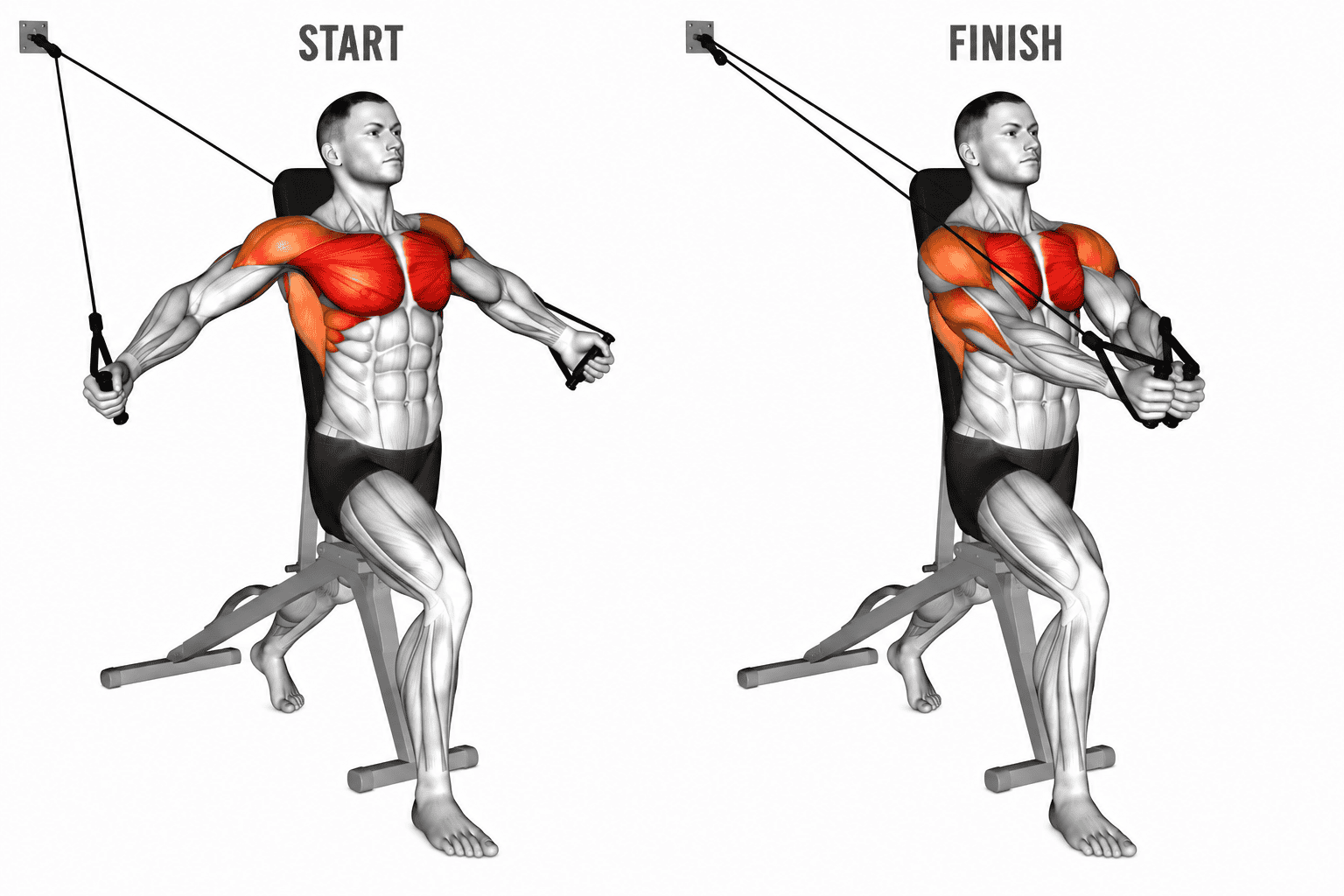
Exercise Description
The Standing Banded Decline Fly is an isolation chest exercise performed with resistance bands anchored above shoulder height. The downward and inward movement pattern emphasizes the lower fibers of the chest while maintaining constant tension throughout the exercise. This movement is effective for improving chest definition, muscle activation, and mind-muscle connection with minimal joint stress.
Primary Muscles Worked
Pectoralis Major (Lower Chest Emphasis)
Secondary Muscles Worked
Anterior Deltoids (Front Shoulders)
Serratus Anterior
Biceps Brachii (Stabilization)
Rotator Cuff Muscles (Stabilizers)
Core Muscles (Stabilization)
How to Perform Correctly
Setup
Secure resistance bands to a stable anchor point above shoulder height.
Stand facing away from the anchor point and hold one handle in each hand.
Step forward until the bands are under tension.
Position your feet shoulder-width apart or in a staggered stance.
Raise your arms out to the sides and slightly below shoulder height with a slight bend in the elbows.
Engage your core and keep your chest lifted.
Movement
Bring your hands downward and inward in a wide arc.
Finish with your hands meeting or nearly meeting in front of your lower chest or upper abdomen.
Squeeze your chest at the bottom of the movement.
Slowly return to the starting position while maintaining control.
Keep a slight bend in the elbows throughout the exercise.
Repeat for the desired number of repetitions.
Common Mistakes to Avoid
Using Too Much Resistance
Excessive band tension can reduce range of motion and compromise technique.
Bending the Elbows Excessively
Turning the movement into a press reduces chest isolation.
Locking the Elbows
Fully straight arms can place unnecessary stress on the elbow joints.
Allowing the Shoulders to Roll Forward
Keep the chest up and shoulder blades stable throughout the movement.
Using Momentum
Swinging the arms decreases muscle activation and control.
Leaning the Torso Excessively
Maintain an upright posture rather than using body weight to assist the movement.
Returning Too Quickly
Control the eccentric phase to maximize muscle engagement.