
Best Dumbbell Exercises for Chest Hypertrophy
Dumbbells are arguably the best tool for chest hypertrophy — greater range of motion, independent arm movement, and a deep stretch position the barbell simply cannot match. Here's every exercise worth knowing and exactly how to use them.
The barbell bench press gets all the attention. It's the measure of strength in almost every gym on earth, and there's no question it builds a strong, thick chest. But when the goal is hypertrophy specifically — maximising muscle size, symmetry and the mind-muscle connection — dumbbells have a compelling case that's backed by both biomechanics and real-world training results.
Dumbbells allow each arm to move independently, so your dominant side can't carry the weaker one. They allow a deeper stretch at the bottom of pressing movements, where much of the hypertrophic stimulus is generated. They allow your wrists and elbows to find their natural path rather than being locked into a fixed bar path. And they allow you to build a complete chest — upper, mid and lower — with the right exercise selection.
Understanding Chest Anatomy
To train a muscle intelligently, you need to understand what it does and where it is. The chest isn't one muscle — it's a large fan-shaped structure with distinct regions that respond to different angles of press and fly.
Clavicular Head
The upper chest. Runs from the clavicle (collarbone) to the humerus. Responds best to incline pressing and high-to-low fly movements.
Sternal Head
The mid chest — the largest portion. Runs from the sternum outward. Trained by flat pressing and fly movements at the horizontal plane.
Costal / Lower Chest
The lower fibres. Attaches near the ribs. Responds to decline pressing and low-to-high cable-style movements — often underdeveloped.
Anterior Deltoid
Front shoulder — a major synergist in all pressing. Reducing its involvement (via shoulder-retracted technique) improves chest isolation.
Triceps Brachii
Extend the elbow in the second half of every press. Fatigue here can limit chest stimulus — especially in beginners.
Serratus Anterior
Anchors the scapula to the ribcage during pressing. Often neglected — key for shoulder health and long-range pressing strength.
The 10 Best Dumbbell Exercises
Filter by chest region to focus your training, or view all 10 exercises below. Click any exercise to expand the full technique guide.
01. Flat Dumbbell Press
MID CHEST
The foundational dumbbell chest exercise. The flat press trains the sternal (mid) head of the pectoralis major through a large range of motion, and the independent dumbbell movement forces both sides to work equally — eliminating the dominant-side compensation that barbell pressing allows.
TECHNIQUE
Lie flat on a bench, feet planted firmly on the floor. Hold the dumbbells at chest height with a pronated grip (palms forward), elbows at roughly 45–75° from your torso.
Retract and depress your shoulder blades — pull them together and slightly down. This protects the shoulder joint and ensures the chest, not the front delts, does the work.
Lower the dumbbells in a controlled arc, feeling the stretch across the chest. Go as deep as your shoulder mobility allows — the stretch is where the hypertrophic stimulus is greatest.
Press upward and inward in an arcing motion, squeezing the chest hard at the top. Don't fully lock out — keep tension on the chest at the top of every rep.
Lower with control over 2–3 seconds. Do not let the dumbbells drop — the eccentric phase is where much of the muscle damage that drives growth occurs.
Pro Tip: Think "push the dumbbells together" at the top of each rep. You can't actually squeeze them together, but the mental cue drives better pec contraction and reduces tricep dominance.
02.Incline Dumbbell Press
UPPER CHEST
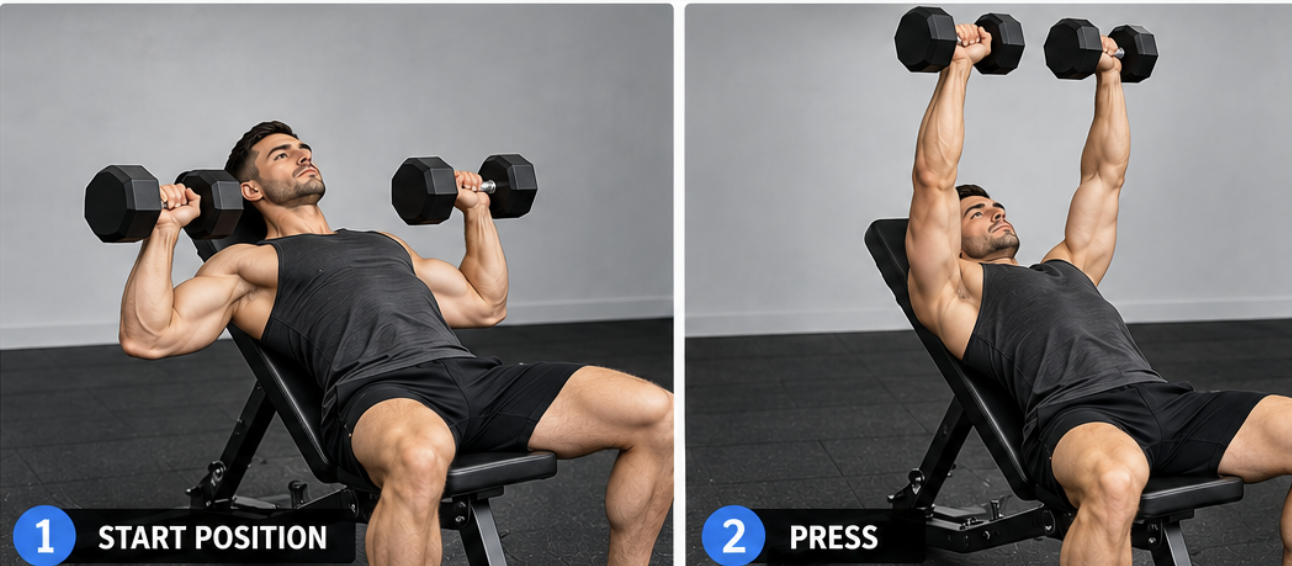
The go-to upper chest builder. Set the bench to 30–45° — research and practice agree that 30° is the sweet spot for clavicular head activation without excessive anterior delt involvement. Higher angles (60°+) shift the load predominantly to the shoulders, reducing the chest stimulus.
TECHNIQUE
Set the bench to 30–45°. Sit back against it with dumbbells resting on your thighs, then kick them up to your shoulders as you lie back.
Retract your shoulder blades against the pad. Your lower back should have a natural arch but your upper back and shoulders should stay pressed into the bench throughout.
Lower the dumbbells to upper chest height — feel the stretch in the upper pec fibres specifically. Allow the elbows to drop below the bench surface for full range.
Press up and slightly in, following the natural arc of the dumbbells. Squeeze at the top — without fully locking out — before lowering for the next rep.
Pro Tip: Many lifters set the bench too high. 45° is the ceiling — try 30° first and see where you feel it more. If you feel it predominantly in the shoulder, lower the angle.
03.Decline Dumbbell Press
LOWER CHEST
One of the most underused chest exercises in typical training programmes. The decline angle places the clavicle above the sternum, shifting load toward the lower pectoral fibres — the part of the chest that gives the lower pec shelf its appearance. Many lifters have underdeveloped lower chests simply because they never train at this angle.
TECHNIQUE
Set the bench to 15–30° decline with ankle support secured. A too-steep decline reduces the chest stimulus and increases anterior delt involvement again.
Hold the dumbbells at mid-to-lower chest height, elbows at roughly 45° from the torso — a slightly narrower elbow position than flat pressing works well here.
Lower with control until you feel the lower chest fibres stretch. The range of motion is slightly shorter than flat pressing — do not force excessive depth.
Drive the dumbbells upward and inward. Focus on squeezing the lower chest fibres specifically — imagine pulling your lower ribs and upper arms together.
Pro Tip: No decline bench available? Lie flat and elevate your feet on a box or step to create a natural body decline. Works just as well for lower chest activation.
04.Dumbbell Chest Fly
MID CHEST
The fly is the premier isolation exercise for the chest — it trains the pectoralis major in shoulder horizontal adduction (arms sweeping across the body), which is the chest's primary function. Where pressing trains the chest through elbow extension, the fly trains it in pure pec action. Use lighter weight and prioritise the stretch and contraction over the load.
TECHNIQUE
Lie flat on a bench, dumbbells held above your chest with a neutral or slightly pronated grip. Elbows have a slight, fixed bend — do not let the elbows change angle during the movement.
Open your arms in a wide arc — like hugging a large barrel — lowering the dumbbells until your chest feels fully stretched. This bottom position is everything in the fly.
Pause for one second at the bottom of the stretch. Let the chest fibres lengthen fully before initiating the return. This pause increases the hypertrophic signal significantly.
Sweep the arms back together, squeezing the chest as you bring the dumbbells toward each other. The movement is an arc, not a press — keep the elbow angle fixed.
At the top, hold the contraction for one second, squeezing the centre of the chest. Lower slowly — 3 seconds down — to maximise time under tension.
Pro Tip: Use a weight you can control through the full arc with a fixed elbow angle. If the elbows are bending significantly, the weight is too heavy and the triceps are taking over what should be a pure chest movement.
05.Incline Dumbbell Fly
UPPER CHEST
The best isolation movement for the upper chest. By combining the incline angle with the fly arc, you place the clavicular head under stretch in the one position it's uniquely trained — lengthened, with the arm moving low-to-high. This combination is extremely effective for upper pec development and is a staple in physique-focused programmes.
TECHNIQUE
Set the bench to 30–45°. Sit back with dumbbells at your sides, then transition to the start position with arms extended above upper chest level.
Arc the arms downward and outward, allowing the dumbbells to move toward the floor at the sides. Feel the upper chest lengthen — there should be a strong pull in the upper pec region at the bottom.
Pause one second in the lengthened position. This is even more important than in the flat fly — the upper chest stretch position is where this exercise generates its unique training stimulus.
Sweep back to the top in a controlled arc, squeezing the upper chest at peak contraction. Focus on the sensation of the upper chest fibres drawing the arms together.
Pro Tip: Imagine you're trying to hug something the size of a car tyre at the top — this cue maintains the proper elbow bend and drives upper pec activation throughout the movement.
06.Dumbbell Pullover
FULL CHEST
A classic exercise that's fallen out of favour — incorrectly. The dumbbell pullover trains the chest in shoulder extension, which is one of the pec's primary functions alongside horizontal adduction. It also stretches the thoracic region and serratus anterior, contributing to rib cage expansion and long-term pressing posture. Arnold Schwarzenegger used pullovers extensively — they're still one of the best tools for long-range chest development.
TECHNIQUE
Lie perpendicular across a flat bench with only your upper back supported, hips dropped toward the floor. Hold a single dumbbell vertically with both hands, clasped under the top plate.
Arms start extended above your chest, slight elbow bend locked in place. From here, arc the dumbbell backward over your head toward the floor behind you.
Lower until you feel a full stretch across the chest and lats. Your hips should be lower than your shoulders — this drop creates greater thoracic extension and deeper chest stretch.
Drive the dumbbell back to the start position, focusing on the chest and lats pulling the weight forward. Do not simply use the triceps to push — it should feel like a sweeping chest movement.
Pro Tip: Breathe in deeply as you lower the dumbbell behind you and fully expand the ribcage at the bottom. This chest-expansion breathing during pullovers was a cornerstone of classic physique training for rib cage development.
07.Dumbbell Floor Press
MID / UPPER CHEST
Often dismissed as a floor exercise, the floor press is actually one of the safest and most effective triceps-and-chest strength builders available. By eliminating the lower half of the range of motion where the shoulder is most vulnerable, it allows heavy loading for the press pattern. For those with shoulder issues who can't flat bench comfortably, this is a smart alternative that keeps pressing volume high.
TECHNIQUE
Lie on the floor with knees bent, feet flat. Hold the dumbbells at chest height with a neutral grip (palms facing each other) — this position is most comfortable on the floor.
Lower the dumbbells until your elbows make contact with the floor. Pause briefly — this brief pause eliminates the stretch reflex and forces the muscles to generate force from a dead stop, increasing strength stimulus.
Press the dumbbells upward to full lockout. Unlike bench pressing, locking out on the floor press is generally safe and adds tricep stimulus.
Control the descent back to the floor. The weight should be heavier than your typical bench press dumbbells due to the shorter range of motion.
Pro Tip: Use this in a strength-focused training block when you want heavy pressing volume without the shoulder stress of full range bench pressing. It pairs well with full-range fly work later in the same session.
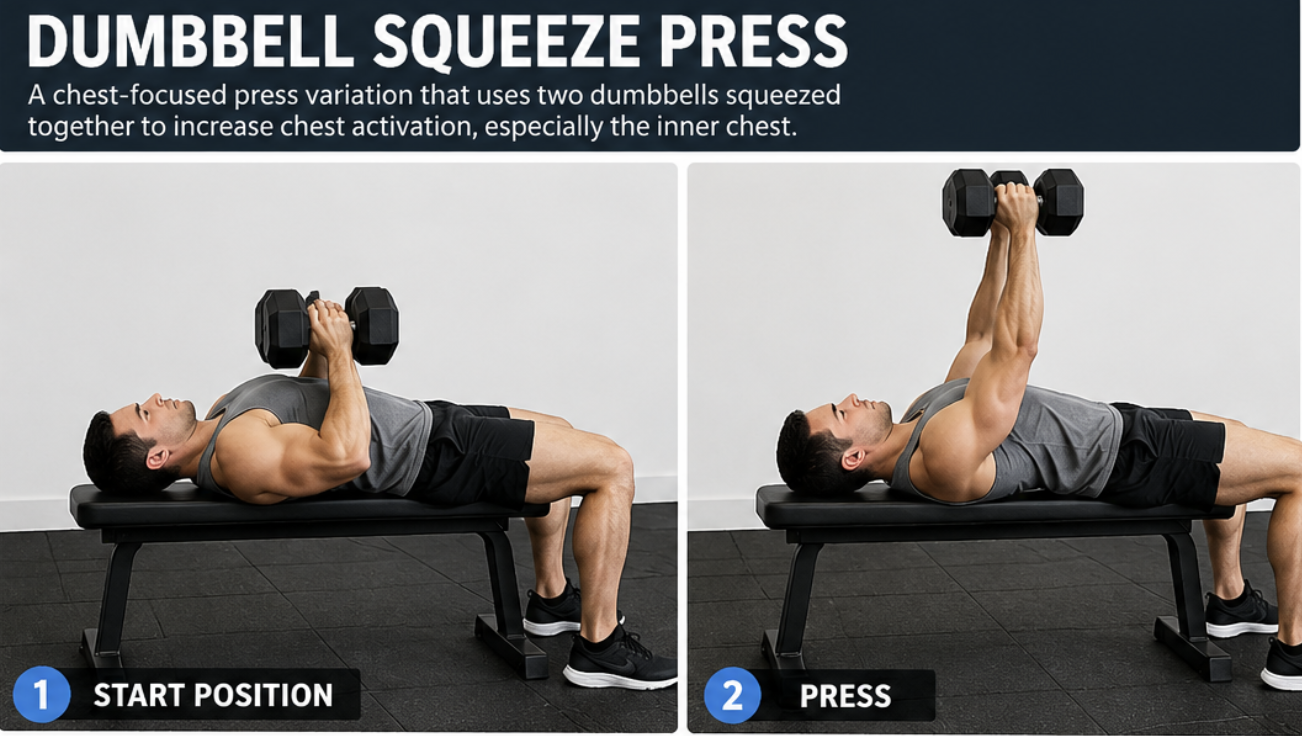
08.Dumbbell Squeeze Press
MID / LOWER CHEST
A deceptively effective movement. By pressing the dumbbells together throughout the entire movement, you create constant adduction force — the chest must work hard to keep the dumbbells touching from bottom to top. This trains the mid and lower chest in its peak contraction position in a way that standard pressing cannot. Lower the weight and feel the burn.
TECHNIQUE
Lie flat on a bench, holding two dumbbells pressed firmly together at mid-chest. Use a neutral grip (palms facing each other) — the dumbbells should be touching throughout the entire movement.
Lower the dumbbells together in a slow, controlled arc, keeping constant inward pressure so they stay in contact throughout the descent.
At the bottom, pause for one second while continuing to press the dumbbells together. The chest is working in two directions simultaneously — pressing upward and squeezing inward.
Press back to the top, squeezing hard as the dumbbells rise. Fully contract the inner chest at the top. Never relax the adduction force — if the dumbbells separate, you've lost the exercise.
Pro Tip: This exercise is excellent as a finisher — use it at the end of a chest session to fully exhaust the mid and lower chest fibres with high reps. 3 × 15 at the end of a pressing session leaves nothing in reserve.
09.Single-Arm Dumbbell Press
FULL CHEST
The single-arm press is the ultimate tool for identifying and correcting side-to-side imbalances. When both arms work together, the stronger side compensates silently. When pressing one arm at a time, the weaker side is exposed and forced to work fully. This exercise also recruits the core heavily to resist rotation — adding a functional training stimulus to a standard pressing movement.
TECHNIQUE
Lie flat on a bench with one dumbbell in one hand. The free hand can rest on your abdomen or grip the bench — it should not push down on the bench to assist.
Brace the core hard — the single-arm press creates a significant rotational demand and the obliques must work to keep the torso flat and stable throughout.
Press the dumbbell through the full range of motion, focusing on the same technique as the standard flat press — shoulder blades retracted, pressing in an arc, squeezing at the top.
Complete all reps on one side before switching. Always start with your weaker arm and match those reps with the stronger arm — never let the stronger side do more volume.
Pro Tip: If you find one side is consistently weaker, give it an additional set each session until it catches up. Running asymmetric imbalances into heavy bilateral training will amplify them over time.
10.Neutral Grip Press (Rotational)
FULL CHEST
A press variation that introduces forearm rotation during the movement — starting pronated at the top and rotating to neutral (palms facing each other) at the bottom. This rotation follows the natural movement pattern of the shoulder joint, reduces impingement risk, and shifts muscle recruitment slightly at different points in the range of motion. Popular with lifters who experience discomfort with fixed-grip pressing.
TECHNIQUE
Begin with dumbbells in a pronated grip (palms forward) at the top of the press, arms fully extended but not locked out.
As you lower the dumbbells, rotate your forearms inward so your palms face each other (neutral grip) at the bottom of the movement.
Pause at the bottom in the neutral position, feeling the stretch across the inner chest and shoulder girdle. This rotating path follows the shoulder's natural arc of rotation.
Press upward, rotating back to pronated as you reach the top. The rotation should be smooth and controlled — it accompanies the press, it does not drive it.
Pro Tip: If standard flat pressing hurts your shoulders, switch to this rotational variation immediately. It reduces internal shoulder stress significantly while maintaining the same hypertrophic stimulus for the chest.
Chest Hypertrophy — 5 Key Principles
Train the Stretch
The most potent hypertrophic stimulus in any muscle occurs when it is under load in a lengthened position. For the chest, this is the bottom of every press and fly. Prioritise exercises and ranges of motion that create a deep chest stretch — this is dumbbells' primary advantage over the barbell.
Cover All Angles
The chest has three functional regions that don't activate identically across all exercises. Train incline, flat and decline angles throughout the week. An upper chest weakness is almost always the result of never training at incline — a single incline exercise per session is often all it takes to fix it.
Press Then Fly
Compound pressing movements (press variations) should come before isolation exercises (flies) in every session. You're stronger and fresher for compound work, and the weights involved in pressing are high enough that performance matters. Flies after presses are a finishing tool — they're not supposed to be done heavy.
Mind-Muscle Connection
The chest is one of the muscles most prone to being overshadowed by the triceps and front deltoid in pressing movements. Deliberately focus on feeling the chest at every point in the range of motion. Slowing the eccentric phase and adding pauses at the stretch position dramatically improves chest activation in lifters who struggle to "feel" the chest working.
Progressive Overload
No rep range or exercise matters without consistent progressive overload. Add weight when you can complete the top of the rep range with good form across all sets. For dumbbell work — where weights jump in increments — increase reps to the top of the range, then move up the dumbbell size on your next attempt.
Volume Per Week
Most intermediate lifters benefit from 12–20 sets of chest per week, distributed across 2–3 sessions. Beginners grow from less (8–10 sets). Advanced lifters may need more. Training the chest twice per week at moderate volume per session outperforms one heavy weekly session for most individuals when hypertrophy is the goal.
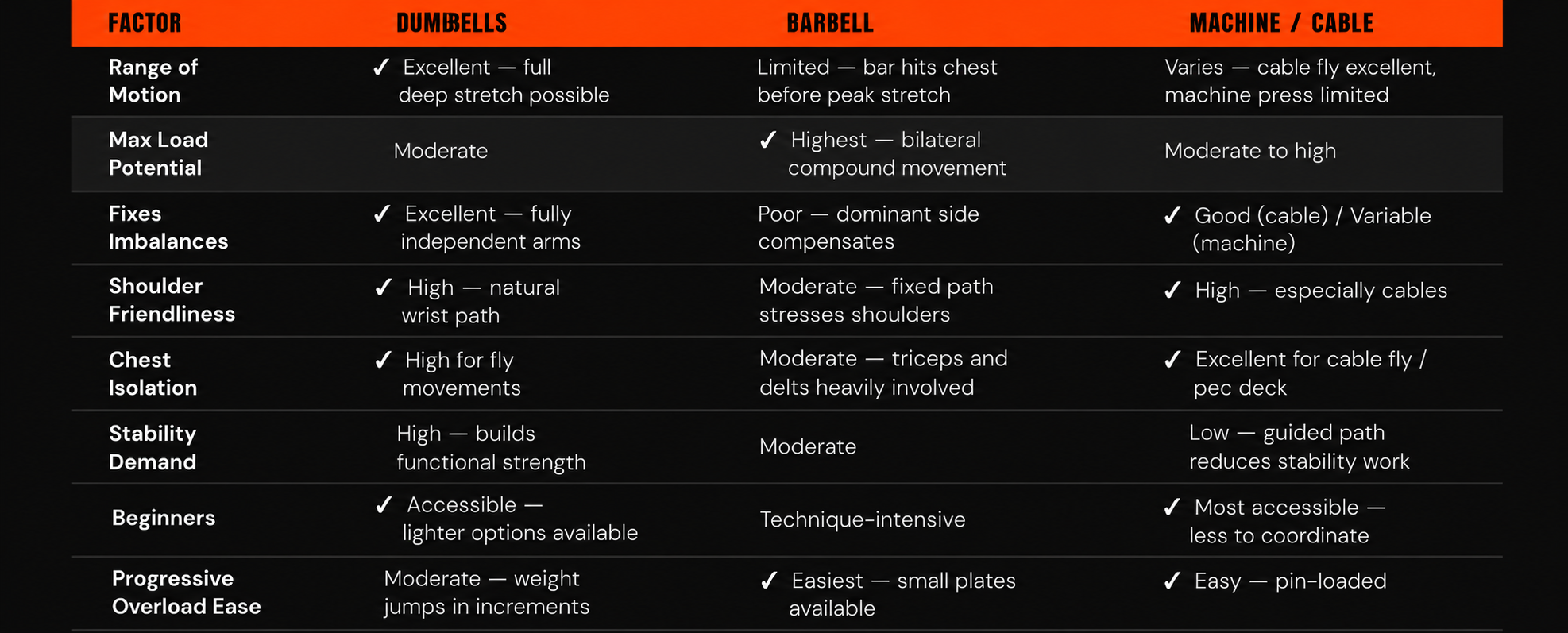
Dumbbell vs Barbell vs Machine — How They Compare
Start sessions with a press, end with a fly. Compound presses first (flat, incline, decline), isolation flies last. This order maintains performance on your heaviest movement while using flies as a targeted finisher.
Slow down the eccentric phase. Lower dumbbells over 2–3 seconds on every pressing and fly exercise. The eccentric is where muscle damage — and therefore growth — is concentrated. Fast eccentrics waste the best part of the rep.
Don't skip the incline. A common complaint of flat-chested lifters is underdeveloped upper pecs. In most cases the fix is simply adding one incline movement to every chest session, consistently, for several months.
Use straps on heavy presses. Grip fatigue can limit your pressing before your chest reaches failure. Using wrist straps on heavier dumbbell pressing ensures the chest determines when the set ends, not the hands.
The Bottom Line
Dumbbells give you everything you need for a complete, well-developed chest. Cover all three regions, prioritise the stretch position, press heavy and fly with intention — and your chest will respond.