
Best Dumbbell Exercises for Back Hypertrophy
The back is the most complex muscle group to train — it's made up of multiple distinct muscles, works across two movement patterns, and requires specific technique to feel it working at all. Dumbbells solve most of those problems better than any other tool.
A well-developed back is arguably the single biggest visual indicator of serious training. Width from the lats, thickness from the rhomboids and mid-traps, and depth from the erectors — these three dimensions together create the physique that looks impressive from every angle. Yet the back remains the most undertrained and least understood muscle group for the majority of gym-goers.
The core problem is a simple one: you can't see the back working. With the chest or biceps, you watch the muscle contract. With the back, you have to feel it — and developing that mind-muscle connection takes deliberate, patient practice. Dumbbells are uniquely suited to this. They allow independent arm movement, natural wrist rotation, and full control over the range of motion — giving you the best possible environment to build back awareness and hypertrophy simultaneously.
Understanding Back Anatomy
The back isn't one muscle — it's a layered collection of muscles that work across different planes and movement patterns. Effective back training requires understanding what each region does and which exercises target it.
Latissimus Dorsi
The largest back muscle — creates the V-taper width. Performs shoulder extension and adduction. Best trained with rowing and pullover movements through a long range of motion.
Rhomboids
Located between the shoulder blades. Retract the scapula — the peak squeeze of every row. Underdeveloped in most lifters who row without conscious scapular retraction.
Trapezius
A large diamond-shaped muscle covering the upper and mid back. Upper traps elevate the shoulder; mid traps retract the scapula; lower traps depress it. All three portions matter.
Rear Deltoids
The posterior shoulder head assists in horizontal rowing movements. Trained directly with face pulls and reverse fly variations — essential for shoulder health and back aesthetics.
Erector Spinae
The long muscles running parallel to the spine. Work isometrically to maintain position in all hinge-based back exercises. Trained directly with back extensions and deadlift variations.
Biceps & Brachialis
Assist with elbow flexion in every row. A common limiting factor — the biceps fatigue before the back in many lifters, cutting sets short before back muscles reach failure.
The two back training patterns:Rows train the back through horizontal pulling — shoulder blades retracting, elbows driving back. Pullovers and straight-arm movements train the lats through shoulder extension — the arm moving from overhead to the hip. A complete back programme uses both. Most people only row.
The 10 Best Dumbbell Exercises
Filter by back region or movement type, or view all 10 exercises. Click any card to open the full technique guide, set/rep recommendations and coaching cues.
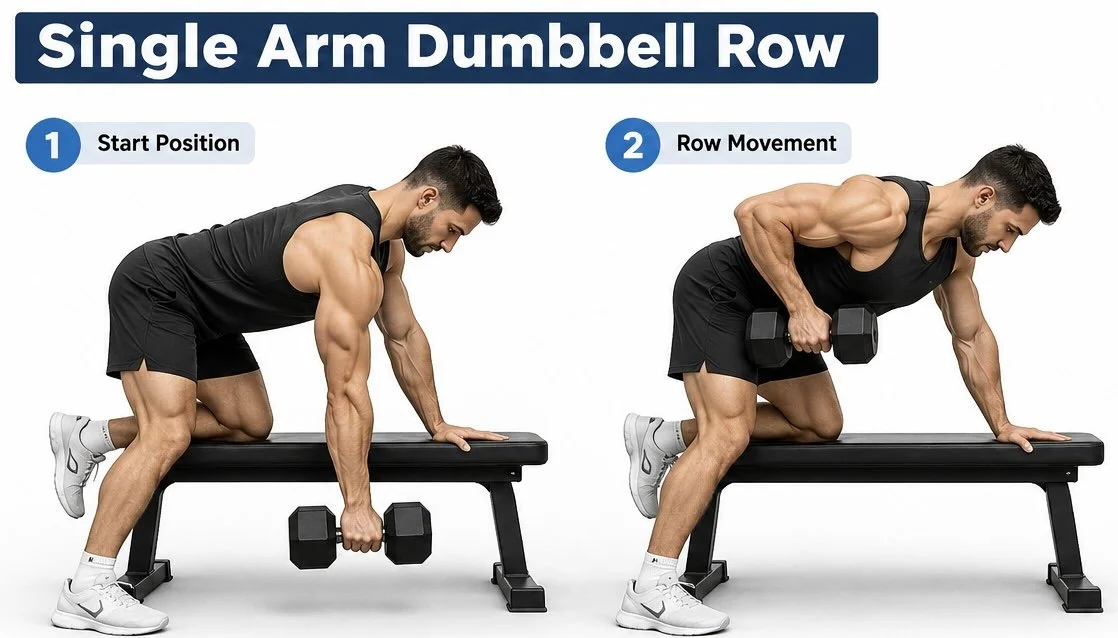
01.Single-Arm Dumbbell Row
FULL BACK
The most important dumbbell back exercise in existence. The single-arm row allows heavy loading, full range of motion, and independent arm movement that exposes and corrects side-to-side imbalances. It trains the entire pulling chain — lats, rhomboids, traps and rear delts — in one movement and is scalable from beginner to elite levels. If you only do one dumbbell back exercise, this is it.
TECHNIQUE
Place your non-working hand and knee on a bench for support. Plant the working-side foot flat on the floor beside the bench. Your torso should be roughly parallel to the floor, back flat and neutral.
Hold the dumbbell with a neutral grip (palm facing the bench). Let the arm hang fully extended, shoulder slightly protracted — feel the lat stretch at the bottom before every rep.
Initiate the pull by driving the elbow toward the ceiling — not by pulling with the hand. Think "elbow to hip pocket" rather than "pull the dumbbell up." This cue shifts activation from the biceps to the lats and upper back.
Pull until the dumbbell reaches your lower ribs or hip. At the top, squeeze the shoulder blade hard toward the spine and hold for one second. This peak contraction is where the rhomboids and mid-traps are fully activated.
Lower with control over 2–3 seconds, allowing the shoulder to protract fully at the bottom. Don't rush the descent — the eccentric phase is where much of the hypertrophic stimulus is generated.
Pro Tip: Allow slight torso rotation at the top of the row — letting the pulling-side shoulder rise slightly allows a fuller range of motion and greater lat activation. This is intentional rotation, not cheating. Keep it controlled and deliberate.
02.Chest Supported Dumbbell Row
UPPER BACK
The chest supported row is the purest upper back isolation tool in dumbbell training. With the chest resting on an incline bench, the lower back and hips are completely removed from the equation — every ounce of effort goes into the back muscles themselves. This makes it ideal for hypertrophy-focused training, high-rep finisher sets, and for lifters whose lower back fatigues before their back muscles do in standard rows.
TECHNIQUE
Set an adjustable bench to 30–45°. Lie chest-down on the pad, feet flat on the floor for stability. Let both arms hang fully extended below the bench with a dumbbell in each hand.
Choose your grip: neutral (palms facing each other) emphasises the lats; pronated (palms back) increases rhomboid and rear delt involvement. Neutral is the better starting point for most lifters.
Drive both elbows upward and back simultaneously, squeezing the shoulder blades together as your hands rise. The chest stays pinned to the pad throughout — this is non-negotiable.
At the top, pause and squeeze the mid-back hard for one to two seconds. Feel the shoulder blades pulled together. This contraction is the entire purpose of the exercise — don't rush through it.
Lower with full control, allowing complete arm extension and shoulder protraction at the bottom. The supported setup means you can safely reach a full stretch — use it every single rep.
Pro Tip: Use wrist straps. Grip fatigue will limit your sets long before the back muscles reach failure without them. Straps ensure the back — not the hands — decides when the set ends.
03.Dumbbell Pullover
LATS / WIDTH
The only dumbbell exercise that trains the lats through shoulder extension — pulling the arm from overhead down toward the hip — rather than through rowing. This movement pattern recruits the lat fibres that rowing simply cannot reach, and the long-range stretch position it creates is one of the most effective hypertrophic stimuli available for lat width. A staple of classic physique training for good reason.
TECHNIQUE
Lie perpendicular across a flat bench — only your upper back supported, hips dropped below bench level. Hold a single dumbbell vertically, clasping both hands under the top plate.
Start with the dumbbell extended above your chest, arms nearly straight with a slight fixed elbow bend. From here, arc the weight slowly backward over your head toward the floor.
Lower until you feel a full stretch across the lats and chest. Your hips dropping below the bench creates greater thoracic extension — this deepens the stretch significantly. Breathe in fully at the bottom.
Drive the dumbbell back to the start position by thinking "pull with the lats" rather than "push with the arms." The lats should be pulling the upper arm from overhead back to the hip — this is their primary function in the movement.
Keep the elbow angle fixed throughout. If the elbows are bending significantly, the triceps and chest are doing the work rather than the lats. Reduce weight until the lat activation is clear.
Pro Tip: To increase lat emphasis, imagine trying to "break the dumbbell in half" by pushing outward against your palms as you pull. This lat engagement cue dramatically improves activation for lifters who tend to feel pullovers only in the chest or triceps.
04.Dumbbell Rear Delt Fly
UPPER BACK
Often treated as a shoulder exercise, the rear delt fly is equally important for upper back development and shoulder health. The rear deltoid, rhomboids and mid-traps all contribute heavily to this movement. Critically, the rear delts are frequently underdeveloped in lifters who push far more than they pull — and an underdeveloped rear delt creates both a visual imbalance and a significant injury risk over time.
TECHNIQUE
Hinge at the hips until your torso is nearly parallel to the floor. Hold dumbbells hanging directly below your shoulders with a neutral grip. Knees are slightly bent.
With elbows slightly bent (and fixed — do not allow them to bend further during the movement), arc the dumbbells outward and upward like opening your arms wide.
Focus on lifting the elbows, not the hands. The arms should move like wings — rising from below to horizontal. At the top, your arms should be approximately parallel to the floor.
Squeeze the rear delts and mid-traps hard at the top. You should feel a strong contraction between and behind the shoulder blades — not just in the shoulders themselves.
Lower slowly — 3 seconds — back to the start. Gravity assists on the way down, so don't let it dominate. Control the descent for maximum time under tension.
Pro Tip: This exercise is almost always done with too much weight. Reduce the load by 30–40% from what you think you need and feel the difference in rear delt and mid-trap activation. Heavy rear delt flies become front delt and trap shrugs.
05.Incline Dumbbell Row
LATS / WIDTH
The incline row is a variation that shifts emphasis strongly toward the lower lats — the part of the lat that contributes to the "V" shape beneath the armpit. By lying face-down on an incline bench and rowing with the arms pulling toward the hip (rather than the ribcage), the lower lat fibres are put under stretch and load in a position that standard rows rarely achieve. A very effective lat width tool often overlooked in typical programming.
TECHNIQUE
Set a bench to roughly 30° incline. Lie face-down so your chest and abdomen are supported, head extending off the top. Hold dumbbells with a neutral grip, arms hanging directly below the bench.
Allow full arm extension at the start — the lats should be in a fully stretched, lengthened position before every rep. Feel the stretch across the side of the torso.
Drive the elbows toward your hips — not toward the ceiling. The elbow path is downward and back, close to the torso, which keeps the tension on the lower lats rather than the upper back.
At the top, squeeze hard and hold one second. The contraction point should feel distinctly lower and wider than a standard row — in the lower lats rather than the mid-upper back.
Lower fully and repeat. Avoid the temptation to use hip drive or body motion — the chest stays on the pad throughout and all the work is done by the arms and back.
Pro Tip: If you're struggling to feel the lower lats, wrap a resistance band around your wrists and pull them apart as you row. This external rotation cue activates the lats and instantly shifts the sensation from upper back to lower lat.
06.Renegade Row
FULL BACK
The renegade row is a full-body exercise disguised as a back movement. Performed from a push-up position with dumbbells as the base, it requires the core to resist rotation while one arm rows — adding massive anti-rotational core demand to an already effective back exercise. It also loads the shoulders and chest isometrically throughout. A highly efficient movement for lifters with limited time who want maximum work per exercise.
TECHNIQUE
Set up in a high push-up position with hands gripping two dumbbells (hex dumbbells work best — they don't roll). Feet wider than hip-width for greater stability. Body forms a straight line head to heel.
Brace the core and glutes hard before every rep. The hips must stay square to the floor — any hip rotation is a form failure. The core's entire job here is to prevent the body from rotating as the arm rows.
Row one dumbbell upward by driving the elbow toward the ceiling, keeping it close to the torso. The movement is identical to the single-arm row — just from a horizontal body position with no bench support.
At the top, squeeze the lat and upper back hard. The shoulder blade should retract fully toward the spine — identical to any other row, just harder to achieve when the core is also fighting rotation.
Lower the dumbbell to the floor with control and repeat on the other side. Alternate arms for each rep. Count reps per arm — never cut the weaker side short.
Pro Tip: Widen your feet for more stability if your hips are rotating. Hip rotation is not a style choice — it completely removes the anti-rotational core demand that makes this exercise unique. Master stability before adding load.
07.Dumbbell Shrug
UPPER TRAPS
The dumbbell shrug directly targets the upper trapezius — the muscle responsible for the thickness of the neck-to-shoulder line that gives the upper back its imposing appearance. Many lifters either neglect shrugs entirely or perform them incorrectly, rolling the shoulders forward in a movement that does nothing for the traps. Done correctly with full elevation and a hard peak contraction, shrugs are one of the most effective direct trap builders available.
TECHNIQUE
Stand holding dumbbells at your sides with a neutral grip, arms fully extended. Stand tall — do not lean forward or allow the upper back to round before starting.
Elevate the shoulders straight up toward your ears as high as possible. There should be no forward or backward rolling — the movement is purely vertical. Think "try to touch your ears with your shoulders."
At the top, hold the contraction for one full second. The upper traps should be fully contracted — you should feel a clear squeeze at the base of the neck and top of the shoulder.
Lower with control over 2 seconds, allowing full depression of the shoulder blades at the bottom. The full depression-to-elevation range maximises the active range of motion for the trap.
Never roll the shoulders. Shoulder rolling in a shrug activates the rotator cuff rather than the traps and increases shoulder impingement risk. Straight up, straight down.
Pro Tip: Add a 2-second pause at the bottom (full shoulder depression) as well as the top. This stretch-to-contraction cycle significantly increases the hypertrophic stimulus compared to bouncing through the range of motion.
08.Straight-Arm Dumbbell Pulldown
LATS / WIDTH
A dumbbell approximation of the cable straight-arm pulldown — one of the most effective lat isolation exercises available. By keeping the arms straight throughout, the biceps and elbows are removed from the equation entirely. The lats must do all the work to pull the arm from the overhead stretch position down to the hip. This is the closest thing to a pure lat exercise that exists in dumbbell training.
TECHNIQUE
Stand facing a bench or surface and hinge forward slightly at the hips, torso angled about 30–45° from vertical. Hold a dumbbell in each hand with arms extended overhead or at shoulder height — this is the lat's stretched position.
With arms straight (elbows locked out and maintained throughout), pull the dumbbells downward in an arc toward your hips. The motion is driven entirely by the lats contracting to extend the shoulder.
At the bottom — dumbbells at hip level — squeeze the lats hard. The feeling should be of the lower lats fully contracting to pull the arms in against the body.
Return slowly to the start position, allowing the lats to fully lengthen overhead. This stretch position is where the unique hypertrophic value of this exercise lies — don't cut it short.
Pro Tip: Use lighter dumbbells than you think you need. This is a pure lat isolation movement — 8–12 kg is often sufficient for most intermediate lifters. The moment the elbows bend, the biceps take over and the exercise is no longer a straight-arm pulldown.
09.Dumbbell Romanian Deadlift
LOWER BACK / POSTERIOR
The Romanian deadlift is the foundational hinge movement for posterior chain development — building the erector spinae, glutes and hamstrings simultaneously. While primarily a lower body exercise, the erectors work under sustained isometric tension throughout, building the lower back thickness and structural strength that supports all other back training. No serious back programme is complete without a hinge movement.
TECHNIQUE
Stand holding dumbbells in front of your thighs with a pronated grip. Feet hip-width apart, knees slightly bent — this slight knee bend is maintained throughout. Do not squat down; this is a hinge, not a squat.
Push your hips backward as you lower the dumbbells down your legs. The dumbbells stay close to the body — brushing the shins as they descend. Your torso tilts forward as the hips move back.
Lower until you feel a full stretch in the hamstrings — usually when the dumbbells reach mid-shin level. Your back must remain flat and neutral throughout. Any rounding of the lower back means you've gone beyond your current mobility.
Drive the hips forward to return to standing — not by pulling with the lower back, but by squeezing the glutes and extending the hips. The back extends as a result of hip extension, not independently.
Stand tall and fully extended at the top, glutes contracted. Reset the brace before lowering for the next rep.
Pro Tip: Think "hips back, not chest down." Most RDL errors come from initiating the movement by dropping the chest instead of pushing the hips backward. Pushing the hips back first naturally brings the chest down — doing it the other way round forces the lower back to round.
Dumbbell Face Pull (Lying)
REAR DELTS / UPPER BACK
Face pulls are one of the most important exercises for long-term shoulder health and upper back development — typically done on a cable machine. This lying dumbbell variation replicates the movement pattern without cables. It trains the rear delts, lower and mid traps, and external rotators of the shoulder simultaneously — the exact muscles that counterbalance the internal rotation stress of heavy pressing and the forward-rounded posture of most people's daily life.
TECHNIQUE
Lie face-down on a flat bench, arms hanging below and slightly forward. Hold very light dumbbells with a neutral grip. This starting position mimics the bottom of a cable face pull.
Raise both dumbbells simultaneously by driving the elbows high and wide — the elbows should be above shoulder level at the top and pointing outward, not upward. Think "double bicep pose" as the top position.
As you raise, externally rotate the shoulders so the forearms move from pointing toward the floor to pointing toward the ceiling at the top. This external rotation component is what makes face pulls uniquely valuable for shoulder health.
At the top, pause and squeeze the rear delts and mid-traps. Feel the compression between the shoulder blades and behind the shoulder caps. Hold for one to two seconds.
Lower with control, reversing the rotation as the arms descend. Every rep includes the full rotation — don't simplify it into a standard rear delt raise.
Pro Tip: Use weights so light they feel almost embarrassing — 3–5 kg is often appropriate even for advanced lifters. The external rotation component is the entire point and it collapses at any meaningful load. Prioritise the movement quality over the numbers.
Back Hypertrophy — 6 Key Principles
Initiate with the Back, Not the Arms
The most common and damaging back training error. If the biceps fatigue before the back in your rows, the arms are leading the movement. Every rep of every row should feel like you're driving an elbow, not curling a dumbbell. Think elbows, not hands — on every set, every session.
Use the Full Range of Motion
The stretch position — full arm extension at the bottom of a row — is where a large portion of the hypertrophic stimulus originates. Many lifters cut the range short at both ends, reducing both muscle damage and the time under tension that drives growth. Full extension at the bottom, full retraction at the top, every rep.
Train Both Pulling Patterns
Rows train the back through horizontal pulling. Pullovers and straight-arm movements train it through shoulder extension. Most programmes only row. Adding one pullover or straight-arm variation per session targets the lat fibres that rowing cannot reach — the difference between a thick back and a wide one.
Build the Mind-Muscle Connection
You cannot see the back working. The mind-muscle connection must be actively developed through lighter loads, deliberate pacing, and focusing on the sensation of contraction at the top and stretch at the bottom. Beginners should spend 4–6 weeks building this awareness before prioritising heavy loading.
Scapular Control Is Everything
The shoulder blades must move deliberately in every back exercise — protracting (moving apart) at the bottom and retracting (squeezing together) at the top. Without scapular control, rows become arm exercises. This is not a subtle point — it is the difference between training the back and missing it entirely.
Weekly Volume and Frequency
The back responds well to higher volume — 15–22 sets per week for most intermediate lifters. Spreading this across two sessions per week (pull days or dedicated back sessions) allows greater total volume than one weekly session without recovery being compromised. Start conservatively and add sets as capacity grows.
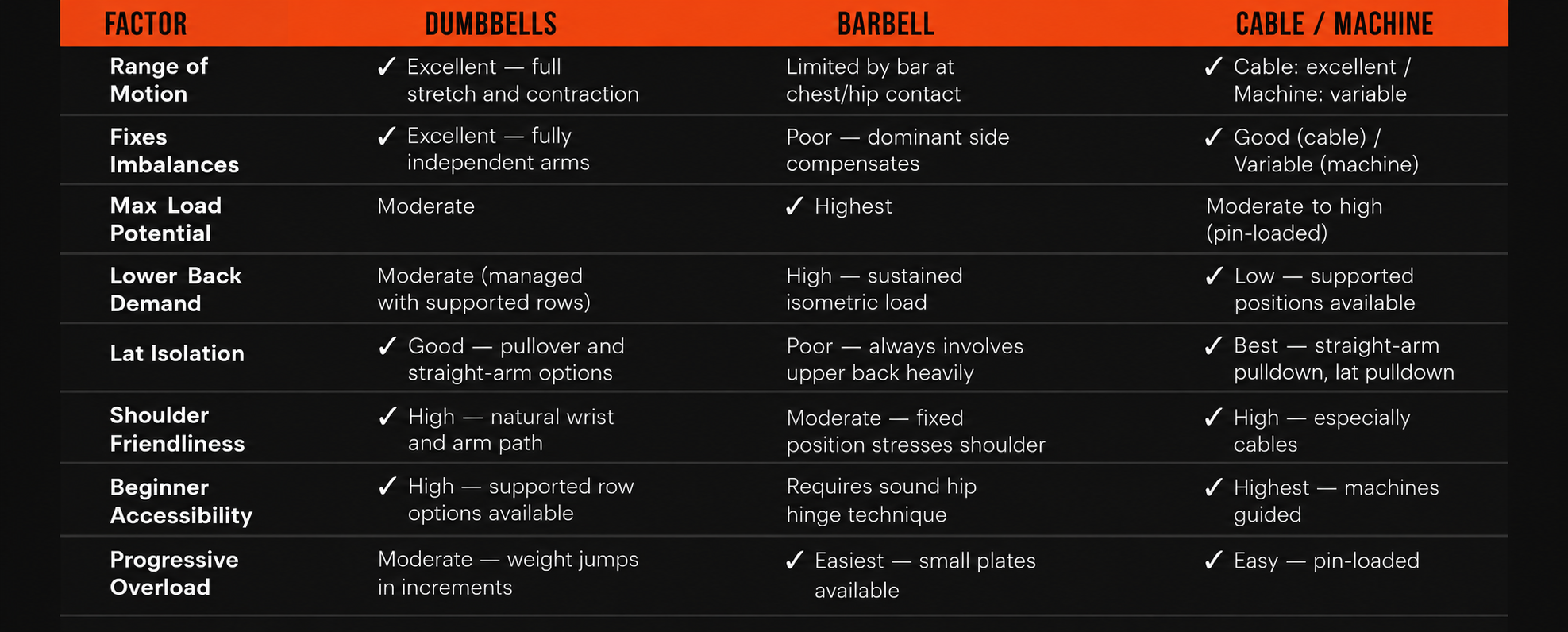
Dumbbell vs Barbell vs Cable — How They Compare for Back
Use straps on heavy rows. Grip is almost always the limiting factor in dumbbell rowing before the back reaches failure. Wrist straps remove this bottleneck and ensure the back — not the hands — determines when each set ends. Use them without hesitation.
Squeeze at the top, stretch at the bottom. These are the two positions where back training either works or doesn't. A full second of peak contraction at the top; complete arm extension and shoulder protraction at the bottom. Make both positions deliberate, not incidental.
Don't skip the pullover. Most lifters' back programmes consist entirely of rows. Adding one lat extension movement per session — pullover or straight-arm variation — trains the portion of the lat that rowing cannot reach and is responsible for the lower lat width that creates the V-taper.
Start with the heaviest compound movement. Programme your single-arm dumbbell row or heavy compound pull first in the session while you're freshest. Isolation work — rear delt flies, face pulls, straight-arm pulldowns — goes at the end. This order maintains performance on the movements that drive the most muscle growth.
The Bottom Line
A complete dumbbell back session covers rows for thickness, pullovers for width, and isolation work for the rear delts and traps. Train the full range, drive with your elbows, and squeeze at the top — your back will respond.