
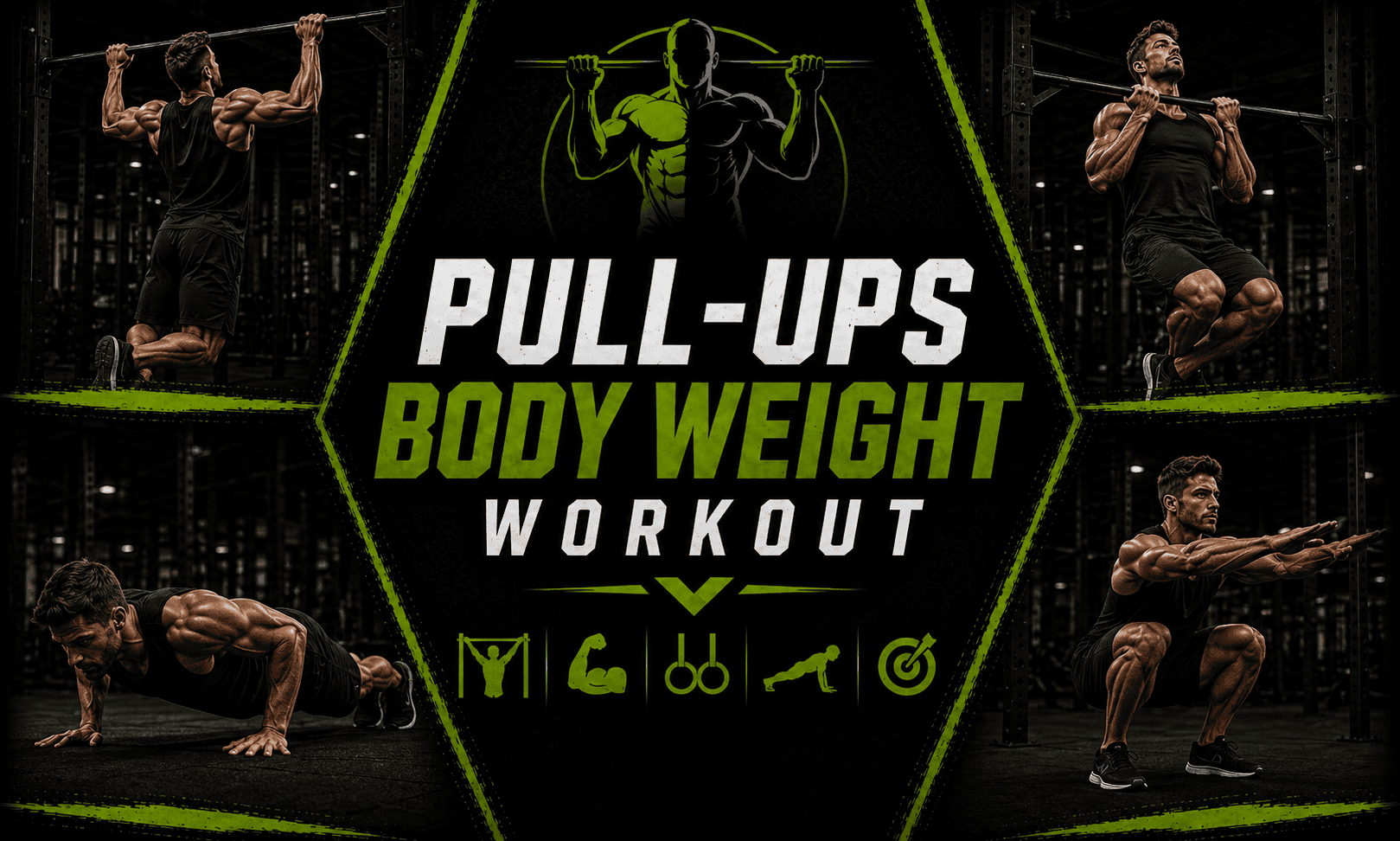
Build Strength, Muscle & Athleticism with Minimal Equipment
Pull-ups, chin-ups and bodyweight training are some of the most effective ways to build upper-body strength, muscle, control and athleticism using little to no equipment. Whether your goal is gaining muscle, improving fitness, increasing pull-up numbers or simply getting stronger at home, bodyweight training can be an incredibly powerful and sustainable approach.
Unlike traditional gym-only programs, bodyweight training develops not only strength and muscle, but also coordination, stability, mobility and relative strength — your ability to control your own body through space. Exercises like pull-ups, push-ups, dips and squats train multiple muscle groups together, creating a more athletic and functional physique.
One of the biggest advantages of bodyweight training is accessibility.
Why Pull-Ups & Chin-Ups Are So Effective
Pull-ups and chin-ups are often considered two of the best upper-body exercises a person can learn. They require minimal equipment, can be performed almost anywhere and build a combination of strength, muscle, athleticism and body control that few exercises can match.
Unlike many machine-based exercises that isolate a single muscle group, pull-ups and chin-ups train the body as a complete system. Your back, arms, shoulders, grip and core all work together to move your entire body through space. This creates a level of functional strength and coordination that transfers well to sports, everyday life and overall fitness.
For many people, performing their first proper pull-up is a major milestone in strength training because it demonstrates real relative strength — the ability to control and move your own bodyweight.
They Build an Impressive Back
One of the biggest reasons pull-ups and chin-ups are so effective is their ability to develop the back muscles.
They heavily train: lats, upperback, rhomboids, reardelts, traps, teres muscles, biceps, forearms, grip, core, shoulders, scapular stabilisers
The lats especially are responsible for creating the wide “V-taper” look many people want. Developing stronger lats not only improves appearance but also improves posture and shoulder stability.
Very few exercises stretch and contract the lats through such a large range of motion as pull-ups.
Why Everyone Should Learn Pull-Ups
Even if your main goal is:
Muscle building
Fat loss
Athletic performance
General fitness
pull-ups provide enormous benefits.
They help develop:
Upper-body strength
Muscle mass
Athleticism
Coordination
Grip strength
Confidence
Functional movement ability
Few exercises offer so many benefits with such little equipment.
For that reason, pull-ups and chin-ups remain some of the most respected and effective exercises in strength training and bodyweight fitness.
Bodyweight Training Builds Real Functional Strength
Bodyweight exercises force the body to stabilize itself throughout the movement. Unlike many machines that lock you into a fixed position, bodyweight movements require coordination between muscles, joints and the core.
Relative strength means how strong you are compared to your bodyweight.
This is one of the biggest advantages of bodyweight training. A person may be able to lift heavy weights in the gym, but still struggle to perform quality pull-ups, dips or push-ups because they lack body control and relative strength.
Improving relative strength helps:
Athletic performance
Speed and explosiveness
Body control
Coordination
Overall movement quality
This is why many athletes incorporate bodyweight exercises even while lifting weights.
Daily Full Body Pull-Ups, Chin-Ups & Bodyweight Workout Routine
Everyone should move and exercise regularly — even with no equipment at all.
A short workout done regularly is far better than doing nothing because you do not have access to a gym or equipment.
Bodyweight training is simple, effective and can be done anywhere:
At home
Outdoors
While traveling
In small spaces
In just 15–20 minutes per day
Detailed Daily Workout Program
Monday
Upper Power: Build raw pulling & pushing strength
Rest 45-60 between sets.
1. Jumping Jacks. Stand with feet together, arms at sides. Jump feet out wide while raising arms overhead. Return to start. Keep a steady rhythm — this is prep, not a sprint. (2 minutes continuous)
2. Pull-Ups. Grab bar shoulder-width, palms facing away. Hang fully, then drive elbows down and back to bring chin above bar. Lower slowly (3 sec down). Don't swing or kip. (4 sets × max reps)
3. Push-Ups. Hands slightly wider than shoulders, body straight from head to heels. Lower chest to 1 inch from floor, elbows at ~45° angle. Press back up explosively. (4 sets × 15 reps)
4. Inverted Rows. Set bar low (waist height). Hang underneath with straight body, heels on floor. Pull chest to bar squeezing shoulder blades together. Lower with control. The more horizontal your body, the harder it is. No low bar? Use a sturdy table edge or two chairs with a broomstick. (3 sets × 12 reps)
5. Diamond Push-Ups. Form a diamond shape with thumbs and index fingers touching. Elbows should flare back (not out). Lower nose toward hands. Press back up. Keep body rigid. These are tough! Reduce reps before reducing form. 6 good reps beats 10 sloppy ones. (3 sets × 10 reps)
6. Burpees. Stand → squat, hands to floor → jump feet back to plank → do a push-up → jump feet to hands → explode up with arms overhead. That's one rep. Move fast but controlled. (3 sets × 10 reps)
7. Dead Hang Stretch. Grip bar with both hands, let your body hang completely relaxed. Breathe deeply, let gravity do the work. Let your shoulders rise up toward your ears. (30–45 seconds)
Tuesday
Core Inferno. Forge an iron midsection.
Rest 30-45 between sets.
1. High Knees. Run in place driving knees up to hip height. Pump arms in opposition. Land softly on balls of feet. Keep core braced throughout. Start slow the first 30 seconds, then build to full speed. (2 minutes continuous)
2. Plank. Forearms on floor, elbows under shoulders. Body forms a straight line. Squeeze glutes, brace abs like you're about to take a punch. Breathe steadily. Don't let hips rise or sink. (3 sets × 45 seconds)
3. Hanging Knee Raises. Hang from bar. Brace core, then slowly pull knees up toward chest. Pause 1 second at top. Lower slowly — don't let legs just drop. Avoid swinging. (4 sets × 12 reps)
4. Mountain Climbers. Start in push-up position. Drive one knee toward chest while keeping other leg extended. Rapidly alternate legs — like running horizontally. Hips stay level, don't bounce them up. (3 sets × 30 seconds)
5. Hollow Body Hold. Lie on back. Press lower back INTO floor — this is crucial. Raise shoulders and legs off floor, arms overhead. Body forms a slight banana shape. Hold. If back arches off floor, raise legs higher. (3 sets × 30 seconds)
6. V-Ups. Lie flat, arms overhead, legs straight. Simultaneously raise arms and legs to meet in the middle, forming a V shape. Touch toes if possible. Lower with control — don't crash down. (3 sets × 12 reps)
7. Child’s Pose. Kneel, sit back on heels, extend arms forward on floor. Let forehead rest on ground. Breathe into your back — feel your ribcage expand. Melt into the stretch. (60 seconds)
Wednsday
Leg Destroyer. Build powerful legs with zero equipment.
Rest 40-55 between sets.
1. Leg Destroyer. Hold bar or wall for balance. Swing one leg forward and back (sagittal), then side to side (frontal). Keep swinging leg straight. Gradually increase range of motion.(2 minutes — 20 swings each direction each leg)
2. Jump Squats. Feet shoulder-width. Squat to 90°, then explode upward jumping off both feet. Land softly with bent knees — absorb the impact. Go straight into next rep. (4 sets × 15 reps)
3. Bulgarian Split Squat. Rear foot elevated on chair/bed at knee height. Step front foot far enough forward that your knee stays over toes. Lower back knee toward floor. Drive up through front heel. Keep torso upright. (3 sets × 12 reps each leg)
4. Glute Bridges. Lie on back, knees bent, feet flat near glutes. Drive hips up by squeezing glutes hard at top. Hold 1 second. Lower slowly. Don't hyperextend your lower back at the top. (3 sets × 20 reps)
5. Lateral Lunges. Stand wide. Shift weight to one side, bending that knee while keeping other leg straight. Hips go back and down (like sitting into one side). Push off bent leg to return. Keep chest up. (3 sets × 10 reps each side)
6. Tuck Jumps. Jump straight up and pull both knees to chest at peak height. Land softly with bent knees. Reset feet fully before next rep — don't rush. Quality over speed. (3 sets × 8 reps)
7. Hamstring Stretch. Sit on floor, one leg straight. Reach toward toes without rounding spine. Hinge at hips — not waist. Feel stretch in back of thigh, not lower back. Hold steady, breathe. (45 sec each leg)
Thursday
HIIT Chaos. Tabata-style intervals — max intensity
Rest 20-55 between sets.
1. Arm Circles + March. March in place with high knees while making large arm circles — forward for 30 sec, backward for 30 sec. Then cross arms over chest repeatedly. Gets shoulders and hips ready. (2 minutes)
2. Burpees. Max reps in 40 seconds. Stand → squat → plank → push-up → jump back to squat → jump up. Keep count of your reps each round and try to match or beat it next round. (40 sec ON / 20 sec OFF — repeat in circuit)
3. Pull-Ups. Max reps in 40 seconds. Use full range of motion — dead hang to chin over bar. If you run out of reps, hang and do negatives or just hold a dead hang. (40 sec ON / 20 sec OFF — repeat in circuit)
4. Jump Squats. Squat to parallel or below, then jump as high as possible. Land with control. Maintain depth — don't turn these into half-squats when tired. (40 sec ON / 20 sec OFF — repeat in circuit)
5. Push-Ups. Max reps with full range. When you can no longer do full push-ups, drop to knees but keep going. Never stop and just rest in the up position. (40 sec ON / 20 sec OFF — repeat in circuit)
6. Mountain Climbers. Plank position, drive alternating knees to chest as fast as possible while keeping hips level. Breathe rhythmically — exhale with each knee drive. (40 sec ON / 20 sec OFF — repeat in circuit)
7. Deep Breathing. Lie flat on back. Inhale for 4 counts, hold 2, exhale for 6 counts. Feel your heart rate dropping with each breath. Let your whole body go heavy and relaxed. (2 minutes)
Friday
Pull & Back. Sculpt your back & build pull strength
Rest 50-60 between sets.
1. Shoulder Rolls + Light Jog. Jog lightly in place while rolling shoulders forward 10 times, then backward 10 times. Then do arm crossovers — reach one arm across chest and pull with other arm. (2 minutes)
2. Wide-Grip Pull-Ups. Grip bar wider than shoulders, palms facing away. This changes the angle to hit outer lats more. Pull elbows straight down. At top, chest should nearly touch bar. Lower fully. (4 sets × max reps)
3. Chin-Ups. Hands shoulder-width, palms facing YOU. This supinated grip allows biceps to fully contribute. Pull chest to bar, squeeze biceps hard at top. Chin fully over bar each rep. (3 sets × max reps)
4. Commando Pull-Ups.Grip bar with hands close together, one in front of other (like holding a sword). Pull up to one side so your head goes to the right of your hands, lower, then pull up to the left side. Alternate each rep. (3 sets × 8 reps each side)
5. Pike Push-Ups. Start in push-up position, then walk feet toward hands until body forms an inverted V (hips high). Bend elbows to lower head toward floor between hands. Press back up. This mimics a shoulder press. (3 sets × 12 reps)
6. Burpee Pull-Ups. Do a burpee under the bar. At the top of your jump, grab the bar and immediately do a pull-up. Lower, drop to floor, repeat. This is an elite movement — each rep is a full body effort. (3 sets × 12 reps)
7. Dead Hang Finish. Hang completely relaxed from bar. Let everything decompress. Breathe slowly. After a heavy pull session this is essential for shoulder joint health and spinal alignment. (3 × 30 seconds)
Saturday
Full Body Burn. Everything, everywhere — in 20 minutes
Rest 60 between sets.
1. Dynamic Stretches. Inchworms (stand, reach to floor, walk hands to plank, walk feet back up), world's greatest stretch (lunge with thoracic rotation), 10 air squats. Flow from one to next. (2 minutes)
2. Pull-Ups. Standard pull-ups. After a full week your grip and lats may be fatigued — that's fine. Hit your max and move on. Vary grip if one style feels beat up. (3 sets × max reps)
3. Push-Ups. Full push-ups with a 2-second pause at the bottom (chest touching floor). This removes elastic energy and forces true strength. Harder than it sounds. (3 sets × 15 reps)
4. Squat Jumps. Deep squat (below parallel if mobile enough), then explosive jump. Land soft, absorb with bent knees, straight into next squat. Think of it as one continuous loaded spring movement. (3 sets × 12 reps)
5. Hanging Leg Raises. Hang from bar, legs straight. Raise legs to 90° (parallel to floor) or higher. The key: don't just raise legs — tilt your pelvis back (posterior pelvic tilt) to actually work lower abs. Lower slowly. (3 sets × 10 reps)
6. Plank-to-Push-Up. Start in forearm plank. Press up to push-up position one arm at a time (right hand, left hand). Lower back to forearms one arm at a time. Alternate which arm leads each rep. Hips stay completely level. (3 sets × 10 reps)
7. Sprint in Place. Go absolutely maximum effort — fastest possible leg turnover, arms pumping hard. 20 seconds 100% then 20 seconds complete rest. This is a sprint, not a jog. (3 × 20 seconds all-out)
Sunday
Active Recovery. Rest is where you actually get stronger
1. Slow Walk or Light March. Walk slowly around your space, or march gently in place. Swing arms loosely. The goal is to gently increase blood flow to sore muscles without stressing them. (5 minutes)
2. Cat-Cow Stretch. On hands and knees. Inhale: arch back, lift head and tailbone (cow). Exhale: round spine to ceiling, tuck chin and tailbone (cat). Move slowly and with breath. Find tight spots and pause there. (2 minutes continuous)
3. Hip Flexor Stretch. Kneel on one knee (like proposing). Push hips forward until you feel a stretch at the front of the back hip. Keep torso tall. For more depth, raise the arm on the kneeling side overhead and lean slightly away. (2 minutes each side)
4. Dead Hang. Simply hang. Let everything go. Breathe into your back and ribcage. Feel your vertebrae separate and your shoulders relax. This is passive — don't engage anything. (3 × 30 seconds)
5. Shoulder Cross Stretch. Pull one straight arm across chest with the other arm. Hold just above the elbow (not the joint). Keep shoulder down — don't shrug. You'll feel it in the back of the shoulder. (90 seconds each arm)
6. Spinal Twist. Lie on back. Pull one knee across body to floor on opposite side, arms spread wide. Look away from the knee. Let gravity do the twisting — don't force it. Breathe into the stretch. (90 seconds each side)
7. Deep Belly Breathing. Lie flat, one hand on belly one on chest. Inhale for 5 counts expanding belly (not chest). Hold 2. Exhale for 7 counts completely. The belly hand should rise, chest hand stays still. (2 minutes)