
Repeat the basics. Record your progress.
5×5 Workout Program at Home
A clear strength routine built around five sets of five repetitions. Alternate two workouts across three training days, using dumbbells, bands, and bodyweight equipment.
This home-gym adaptation keeps your exercise list focused and your next session easy to plan. Start with manageable loads, practice controlled repetitions, and build gradually.
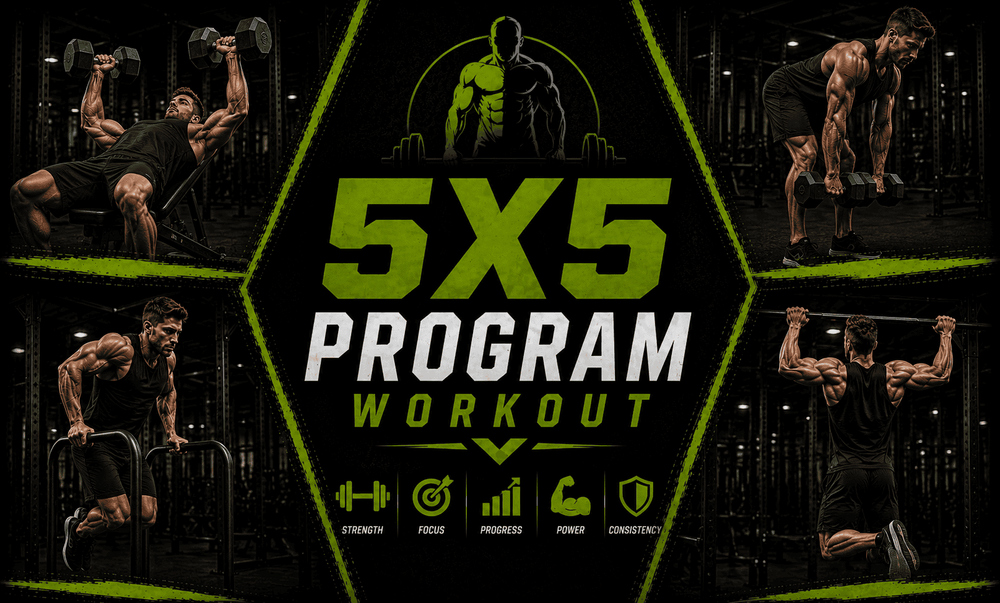
Understand the format
What does 5×5 mean?
Complete five working sets of five repetitions for an exercise, resting between sets. That is 25 working repetitions in total. Warm-up sets come first and do not count toward the five working sets.
5×5 describes a sets-and-reps structure, not one universal program. The routine below is HomeGymDaily’s adaptation for home equipment; it is not the official StrongLifts or Starting Strength program. Accessories use higher repetitions, and core work is optional.
Your training week
Alternate A and B. Leave a day between.
Monday, Wednesday, and Friday are an example. Any three nonconsecutive days can work. Continue the sequence across weeks instead of restarting with A every Monday.
Week 1
Week 2
Use the days between sessions for recovery or comfortable light activity. If you miss a workout, continue with the next letter at your next suitable session; do not double up.
Check your equipment and starting load
Dumbbells & bench
A pair of dumbbells with manageable weight increments, clear floor space, and a stable weight bench for the bench press.
No bench? Use a dumbbell floor press with a controlled setup. Its range differs from a bench press, so log it as a separate exercise.
Bar, bands & supports
A securely installed pull-up bar, purpose-made dip station, long resistance bands, and compatible rated anchors.
Inspect bands before use and follow equipment instructions. Avoid improvised supports and loose weights held between your feet.
A repeatable starting point
Choose a load you can control through every set. Aim to finish with roughly 1–2 good repetitions still possible, rather than forcing a final rep.
Begin lighter if you are unsure. Your starting weight is a practice decision, not a test of your maximum.
The sessions
Two workouts. A clear purpose.
Warm up with easy movement, then progressively heavier practice sets for the main lifts. Rest around 2–3 minutes between main working sets, taking longer when needed to repeat the movement with control. Use roughly 60–120 seconds for accessories as a starting point.
Workout A
Squat · Press · Pull
Lower-body work, horizontal pressing, and a vertical pull.
Hold the dumbbell close, keep your feet stable, and use a depth you can control. Stop increasing load if holding the weight becomes the limiting factor.
Use a stable bench and a weight you can position and lower safely. Without a bench, choose the floor-press alternative.
Use a controlled, repeatable range. Choose appropriate assistance if five clean repetitions are not yet manageable; do not force five failing sets.
Use a rated anchor and light enough resistance to keep the movement steady. Check band condition and anchoring before every session.
Choose a duration you can hold without losing position. End the set when control changes.
Workout B
Hinge · Press · Row
A hip hinge, overhead pressing, dips, and a supporting row.
Keep the weights close and move your hips back with soft knees. Lower only as far as you can maintain a controlled torso position.
Brace your trunk and press without leaning back to finish the repetition. Make sure there is enough overhead clearance.
Use a stable dip station and a comfortable range. Dips are optional for those without the equipment or ability: use an appropriate push-up variation instead and record the change.
Use a secure anchor or an underfoot setup designed for your band. Keep your torso steady and control the return.
Use a secure bar and avoid swinging. Choose floor-based core work if hanging is not suitable.
Adapt the setup without losing the plan
No pull-up bar?
Use a suitable dumbbell row as a practical pulling alternative. It changes the movement pattern, so keep the replacement consistent and track its load separately.
No dip station?
Choose a push-up variation that matches your ability. Use controlled repetitions with some effort in reserve; five reps should not force an awkward or overly difficult setup.
Only light weights?
Five reps may not provide much challenge. A routine with higher repetition ranges may fit your equipment better. Explore our dumbbell workout plans.
Make progress you can measure
Earn the next increase
01 · Record
Log each session
Write down the exercise, weight per dumbbell, repetitions in every set, and any assistance. Keep your technique and setup consistent.
02 · Repeat
Complete controlled sets
Keep the same weight until all five sets of five are manageable with good control. You do not need to add weight at every workout.
03 · Increase
Use the smallest step
Try the smallest available weight increase. If it is too large to keep your technique, return to the previous load or use equipment with smaller increments.
If you miss repetitions: stop before technique breaks down, record the result, and repeat the load next time. If the same weight repeatedly feels unmanageable, reduce it and review your rest, exercise setup, and total workload.
For bands and bodyweight movements: build control first, then gradually reduce assistance or adjust resistance. Use purpose-made loading equipment only when you can manage the unweighted movement safely.
5×5 is one option, not a requirement for progress. ACSM’s resistance-training guidance emphasizes consistent participation and tailoring training to the individual. The sample routine here is not an ACSM-prescribed program.
5×5 workout questions
Is this a beginner workout?
It can suit someone who has learned the movements and can manage the workload. A complete beginner may need fewer sets, easier variations, or coaching first. Five full sets of pull-ups and dips are not an entry requirement.
Can I follow it without a bench?
Yes, use the floor-press substitution for the dumbbell bench press. The other exercises still need the equipment or alternatives described above. A bench-free version is not automatically equipment-free.
Should every exercise use five sets of five?
No. The main lifts use that target structure; band accessories use higher repetition ranges, and core work is optional. Warm-up sets are additional, lighter practice sets.
How long should I follow the program?
Use your log, technique, recovery, and enjoyment to assess whether it still fits. There is no fixed deadline or guaranteed transformation. Adjust the plan if equipment limits or recovery repeatedly prevent manageable sessions.
Can I add other workouts?
Avoid stacking another complete strength program on top. Account for all the work you do during the week, and keep enough recovery between demanding sessions for the same muscles.
Is 5×5 the same as StrongLifts or Starting Strength?
No. Those are distinct named programs with their own exercise prescriptions. This page offers a home-equipment adaptation using a five-by-five structure for its main lifts.
Find the routine that fits
Keep your next session simple
Pick your training days, check your equipment, and record your first manageable session. Use the exercise library when you need help understanding a movement.
General fitness information, not an individualized training prescription. If a health condition or injury affects your exercise choices, seek qualified guidance. Read our fitness disclaimer.