
Standing Band Chest Press
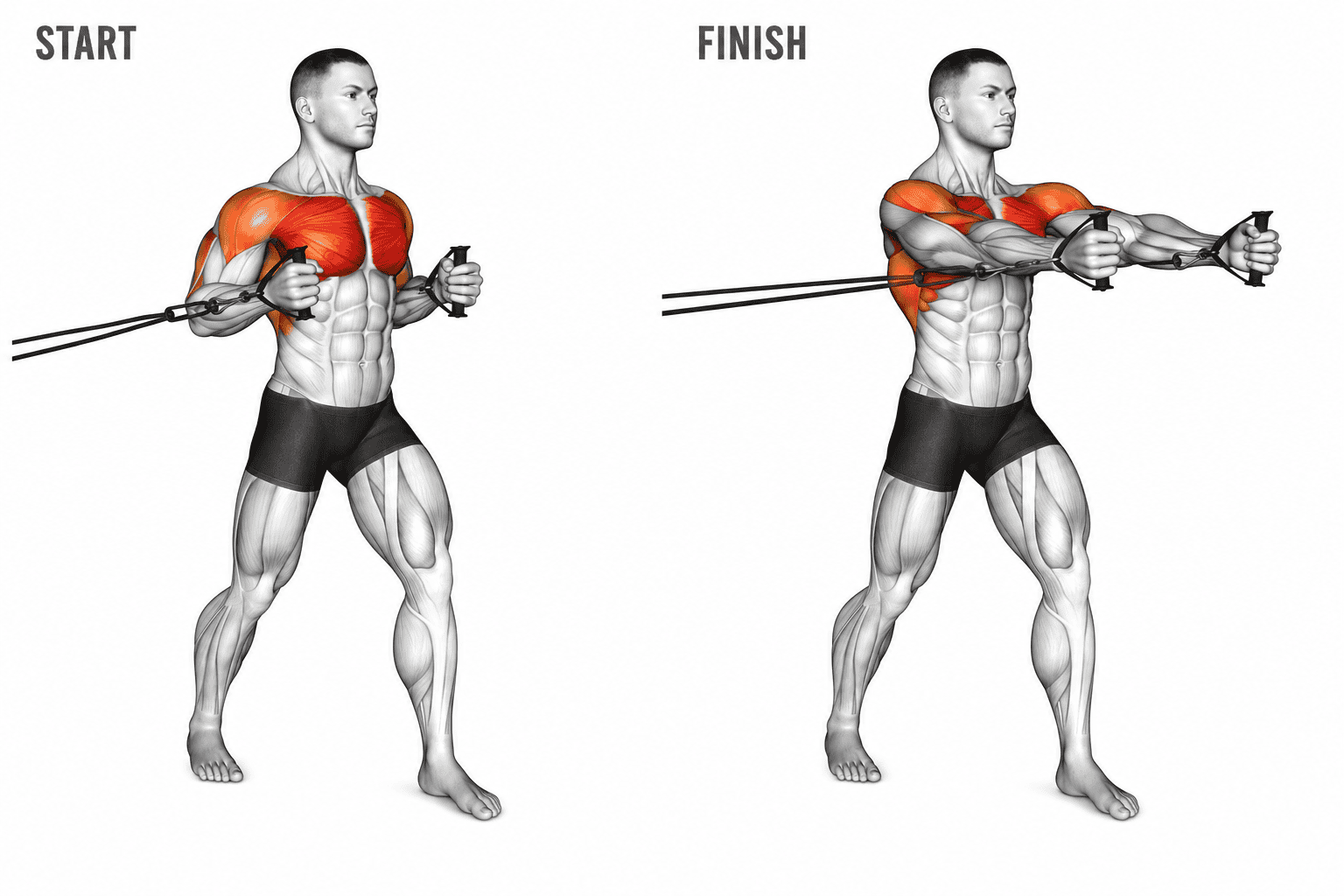
Exercise Description
The Standing Band Chest Press is a resistance-band exercise that mimics the movement pattern of a traditional bench press while being performed in a standing position. It targets the chest, shoulders, and triceps while also requiring significant core engagement to stabilize the body. This exercise is ideal for home workouts, warm-ups, rehabilitation programs, and strength training when free weights are unavailable.
Primary Muscles Worked
Pectoralis Major (Chest)
Secondary Muscles Worked
Anterior Deltoids (Front Shoulders)
Triceps Brachii
Serratus Anterior
Rectus Abdominis (Core)
Obliques
Rotator Cuff Muscles (Stabilizers)
Lower Back Muscles (Stabilization)
How to Perform Correctly
Setup
Secure a resistance band to a stable anchor point at chest height behind you.
Hold one handle in each hand and step forward until the band is under tension.
Position your feet in a staggered or shoulder-width stance for balance.
Bring your hands to chest level with elbows bent.
Engage your core and maintain an upright posture.
Retract your shoulder blades slightly and keep your chest lifted.
Movement
Press the handles forward until your arms are nearly straight.
Allow your hands to move slightly toward each other as you extend your arms.
Squeeze your chest at the end of the movement.
Slowly return to the starting position under control.
Maintain tension in the band throughout the exercise.
Repeat for the desired number of repetitions.
Common Mistakes to Avoid
Using Too Much Resistance
Excessive band tension can compromise form and reduce range of motion.
Leaning Forward Excessively
Maintain an upright torso instead of turning the exercise into a forward lean.
Allowing the Lower Back to Arch
Keep the core engaged to protect the spine and maintain proper posture.
Shrugging the Shoulders
Keep the shoulders down and away from the ears throughout the movement.
Locking the Elbows Aggressively
Extend the arms under control without forcefully snapping the elbows straight.
Letting the Band Pull the Arms Back
Control the return phase rather than allowing the resistance to dictate the movement.
Incomplete Range of Motion
Fully press forward and return to the starting position while maintaining tension.