
Side Plank
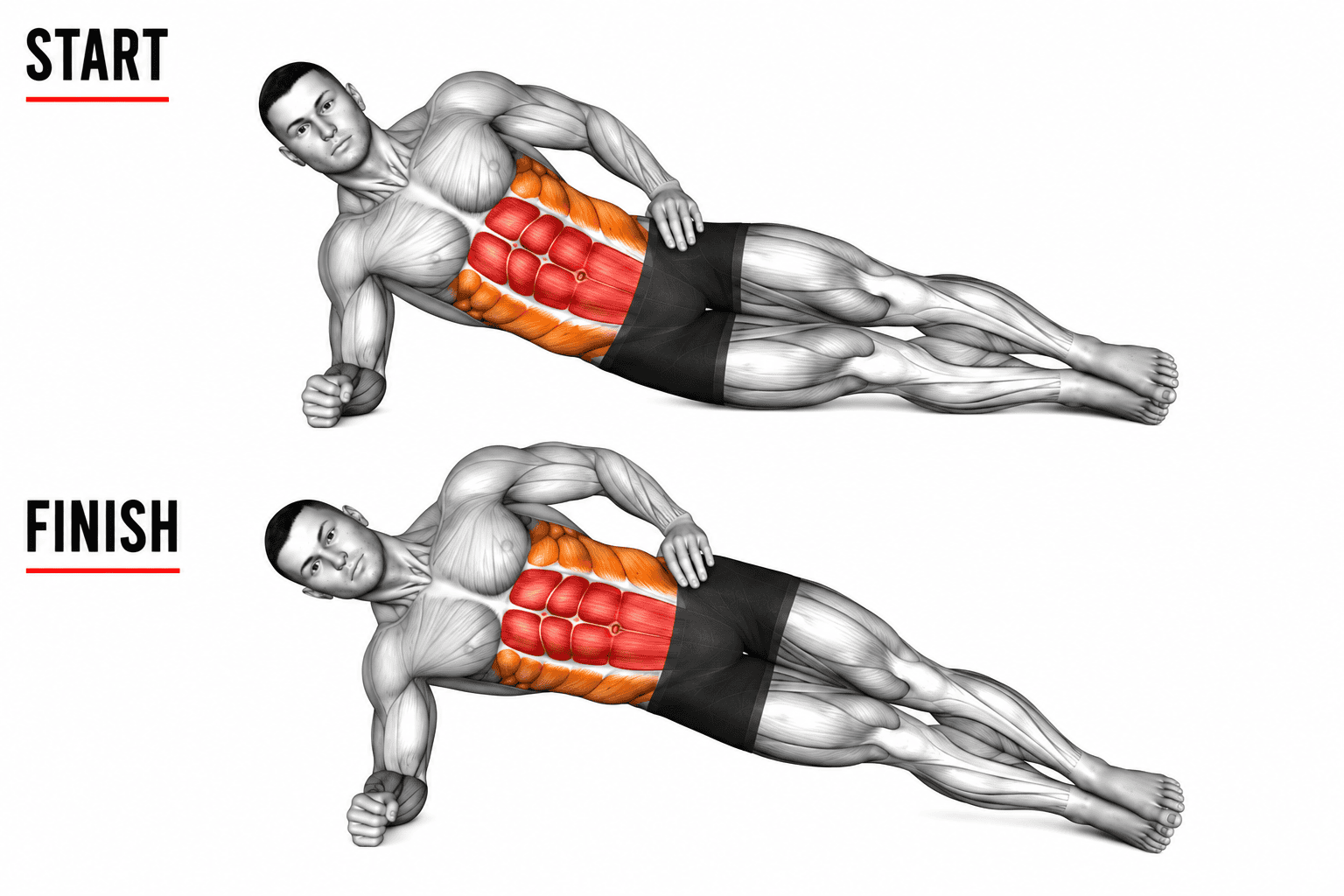
Exercise Description
The Side Plank is an isometric core exercise that primarily targets the obliques while also strengthening the muscles responsible for spinal stability, hip control, and shoulder stabilization. Unlike the traditional plank, which challenges the body from front to back, the side plank trains the core to resist lateral bending and rotation, making it highly effective for improving balance, posture, and functional core strength.
Primary Muscles Worked
External Obliques
Internal Obliques
Secondary Muscles Worked
Transverse Abdominis
Rectus Abdominis
Quadratus Lumborum
Gluteus Medius
Gluteus Maximus
Deltoids
Serratus Anterior
Hip Stabilizers
Erector Spinae
How to Perform Correctly
Setup
Lie on your side on an exercise mat.
Position your elbow directly beneath your shoulder.
Stack your feet on top of each other or place one foot in front of the other for additional stability.
Keep your body in a straight line from head to feet.
Engage your core and glutes before lifting.
Movement
Press your forearm into the floor and lift your hips off the ground.
Raise your body until it forms a straight line from your head to your heels.
Keep your shoulders stacked and your chest open.
Maintain tension through your core, glutes, and hips.
Hold the position for the prescribed amount of time.
Lower yourself under control and repeat on the opposite side.
Common Mistakes to Avoid
Allowing the Hips to Sag
Keep your hips elevated and maintain a straight body line.
Rotating the Torso Forward
Keep your shoulders stacked and your chest facing forward.
Shrugging the Supporting Shoulder
Keep your shoulder stable and away from your ear.
Holding the Breath
Continue breathing steadily throughout the hold.
Looking Down Excessively
Maintain a neutral head and neck position.
Raising the Hips Too High
Keep the body aligned rather than creating a bend at the waist.
Relaxing the Core
Maintain constant abdominal tension throughout the exercise.