
Hanging Leg Raise
Exercise Description
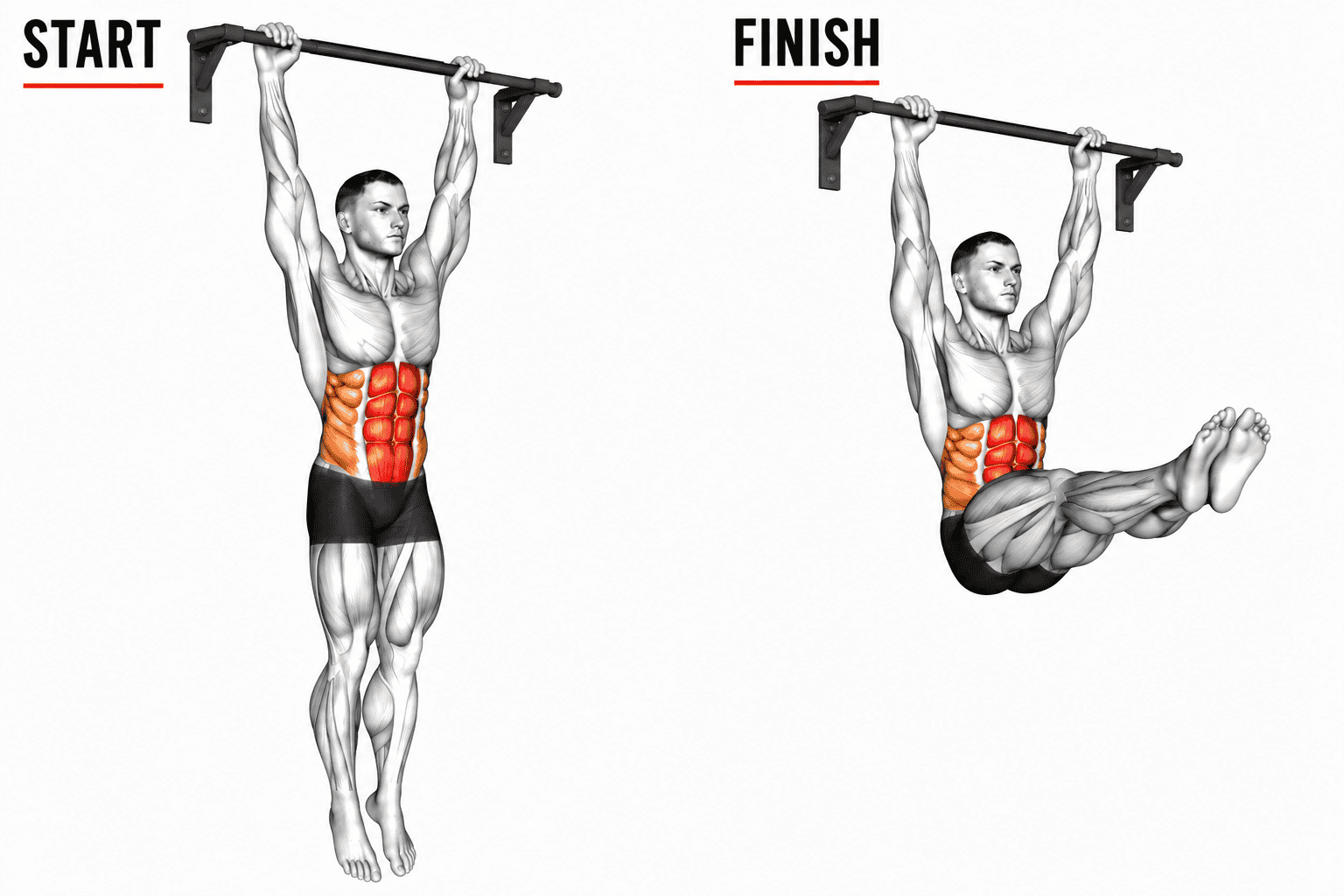
The Hanging Leg Raise is an advanced bodyweight core exercise that targets the abdominal muscles by lifting the legs while hanging from a pull-up bar. Compared to the Hanging Knee Raise, this variation increases the lever length by keeping the legs straight, significantly increasing the demand on the core. The exercise develops abdominal strength, hip flexor strength, grip endurance, and overall body control while improving core stability and athletic performance. The Hanging Leg Raise is often considered one of the most effective bodyweight exercises for building a strong, well-developed core.
Primary Muscles Worked
Rectus Abdominis
Hip Flexors
Secondary Muscles Worked
External Obliques
Internal Obliques
Transverse Abdominis
Serratus Anterior
Forearm Flexors (Grip Muscles)
Latissimus Dorsi (Stabilization)
Shoulder Stabilizers
Quadriceps (Leg Stabilization)
How to Perform Correctly
Setup
Hang from a pull-up bar using an overhand grip slightly wider than shoulder-width.
Fully extend your arms and allow your body to hang naturally.
Engage your shoulders by pulling them slightly down and back.
Tighten your core and keep your legs straight and together.
Minimize swinging before beginning the movement.
Movement
Contract your abdominal muscles and raise your legs upward while keeping them straight.
Lift your legs until they are at least parallel to the floor or higher if mobility and strength allow.
Focus on curling your pelvis upward at the top of the movement for maximum abdominal activation.
Pause briefly at the top position.
Slowly lower your legs back to the starting position under control.
Eliminate any excessive swinging before beginning the next repetition.
Repeat for the desired number of repetitions.
Common Mistakes to Avoid
Using Momentum
Avoid swinging the legs to generate upward movement.
Bending the Knees Excessively
Keep the legs as straight as possible throughout the exercise.
Dropping the Legs Quickly
Control the lowering phase to maintain core tension.
Relying Primarily on the Hip Flexors
Focus on lifting through the abdominals and curling the pelvis upward.
Shrugging the Shoulders
Keep the shoulders stable and actively engaged.
Arching the Lower Back
Maintain core tension throughout the movement.
Performing Partial Repetitions
Use a full range of motion while maintaining proper control.