
Floor Barbell Press
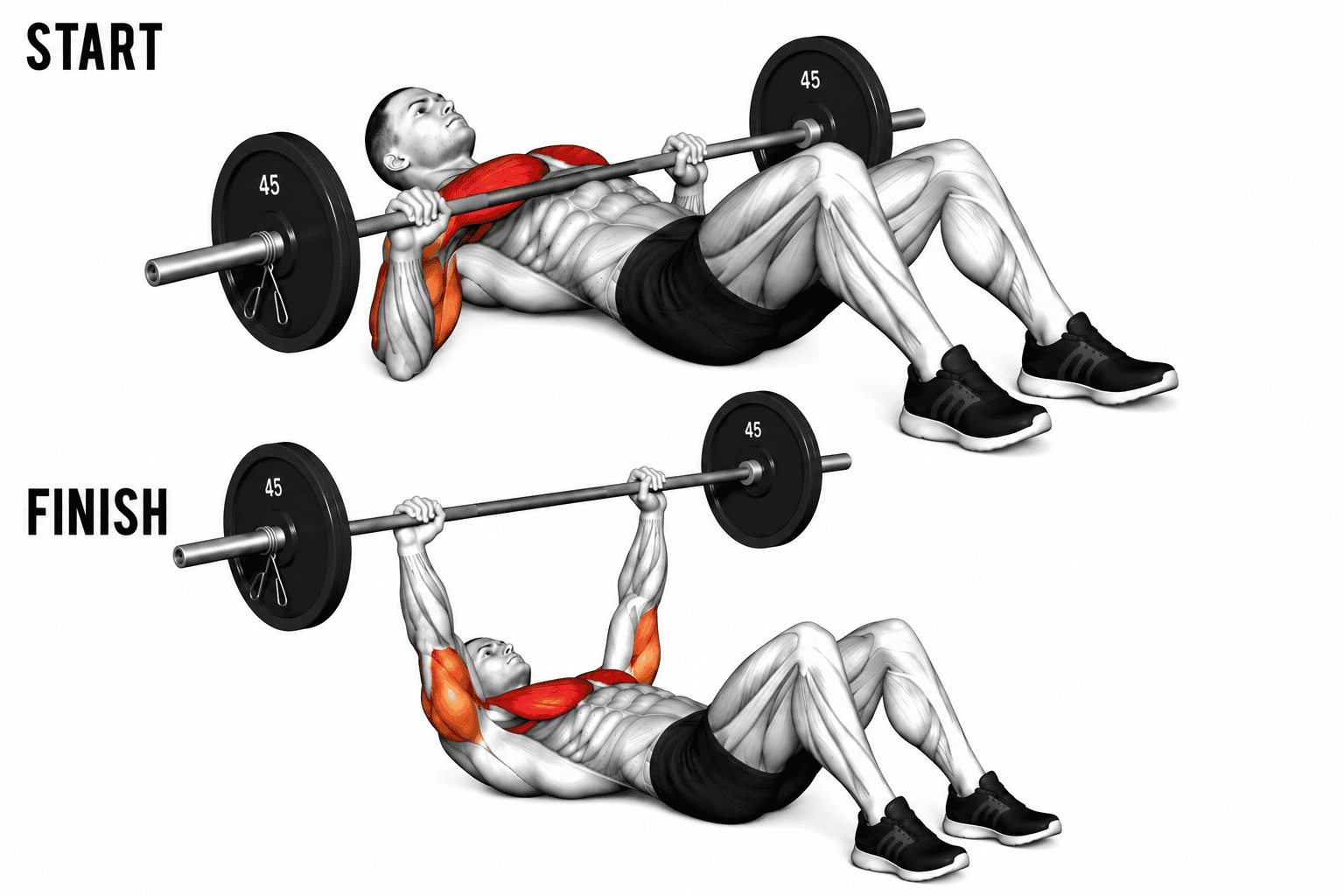
Exercise Description
The Floor Barbell Press is a compound upper-body exercise performed while lying on the floor instead of a bench. The floor limits the range of motion by preventing the elbows from traveling below the torso, reducing stress on the shoulders while still effectively developing chest, triceps, and pressing strength. It is commonly used by strength athletes to improve lockout power and pressing mechanics.
Primary Muscles Worked
Pectoralis Major (Chest)
Triceps Brachii
Secondary Muscles Worked
Anterior Deltoids (Front Shoulders)
Serratus Anterior
Rotator Cuff Muscles (Stabilizers)
Upper Back Muscles (Stabilization)
How to Perform Correctly
Setup
Place a loaded barbell in a power rack with the bar positioned low enough to be unracked while lying on the floor.
Lie flat on your back underneath the barbell.
Bend your knees and place your feet flat on the floor for stability.
Grip the bar slightly wider than shoulder-width apart.
Retract your shoulder blades and keep your chest elevated as much as possible.
Unrack the bar and position it directly above your chest with straight arms.
Movement
Lower the barbell slowly toward your chest.
Continue lowering until your upper arms lightly touch the floor.
Pause briefly while maintaining tension.
Press the barbell upward until your arms are nearly straight.
Repeat for the desired number of repetitions.
Carefully return the bar to the rack after completing the set.
Common Mistakes to Avoid
Bouncing the Elbows Off the Floor
Allowing the elbows to strike the floor forcefully can increase joint stress and reduce muscle tension.
Relaxing at the Bottom
Maintain upper-body tension when your arms contact the floor rather than completely resting.
Flaring the Elbows Excessively
Elbows positioned too far from the body can place unnecessary stress on the shoulders.
Using Excessive Weight
Heavy loads may compromise technique and bar control.
Allowing the Wrists to Bend Backward
Keep wrists neutral and aligned with the forearms throughout the movement.
Losing Shoulder Blade Position
Keep the shoulder blades retracted and stable during each repetition.
Incomplete Lockout
Fully extend the elbows under control to maximize triceps engagement and strength development.