
Farmers Carry
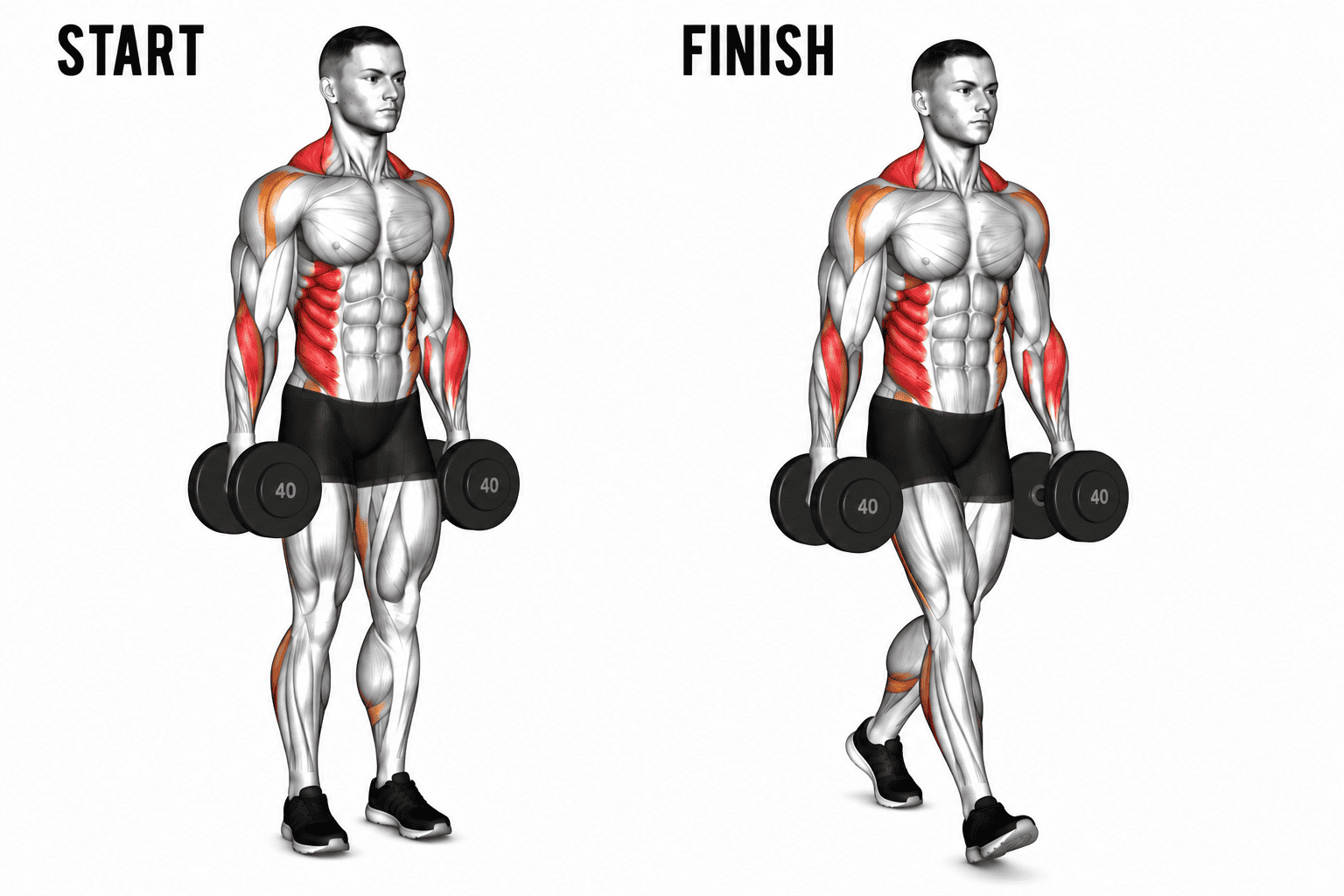
Exercise Description
The Farmer’s Carry is a functional full-body exercise that involves walking while holding heavy weights at your sides. Although it appears simple, it is one of the most effective exercises for developing grip strength, core stability, posture, and overall muscular endurance. The Farmer’s Carry challenges multiple muscle groups simultaneously and closely mimics real-world tasks such as carrying heavy objects, making it highly valuable for both athletic performance and everyday strength.
Primary Muscles Worked
Forearm Flexors (Grip Muscles)
Upper Trapezius
Secondary Muscles Worked
Core Muscles (Rectus Abdominis, Obliques, Transverse Abdominis)
Erector Spinae
Deltoids (Shoulder Stabilizers)
Gluteus Maximus
Quadriceps
Hamstrings
Calves
Lats (Latissimus Dorsi)
Rhomboids
Forearm Extensors
How to Perform Correctly
Setup
Place two dumbbells, kettlebells, or farmer’s carry handles on the floor beside you.
Stand between the weights with your feet approximately hip-width apart.
Hinge at the hips and bend your knees to grasp the weights.
Lift the weights using proper deadlift mechanics.
Stand tall with your chest lifted and shoulders pulled back.
Engage your core and maintain a neutral spine.
Movement
Walk forward using controlled and deliberate steps.
Keep your arms fully extended and the weights close to your sides.
Maintain an upright posture throughout the carry.
Keep your shoulders level and avoid leaning to either side.
Continue walking for the prescribed distance or time.
When finished, lower the weights to the floor using proper lifting technique.
Common Mistakes to Avoid
Rounding the Shoulders
Keep your chest up and shoulders pulled back throughout the carry.
Leaning Side to Side
Maintain a balanced posture and avoid shifting your body weight.
Taking Steps That Are Too Large
Use controlled, natural strides to maintain stability.
Looking Down Constantly
Keep your head neutral and your eyes focused forward.
Using Excessive Weight
Heavy loads that compromise posture reduce effectiveness and increase injury risk.
Rushing the Movement
Focus on maintaining proper posture rather than walking quickly.
Dropping the Weights Improperly
Lower the weights under control using proper lifting mechanics.