
Dumbbell Lateral Lunge
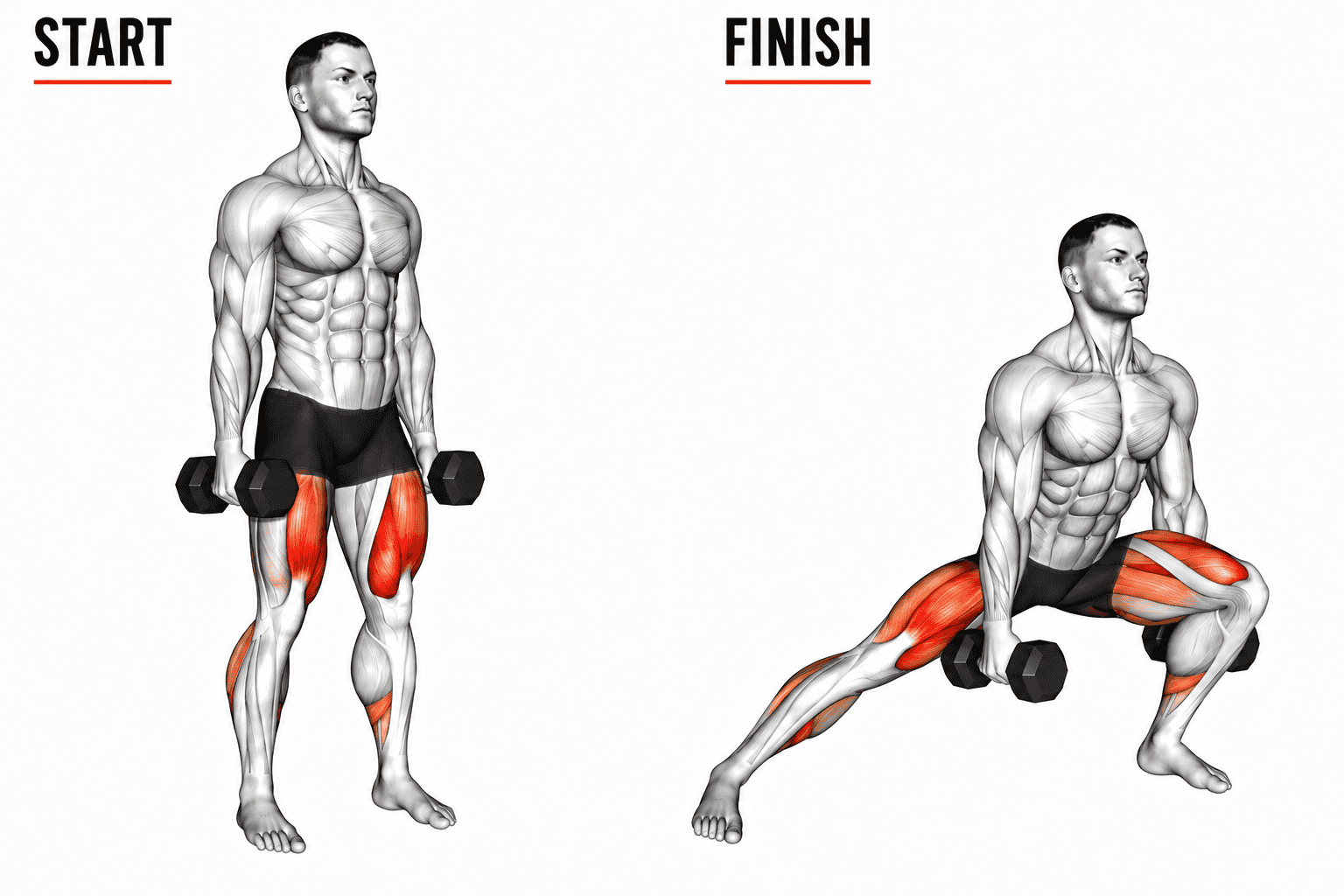
Exercise Description
The Dumbbell Lateral Lunge is a unilateral lower-body exercise that strengthens the legs, glutes, and inner thighs while improving balance, mobility, and lateral movement ability. Unlike traditional forward or reverse lunges, the lateral lunge challenges the body in the frontal plane by stepping to the side. This movement helps develop lower-body strength, hip stability, and athletic performance while targeting muscles that are often undertrained in straight-ahead exercises.
Primary Muscles Worked
Quadriceps
Gluteus Maximus
Adductors (Inner Thighs)
Secondary Muscles Worked
Gluteus Medius
Hamstrings
Calves (Gastrocnemius and Soleus)
Hip Stabilizers
Rectus Abdominis
Obliques
Erector Spinae
Forearm Muscles (Grip Stabilization)
How to Perform Correctly
Setup
Stand upright holding a dumbbell in each hand at your sides.
Position your feet hip-width apart.
Lift your chest and pull your shoulders back.
Engage your core and maintain a neutral spine.
Keep your head and neck in a natural position.
Movement
Take a large step to the side with one leg.
Shift your hips backward as you bend the stepping knee.
Keep the non-working leg straight while maintaining both feet flat on the floor.
Lower until the working thigh is approximately parallel to the floor or as low as your mobility allows.
Keep your chest lifted and your weight centered over the working leg.
Push through the heel of the bent leg to return to the starting position.
Repeat all repetitions on one side or alternate sides as desired.
Common Mistakes to Avoid
Allowing the Knee to Collapse Inward
Keep the working knee aligned with the toes throughout the movement.
Leaning Excessively Forward
Maintain a proud chest and neutral spine.
Taking Too Small of a Step
A short step reduces range of motion and limits muscle activation.
Lifting the Heel of the Working Foot
Keep the entire foot in contact with the floor for stability and force production.
Rounding the Back
Maintain a neutral spine throughout the exercise.
Using Excessive Weight
Heavy dumbbells can compromise balance and proper movement mechanics.
Rushing the Repetitions
Move slowly and under control to maximize stability and muscle engagement.