
Diamond Push-Up
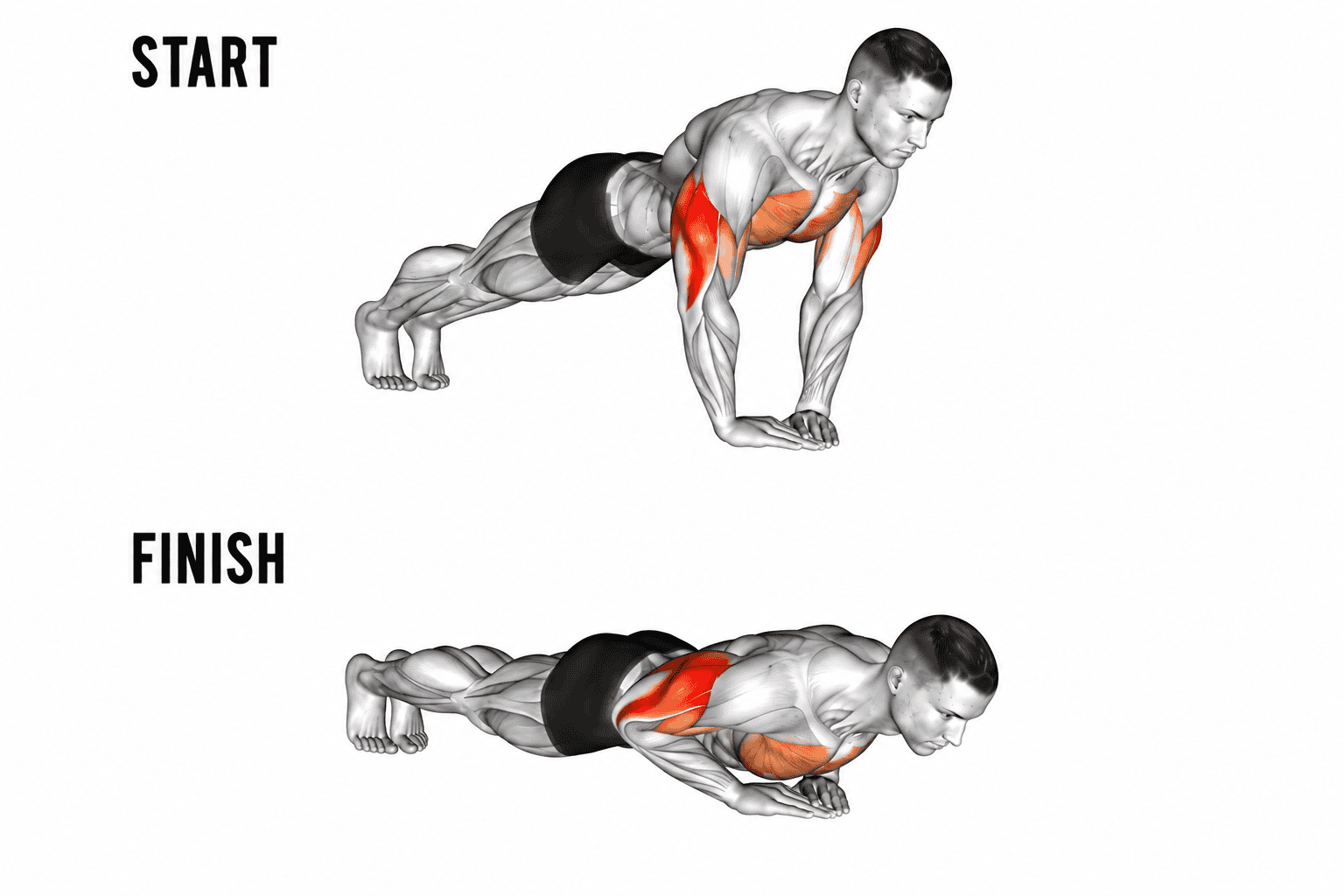
Exercise Description
The Diamond Push-Up is an advanced bodyweight exercise that places greater emphasis on the triceps while still effectively training the chest and shoulders. The exercise gets its name from the diamond-shaped hand position formed by placing the thumbs and index fingers close together beneath the chest. This narrower hand placement increases elbow extension demands, making it one of the most effective push-up variations for triceps development.
Primary Muscles Worked
Triceps Brachii
Pectoralis Major (Chest)
Secondary Muscles Worked
Anterior Deltoids (Front Shoulders)
Serratus Anterior
Rectus Abdominis (Abdominals)
Obliques
Transverse Abdominis
Gluteus Maximus
Lower Back Muscles (Stabilization)
How to Perform Correctly
Setup
Begin in a high plank position.
Place your hands directly beneath your chest with your thumbs and index fingers touching or nearly touching to form a diamond shape.
Position your shoulders directly above your hands.
Extend your legs behind you with your feet together or slightly apart.
Engage your core and glutes to maintain a straight line from head to heels.
Keep your neck neutral and your gaze slightly forward.
Movement
Lower your body by bending your elbows while keeping them close to your sides.
Continue descending until your chest is just above your hands.
Pause briefly at the bottom position.
Push through your palms and extend your elbows to return to the starting position.
Maintain a rigid body position throughout the movement.
Repeat for the desired number of repetitions.
Common Mistakes to Avoid
Allowing the Hips to Sag
Dropping the hips reduces core engagement and places stress on the lower back.
Flaring the Elbows
Keep the elbows close to the body to maximize triceps activation.
Using a Partial Range of Motion
Lower your chest fully and press back to full extension.
Raising the Hips Too High
Maintain a straight body position rather than turning the exercise into a pike.
Letting the Head Drop
Keep your neck neutral and aligned with your spine.
Rushing the Movement
Perform each repetition with control rather than relying on momentum.
Placing the Hands Too Far Forward
Keep the hands positioned directly beneath the chest for proper mechanics.