
Best Dumbbell Exercises for Leg Hypertrophy
Science-backed movements to build bigger, stronger legs using only dumbbells — from quads and hamstrings to glutes and calves.
Leg Muscle Anatomy
Your legs are the largest muscle group in your body. Understanding each muscle helps you select exercises that hit every region with intention, not just go through the motions.
FRONT OF THIGH
Quadriceps
Four muscles responsible for knee extension and leg mass. Respond best to deep knee flexion under load through a full range of motion.
BACK OF THIGH
Hamstrings
Handle knee flexion and hip extension. Best trained through hip-hinge movements with full stretch at the bottom position.
POSTERIOR CHAIN
Glutes
Gluteus maximus, medius, and minimus drive hip extension and rotation. Hip thrusts and split squats are elite glute builders.
LOWER LEG
Calves
Gastrocnemius and soleus work together for plantarflexion. Respond best to full range calf raises with a deep stretch and full contraction.
HIP STABILITY
Hip Flexors & Adductors
Recruited heavily during lunges, split squats, and sumo variations. Critical for balanced leg development and hip stability.
SHIN / ANTERIOR
Tibialis Anterior
Often neglected — dorsiflexes the foot and stabilises the knee. Crucial for athletic performance and knee health under load.
Two Leg Training Patterns
Effective leg programming combines both movement types. Neither alone gives you complete development.
Knee-Dominant (Quad Focus)
Deep knee bend under load
Tibia moves forward over foot
Examples: squats, lunges, step-ups
Builds quad mass & knee stability
Hip-Dominant (Posterior Focus)
Hip hinge with neutral spine
Tibia stays relatively vertical
Examples: RDLs, hip thrusts, good mornings
Builds hamstrings, glutes & lower back
10 Best Dumbbell Leg Exercises
Each exercise is selected for its ability to load the target muscle through a full range of motion — the number one factor in dumbbell leg hypertrophy.
01
Goblet Squat
QUADS GLUTES CORE
The gold standard dumbbell squat. Holding the weight at chest height counterbalances your body, allowing a deep, upright squat that maximises quad engagement and reduces lower back stress.
Hold one dumbbell vertically at your chest, cupping the top plate with both hands
Feet shoulder-width apart, toes turned slightly out (10–20°)
Push your knees out in the direction of your toes throughout the descent
Aim to get your thighs below parallel — depth is where the quads truly work
Drive through your whole foot to stand, squeezing glutes at the top
Keep your chest tall and elbows inside your knees at the bottom
02
Dumbbell Romanian Deadlift
HAMSTRINGS GLUTES ERECTORS
The single most effective dumbbell exercise for hamstring hypertrophy. The RDL loads the hamstrings in a lengthened position — exactly the stimulus needed for growth. Dumbbells allow a greater stretch than the barbell for many lifters.
Stand with dumbbells in front of your thighs, shoulder-width apart
Soft bend in the knees — maintain this throughout; this is NOT a squat
Hinge at the hips, pushing them back as you lower the weights along your legs
Feel a deep stretch in your hamstrings — typically around mid-shin depth
Keep your back flat and chest proud throughout the entire movement
Drive your hips forward to return to standing, squeezing glutes hard at the top
03
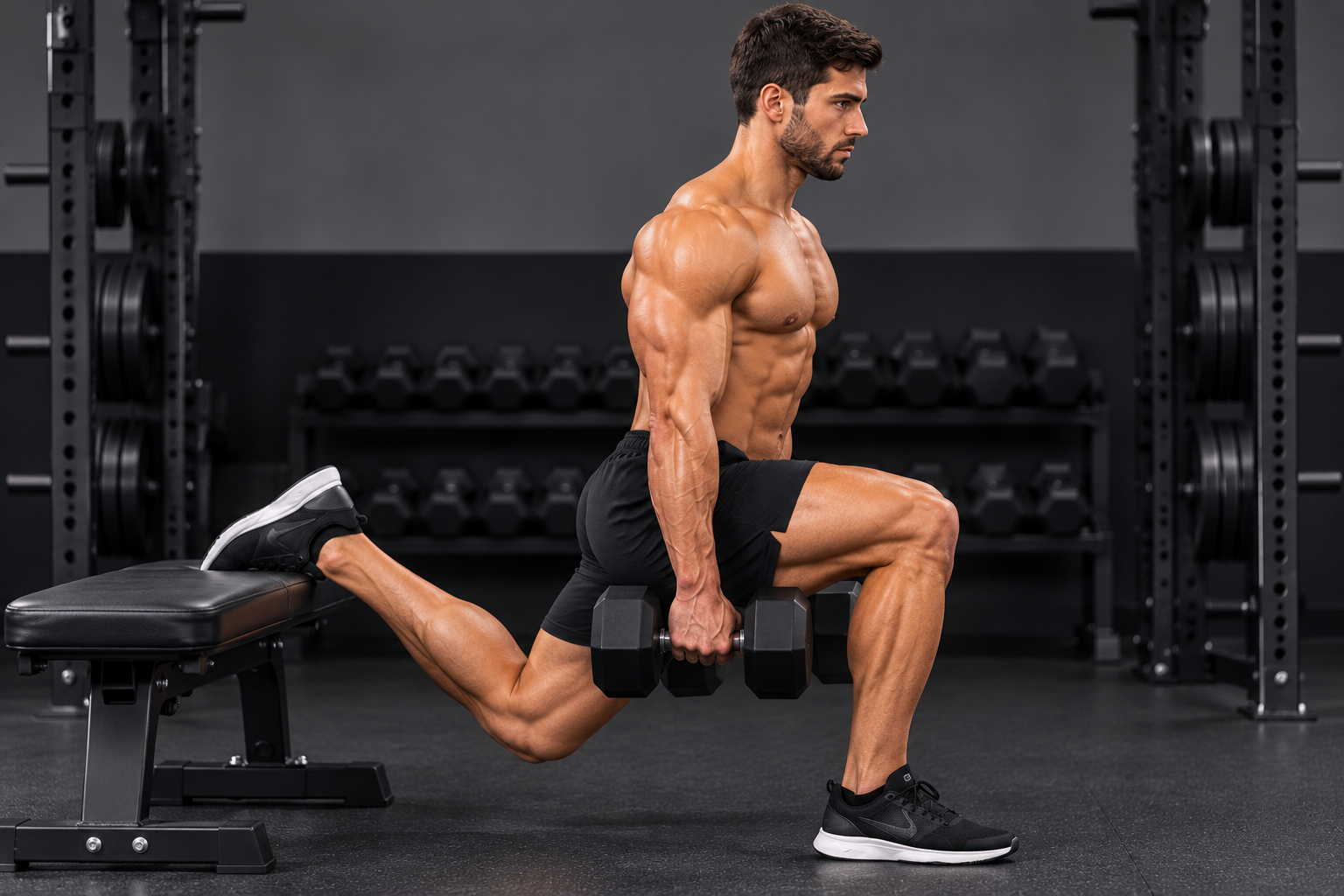
DB Bulgarian Split Squat
QUADS GLUTES BALANCE
Arguably the king of dumbbell leg exercises. The BSS loads one leg at a time, exposes imbalances, and creates a deep stretch through the quad and hip flexor. Many coaches argue it builds more leg mass per unit of spinal load than any other movement.
Rear foot elevated on a bench or box (laces down), hold a dumbbell in each hand
Front foot far enough forward so your shin stays close to vertical at the bottom
Lower straight down — not forward — until rear knee nearly touches the floor
Keep your torso upright for quad emphasis; lean forward slightly for more glute
Drive through the heel and mid-foot of your front foot to return
Complete all reps on one leg before switching sides
04
Single-Leg Romanian Deadlift
HAMSTRINGS GLUTES STABILITY
A unilateral RDL that exposes and corrects hamstring imbalances. The counterbalancing rear leg increases hip flexion range and puts the glutes through a greater stretch than the bilateral version.
Stand on one leg with a slight bend in the knee, holding one or two dumbbells
Hinge forward at the hip, extending the free leg behind you as a counterweight
Lower the dumbbell(s) toward the floor while keeping your hips square to the ground
Feel the stretch in the standing leg's hamstring — go as low as form allows
Use a wall or post for balance assistance while learning — not a cheat, it's smart
Drive through the standing heel to return, squeezing the glute at the top
05
Dumbbell Reverse Lunge
QUADS GLUTES HAMSTRINGS
Far more knee-friendly than the forward lunge. Stepping backward reduces shearing forces on the knee while still loading the quads and glutes through a full range of motion. Perfect for training around knee issues.
Stand holding dumbbells at your sides, feet hip-width apart
Step one foot back and lower your rear knee toward the floor
Front shin stays close to vertical — this is crucial for knee health
Both knees should be near 90° at the bottom of the movement
Push through your front foot to return to standing
Alternate legs or complete all reps on one side first
06
Dumbbell Hip Thrust
GLUTES HAMSTRINGS
The most direct glute isolation exercise available with dumbbells. Research consistently shows the hip thrust produces the highest glute activation of any exercise. Loading with a dumbbell across your hips is highly effective for moderate loads.
Sit with your upper back against a bench edge, dumbbell placed across your hip crease
Feet flat on the floor, hip-width apart, knees at roughly 90° when hips are raised
Drive your hips upward until your body forms a straight line from knees to shoulders
Squeeze glutes hard at the top and hold for 1–2 seconds
Keep your chin tucked to avoid hyperextending the lower back
Lower with control — don't let the hips drop rapidly
07
Dumbbell Step-Up
QUADS GLUTES UNILATERAL
An underrated quad and glute builder. Step-ups train the legs in an extremely functional pattern while placing high tension on the glutes and quads. Box height dictates emphasis — higher box means more glute, lower box means more quad.
Stand in front of a box or bench, holding dumbbells at your sides
Step up with one foot fully planted on the box surface
Drive through that heel to lift your body — don't push off the back foot
Bring the rear foot up to meet the front before stepping back down
Lower with control — the eccentric is where growth happens
Box height: knee height for quad focus, higher for glute focus
08
Dumbbell Good Morning
HAMSTRINGS GLUTES ERECTORS
A hip-hinge movement that takes the hamstrings through an even greater stretch than the RDL. The dumbbell held behind the neck shifts load to the hips, making it excellent for posterior chain development while reinforcing the hip hinge pattern.
Hold one dumbbell behind your neck with both hands gripping each end
Stand with feet shoulder-width apart, slight bend in the knees
Hinge at the hips, maintaining a neutral spine, until torso is near parallel to floor
Feel a full hamstring stretch at the bottom position
Drive through the hips to stand tall — don't hyperextend at the top
Start light — this exercise punishes poor form immediately
09
Single-Leg Calf Raise
CALVES GASTROCNEMIUS SOLEUS
The single-leg variation doubles the load per calf versus bilateral raises. The key is full range — deep stretch at the bottom, full contraction at the top — not just bouncing through the movement. Pause at the top to eliminate momentum.
Stand on one foot on the edge of a step, holding a dumbbell in the same-side hand
Let your heel drop as far below the step as comfortable to load the stretch
Rise up as high as possible onto your toes, fully contracting the calf
Pause for 1–2 seconds at the top — don't bounce
Lower slowly and deliberately — the eccentric is critical for calf growth
Use a wall for balance with your free hand if needed
10
Sumo Dumbbell Deadlift
FULL LEG GLUTES HAMSTRINGS
The wide stance brings the adductors and glutes into play far more than a conventional deadlift. Holding a heavy dumbbell vertically between your legs allows a deep bottom position that loads the entire posterior chain and inner thighs simultaneously.
Stand with feet wider than shoulder-width, toes turned out 30–45°
Hold one dumbbell vertically between your legs with both hands
Hinge at the hips and bend the knees until the dumbbell touches the floor
Keep your chest up, back flat, and knees tracking over your toes
Drive the floor away and extend hips and knees simultaneously to stand
Squeeze glutes and adductors hard at the top position
6 Hypertrophy Principles for Legs
Apply these principles to any leg programme and accelerate your results. They're not optional extras — they separate maintenance from genuine growth.
01
Train Through Full Range
Research shows muscles grown in the lengthened position are larger and stronger. Deep squats and full RDLs beat partial reps every time for hypertrophy.
02
Balance Knee & Hip Dominant
Quad and hamstring development requires both movement types. A programme built only on squats will leave your hamstrings and glutes chronically underdeveloped.
03
Prioritise Progressive Overload
Your legs adapt fast. If you're doing the same weights for the same reps week after week, you're maintaining — not growing. Add load or reps consistently.
04
Use Unilateral Work
Most people have a dominant leg. Single-leg exercises force each leg to work independently, eliminating compensation and building balanced mass on both sides.
05
Control the Eccentric
The lowering phase (2–4 seconds) causes more muscle damage than the lifting phase. Controlled eccentrics on squats, RDLs and lunges significantly enhance hypertrophy.
06
Don't Neglect Calves
Calves are stubborn but trainable. They respond best to high volume (15–20+ reps), full range of motion, and the stretch position loaded under real tension.
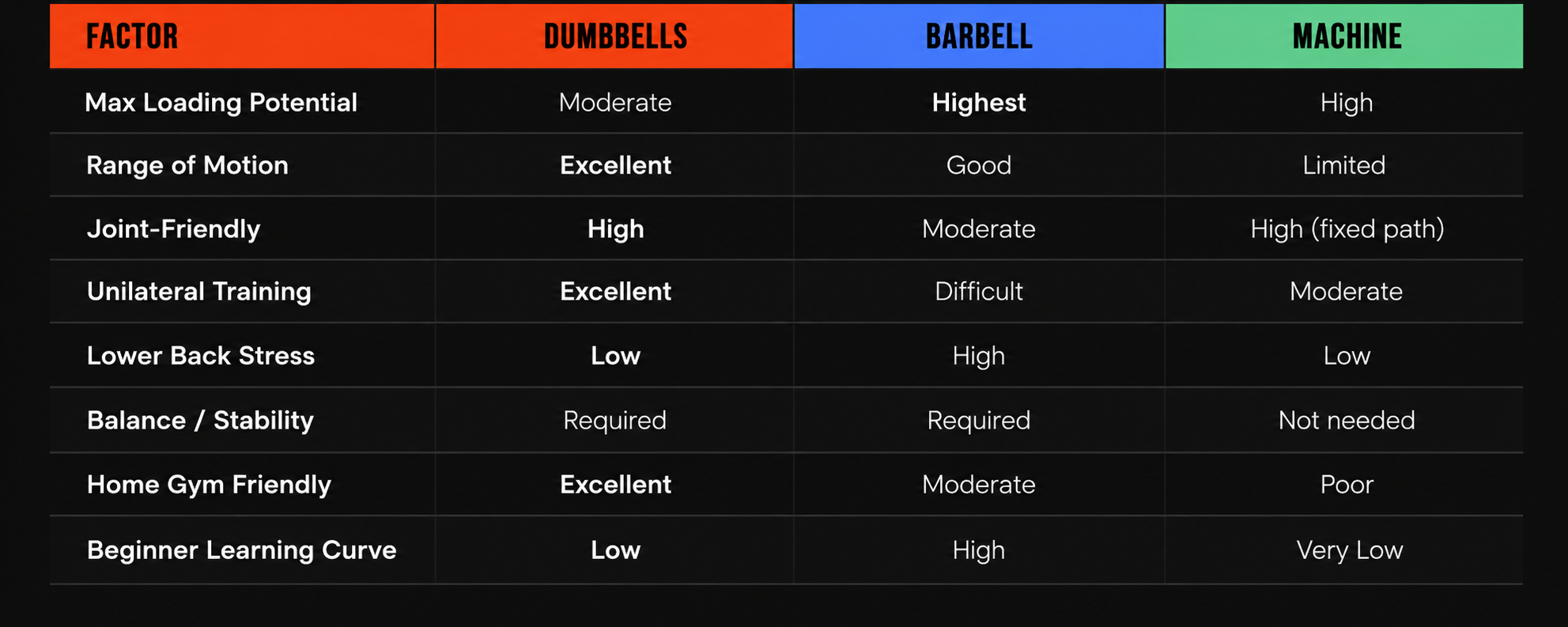
Dumbbells vs Barbells vs Machines
Each tool has its place in leg training. Here's an honest breakdown of where dumbbells excel, where they fall short, and when to use each.
Training Tips for Leg Growth
01
Warm Up Your Hips Before Every Session
Cold, stiff hips lead to poor squat depth and increased injury risk. 5 minutes of hip circles, deep squat holds and leg swings transforms movement quality instantly.
02
Train Legs Twice Per Week
Legs are your largest muscle group. One session per week leaves progress on the table. Two sessions — ideally 48–72 hours apart — drives significantly better hypertrophy outcomes.
03
Go Heavier on Compound Movements
The goblet squat, RDL and Bulgarian split squat can all handle meaningful load. Don't baby these exercises — most people leave significant gains on the table by going too light.
04
Use Higher Reps for Calves
Calf muscles are predominantly slow-twitch and respond better to higher rep ranges (15–25). Sets of 10 at heavy load barely stimulates them. Volume and burn is the calf's language.
05
Eat to Support Leg Growth
Your legs contain the biggest muscles in your body. Building them requires a genuine calorie surplus (250–500 kcal above maintenance) and adequate protein (1.6–2.2g per kg bodyweight).
06
Rest More Than You Think Between Sets
Compound leg exercises are metabolically demanding. 90–120 seconds between heavy sets isn't laziness — it's what allows you to produce the force needed for actual growth stimulus.
Build Serious Legs with Dumbbells
Dumbbells are not a compromise — they're a legitimate tool for building impressive legs. The combination of goblet squats, Romanian deadlifts, Bulgarian split squats, and hip thrusts covers every major muscle of the lower body effectively.
Prioritise progressive overload, train through full range, and balance knee-dominant and hip-dominant movements every week. The lifters with the best dumbbell-built legs share one thing: they push their weights progressively over months and years, not just weeks.