
Banded Upright Row
Exercise Description
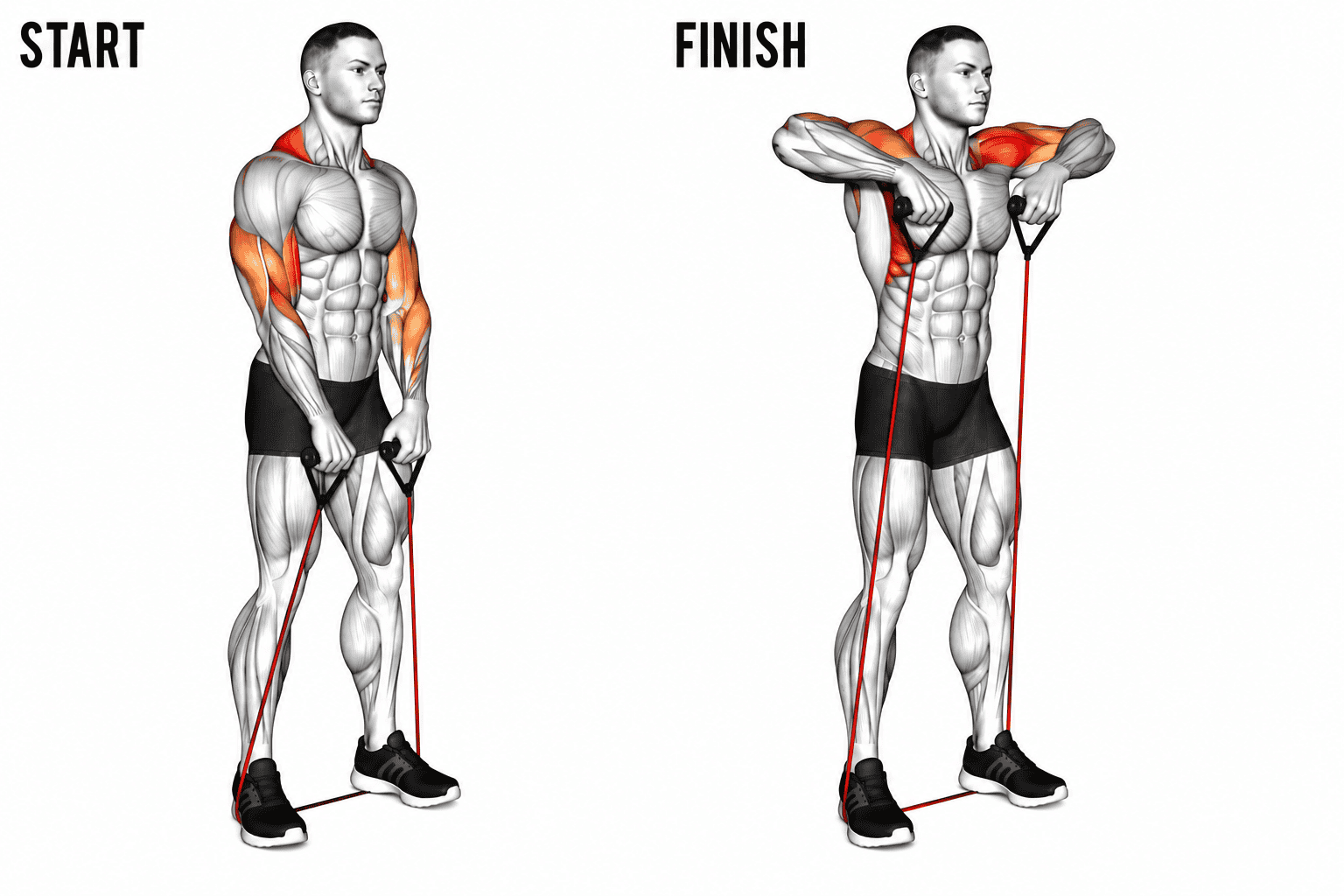
The Banded Upright Row is a resistance-band exercise that targets the shoulders and upper back by pulling the band vertically along the front of the body. It is an effective movement for developing shoulder strength, upper trapezius muscle development, and overall upper-body stability. The resistance band provides constant tension throughout the exercise, making it a versatile option for home and gym workouts.
Primary Muscles Worked
Lateral Deltoids (Side Shoulders)
Upper Trapezius
Secondary Muscles Worked
Anterior Deltoids (Front Shoulders)
Posterior Deltoids (Rear Shoulders)
Rhomboids
Levator Scapulae
Biceps Brachii
Brachialis
Forearm Flexors
Core Muscles (Stabilization)
How to Perform Correctly
Setup
Stand on the center of a resistance band with your feet approximately shoulder-width apart.
Hold one end or handle of the band in each hand using an overhand grip.
Allow your arms to hang straight in front of your thighs.
Stand tall with your chest lifted and shoulders relaxed.
Engage your core and maintain a neutral spine.
Movement
Pull the band upward along the front of your body.
Lead the movement with your elbows, keeping them higher than your hands.
Raise the band until your elbows reach approximately shoulder height.
Pause briefly at the top of the movement.
Slowly lower the band back to the starting position under control.
Maintain tension in the band throughout the exercise.
Repeat for the desired number of repetitions.
Common Mistakes to Avoid
Pulling the Elbows Too High
Raising the elbows significantly above shoulder level can increase stress on the shoulder joints.
Using Excessive Resistance
A band that is too heavy may force poor technique and reduced range of motion.
Shrugging the Shoulders Excessively
Avoid elevating the shoulders toward the ears during the movement.
Swinging the Body
Use controlled movement rather than momentum to lift the band.
Bending the Wrists
Keep the wrists neutral and aligned with the forearms.
Rounding the Upper Back
Maintain an upright posture with the chest lifted throughout the exercise.
Lowering Too Quickly
Control the return phase to maximize muscle activation and safety.