
Banded Good Morning
Exercise Description
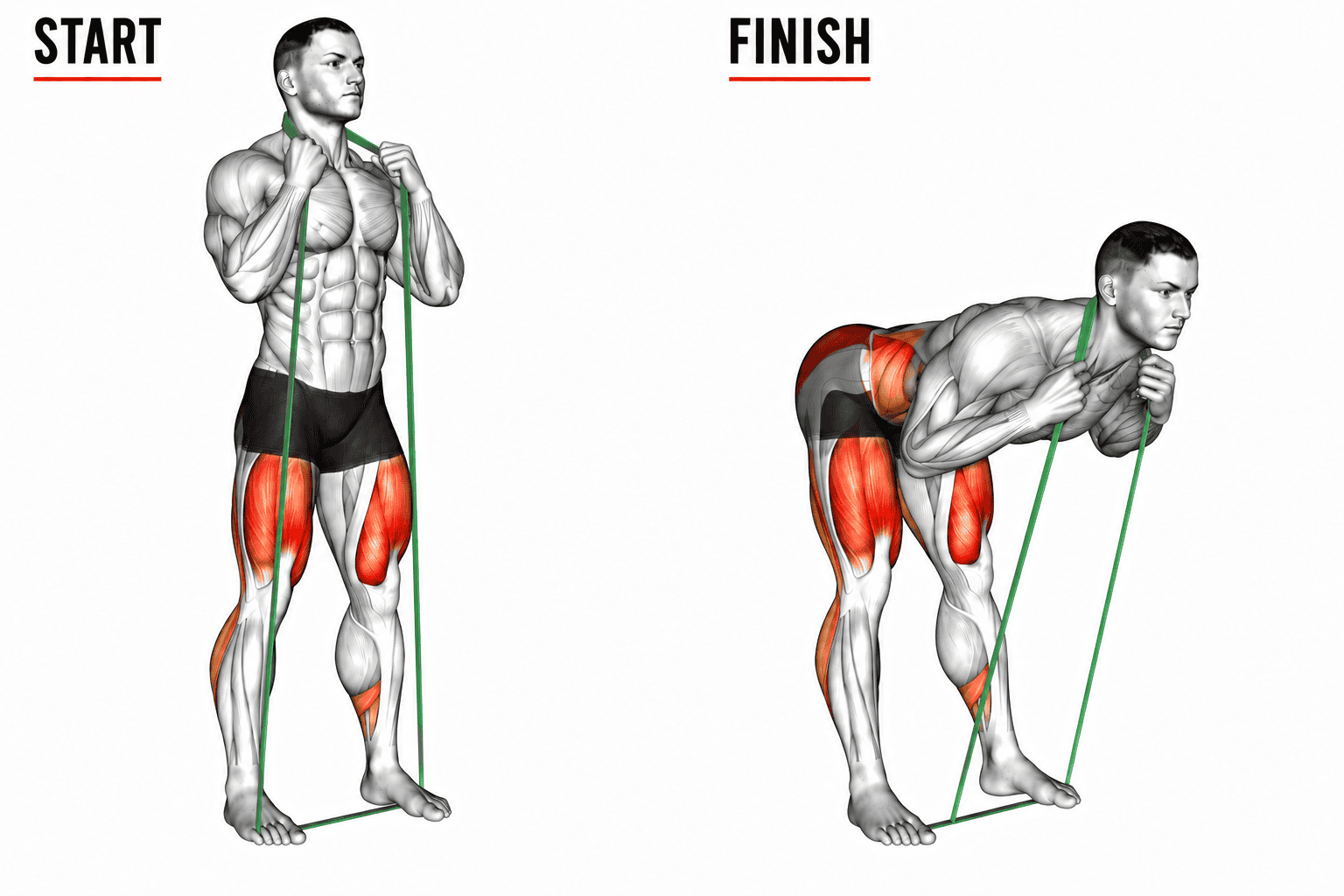
The Banded Good Morning is a posterior-chain exercise that strengthens the hamstrings, glutes, and lower back through a controlled hip-hinge movement. Performed with a resistance band looped under the feet and across the upper back or shoulders, the exercise mimics the movement pattern of a traditional good morning while providing accommodating resistance. It is highly effective for improving hip-hinge mechanics, strengthening the posterior chain, enhancing posture, and developing functional lower-body strength with minimal equipment.
Primary Muscles Worked
Hamstrings
Gluteus Maximus
Secondary Muscles Worked
Erector Spinae (Lower Back)
Adductor Magnus
Gluteus Medius
Rectus Abdominis
Obliques
Hip Stabilizers
Upper Back Muscles (Trapezius and Rhomboids)
How to Perform Correctly
Setup
Stand on the center of a resistance band with your feet approximately shoulder-width apart.
Loop the band over your shoulders or upper back, ensuring it rests comfortably and securely.
Stand upright with a slight bend in your knees.
Lift your chest and pull your shoulders back.
Engage your core and maintain a neutral spine.
Keep your head and neck aligned with your spine.
Movement
Push your hips backward while maintaining a slight bend in your knees.
Lower your torso by hinging at the hips until you feel a strong stretch in your hamstrings.
Keep your back flat and chest up throughout the movement.
Maintain tension in the band during the entire repetition.
Drive your hips forward and squeeze your glutes to return to the starting position.
Stand tall without excessively arching your lower back.
Repeat for the desired number of repetitions.
Common Mistakes to Avoid
Rounding the Lower Back
Maintain a neutral spine throughout the movement.
Bending the Knees Excessively
The exercise should be driven primarily by the hips rather than becoming a squat.
Looking Up Excessively
Keep your neck neutral and aligned with your spine.
Using Excessive Resistance
A band that is too strong can compromise form and reduce range of motion.
Not Pushing the Hips Back
Focus on moving the hips backward rather than simply bending forward.
Hyperextending at the Top
Stand upright without leaning backward excessively.
Rushing the Repetitions
Perform each repetition slowly and under control.