
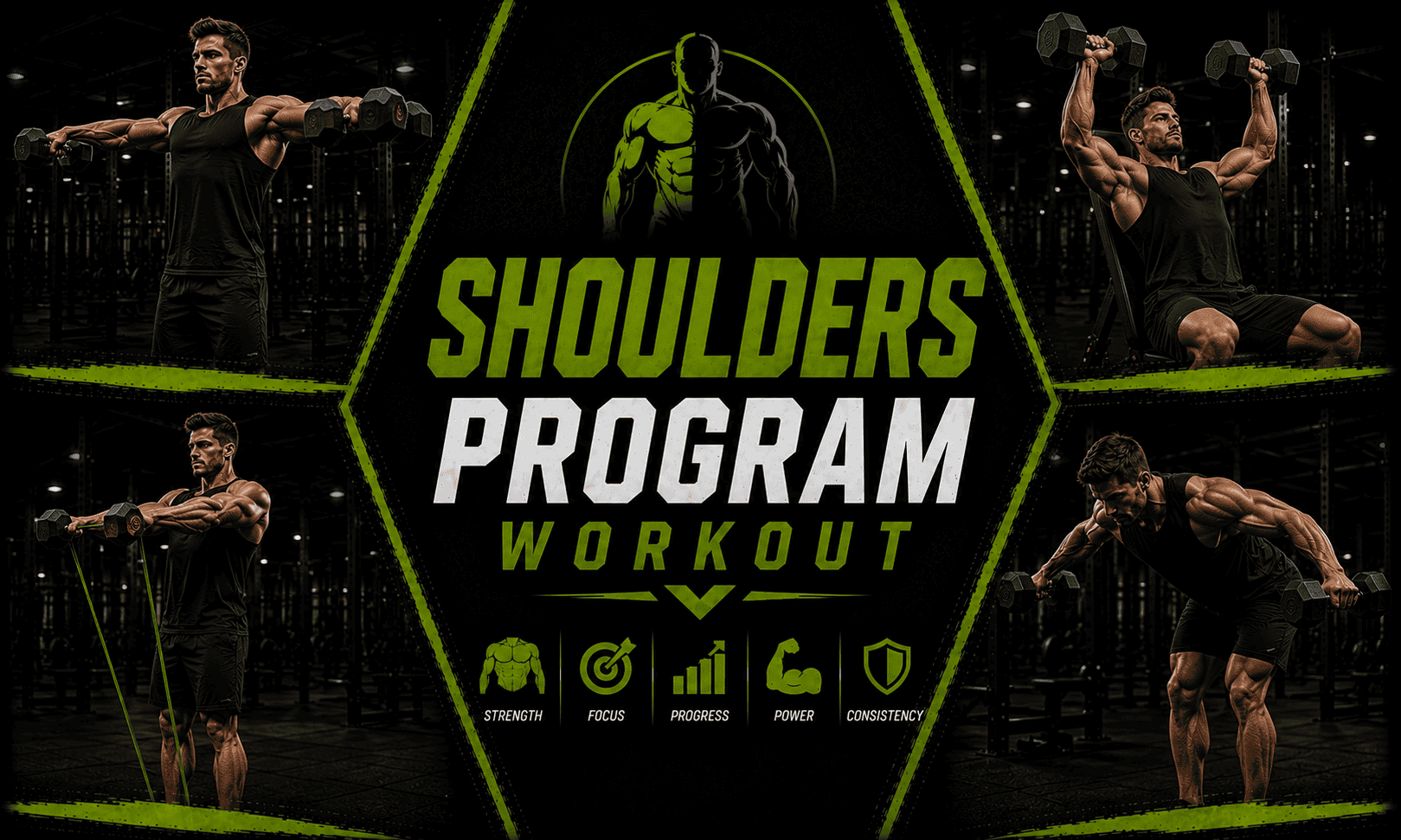
Full Shoulder Workout
Strong shoulders contribute to upper-body strength, posture, and athletic performance. This workout targets all three heads of the deltoids—front, side, and rear—while also strengthening the stabilizing muscles of the shoulders and upper back.
Seated Dumbbell Shoulder Press
4 sets × 6–10 reps
Sit upright on a bench with back support and press the dumbbells overhead until your arms are fully extended. Lower the weights under control and maintain a stable torso throughout the movement.
Dumbbell Lateral Raise
4 sets × 10–15 reps
Raise the dumbbells out to the sides until your arms are roughly parallel to the floor. Focus on controlling the movement rather than using momentum. This is one of the best exercises for developing shoulder width.
Incline Rear Delt Raise
4 sets × 10–15 reps
Lie face down on an incline bench and raise the dumbbells out to the sides. Keep a slight bend in the elbows and focus on squeezing the rear deltoids at the top of each repetition.
Standing Resistance Band Front Raise
3 sets × 10–15 reps
Stand on the band and raise the handles in front of your body until shoulder height. Lower slowly to maintain tension throughout the movement.
Dumbbell Arnold Press
3 sets × 8–12 reps
Begin with the dumbbells in front of your shoulders and palms facing you. Rotate the wrists while pressing overhead. This variation trains all three deltoid heads through a larger range of motion.
Resistance Band Face Pull
3 sets × 12–15 reps
Anchor the band at face level and pull toward your forehead while driving the elbows outward. This exercise helps strengthen the rear delts, traps, and rotator cuff muscles.
Progression
Gradually increase dumbbell weight, band resistance, or repetitions as exercises become easier. For lateral raises, rear delt raises, and face pulls, prioritize strict form before increasing resistance.
Shoulder Program
Beginner
Shoulders have three distinct heads — front, side, and rear. Most beginners overtrain the front (from all the pressing) and neglect the side and rear. This program deliberately balances all three from day one to build round, healthy shoulders.
Shoulder CARs (Controlled Articular Rotations). Arm at side. Slowly rotate your entire arm in the largest circle you can — up in front, overhead, out to the side, behind you, back down. Go as slow as possible (10+ seconds per circle). Feel every degree of motion. Reverse direction. Do both arms. (This is the single best shoulder warm-up that exists. It explores the entire shoulder joint range before loading it. Every shoulder session starts here — no exceptions.)
Dumbbell Overhead Press. Sit on bench, back upright. Dumbbells at ear height, palms forward, elbows at 90°. Press straight up until arms nearly lock out — dumbbells converge slightly at top. Lower to ear height (not lower). Keep core braced, don't arch back excessively. (Seated eliminates leg drive — every ounce of the work is on the shoulders. Beginner key: don't lower past ears, it puts unnecessary stress on the rotator cuff before it's conditioned.)
Band Lateral Raise. Stand on band, hold both ends. Raise arms out to sides until parallel to floor — thumbs slightly down (like pouring a jug). Elbows slightly bent and stay higher than wrists. Slow 3-second lowering. The band gets harder as you raise — perfect resistance curve. (Lateral raises are THE exercise for shoulder width. The lateral deltoid only gets targeted by lateral movements — pressing alone won't build it. These should be in every shoulder session.)
Dumbbell Front Raise. Stand, dumbbell in one hand, arm straight. Raise arm forward to shoulder height — no higher. Thumb slightly up. Lower slowly (3 sec). Don't swing or use momentum. Alternate arms or do both simultaneously. (Front raises are often skipped because pressing already works the front delt. At beginner level, include them to learn isolation. At intermediate+ you may not need them at all due to pressing volume.)
Band Face Pulls. Anchor band at face height. Hold both ends, step back. Pull toward your face — elbows high and wide, hands ending beside your ears. The external rotation (thumbs pointing behind you at the finish) is the entire point of this exercise. Hold 1 sec. Return slowly. (Face pulls are the most important shoulder health exercise that almost nobody does. They directly counteract the internal rotation tightness from all pressing. Do these at the end of EVERY upper body session, not just shoulder day.)
Dumbbell Bent-Over Lateral Raise. Hinge at hips 45°, back flat, dumbbells hanging. Raise arms out to sides — elbows slightly bent, thumbs down. Think about pointing your elbows toward the ceiling rather than raising the weights. Squeeze rear delts at top. Lower with control. (Most people hinge too much (nearly parallel to floor) which turns this into a back exercise. Stay at 45° to keep the emphasis on rear delts.)
Shoulder Capsule Stretch. Cross one arm across chest. With other hand, gently press the upper arm (not elbow) toward your body. Hold. Then: reach same arm behind your head, grab elbow and gently pull — overhead tricep/shoulder stretch. Hold 30 sec each position. (Shoulder impingement is the #1 shoulder injury in training. The posterior capsule tightness that causes it is directly addressed by this stretch. Do it every session.)
Intermediate
For those with 3+ months of shoulder training. Separates sessions into pressing days and isolation days. Introduces unilateral work, mechanical advantage techniques, and higher lateral delt volume — the key driver of the 3D shoulder look.
Arnold Press. Start with dumbbells in front of face, palms facing YOU (like top of a curl). As you press overhead, rotate palms forward simultaneously, so at the top palms face away. Reverse on the way down. The rotation recruits all three delt heads through the movement. (The Arnold press hits more deltoid fibers in one movement than any other pressing variation. The key is slow, controlled rotation — not just pressing and flopping the hands.)
Dumbbell Lateral Raise (Mechanical Drop Set). Standing lateral raises to failure → immediately lean slightly forward (30°) and continue raises to failure → immediately fully bent over (90°) and continue raises to failure. Each body position changes the mechanical advantage, letting you continue past normal failure with the same weight. (Lateral delts are notoriously difficult to overload and respond best to high volume. Mechanical drop sets deliver the volume without needing multiple sets of rest.)
Single-Arm Overhead Press (Standing). Stand, one dumbbell at shoulder. Press overhead while bracing core — resist the urge to lean away from the weight (that's cheating the shoulder and stressing the lower back). Squeeze glutes for stability. Lower with control. Switch arms. (Single-arm standing press reveals and fixes left-right shoulder imbalances. The anti-lateral flexion demand also builds the obliques significantly — a bonus.)
Band Upright Row. Stand on band, grip both ends narrow (fist-width apart). Pull straight up, leading with elbows — elbows rise above hands and wrists at the top, to just above shoulder height. The band keeps tension at the top where dumbbells get easy. Control the descent. (Keep elbows above hands throughout the entire movement. Hands leading = bicep curl. Elbows leading = upright row. The difference is entirely in which joint moves first.)
Pike Push-Ups. Hands on floor in push-up position. Walk feet toward hands until body forms an inverted V — hips high. Bend elbows to lower head between hands toward floor. Press back up. The more vertical your torso, the more shoulder-dominant. Elevate feet on bench to increase difficulty. (Pike push-ups are a direct progression toward handstand push-ups. Each elevation of the feet increases the shoulder load. This is the pull-up bar replacement for a shoulder press machine.)
Dumbbell Cuban Press. Stand holding light dumbbells. Upright row to shoulder height (elbows high). Then externally rotate forearms upward until forearms are vertical (like goalpost). Then press overhead. Reverse all three steps back down. One continuous flow. (The Cuban press is a rotator cuff strengthening exercise disguised as a shoulder movement. It directly trains external rotation which is the most underdeveloped movement in most lifters. Use light weight — this is about rotation quality, not load.)
High-Volume Face Pulls. Same technique as beginner. At intermediate, increase to 25 reps and 4 sets. Use a lighter band to maintain the external rotation quality throughout all reps. Elbows stay high and wide throughout — don't let them drop. (As pressing load increases at intermediate level, face pull volume needs to scale with it. 4×25 keeps shoulder health in check while adding significant rear delt development.)
Doorway + Overhead Shoulder Stretch. Two stretches: (1) Doorway pec/shoulder stretch — arm at 90° on wall, rotate body away. (2) Overhead lat/shoulder stretch — one arm overhead, grab elbow with other hand, lean to the side. Hold each 90 sec. The second stretch gets the lat-shoulder connection that overhead pressing tightens. (Overhead pressing tightens the lats, which limits shoulder mobility over time. The overhead stretch directly addresses this — critical for maintaining pressing range of motion.)
Advanced
For experienced lifters with well-developed baseline shoulder strength. Uses handstand progressions, heavy unilateral loading, advanced band techniques, and periodized volume to push shoulder development to its natural ceiling.
Handstand Push-Up Progression. Against wall: kick into handstand, hands shoulder-width. Lower head to floor (full ROM). Press back up. Not ready for full: elevate feet on bench as high as possible (pike push-up with max elevation). Progression: box pike → elevated pike → wall handstand negatives → full wall HSPU. (The handstand push-up is the ultimate overhead pressing movement — you're pressing your entire bodyweight. Even partial range reps build significant shoulder mass and strength.)
Seated Dumbbell Press (Heavy 5s). Maximum weight you can press for 5 perfect reps. Scapulae retracted and depressed. Elbows slightly in front of the body plane (not directly to sides). 4-second lowering. Explosive press. Spot yourself with your knee if needed at rep 4-5. (Strength-focused pressing (5 rep range) builds the dense, full muscle bellies that high-rep work alone cannot achieve. Alternate heavy 5-rep sessions with higher-rep volume sessions weekly.)
Lateral Raise 21s. 7 reps lower half ROM (0° to 45°) + 7 reps upper half ROM (45° to 90°) + 7 full ROM reps. No rest between portions. This technique creates metabolic stress at every point in the range simultaneously, forcing the lateral delt to adapt to different angles of tension. (21s work because the lateral delt has different strength curves at different angles. Training each zone separately before doing full reps ensures no portion gets a free ride.)
Band Pull-Apart + External Rotation Superset. 20 pull-aparts (arms forward, pull band to chest width apart). Immediately: hold band at sides, elbows bent 90°, rotate forearms outward against band resistance (external rotation). 15 reps. The combo hits every rear-chain shoulder muscle without rest. (Advanced lifters need even higher rear delt and external rotator volume to balance the heavy pressing load. This superset delivers maximum work in minimum time.)
Dumbbell Lateral Raise (Lying Side). Lie on your side on a bench (or floor). Hold dumbbell in top hand, arm resting on side. Raise arm straight up to vertical. Lower slowly. Because you're lying down, the trapezius CANNOT help — it's pure lateral delt. You'll need far less weight than standing. (This is the most isolated lateral delt exercise possible. No traps, no momentum, no cheating. The weights will feel embarrassingly light but the burn will be intense — that's exactly right.)
Single-Arm Band Lateral Raise (Constant Tension). Anchor band low on same side. Step away from anchor point. Raise arm laterally — band pulls down AND inward creating constant tension even at the start (unlike dumbbells which have zero tension at the bottom). Never fully lower — keep tension throughout. (Bands load the bottom of the lateral raise. (Bands load the bottom of the lateral raise (where dumbbells are easy) and the top equally. This is the key advantage — the entire range of motion is challenged.)
Dumbbell Cuban Press (Heavy). Same movement as intermediate but with heavier weight and slower tempo. 2-second pause at the external rotation position (forearms vertical). This is now a strength exercise for the rotator cuff — the most injury-preventive work in this entire program. (A strong rotator cuff is the difference between a shoulder that holds up under years of heavy loading and one that breaks down. The Cuban press builds it directly.)
Dead Hang Shoulder Decompression. Simply hang. After a heavy shoulder session, the glenohumeral joint is compressed from all the overhead loading. Hanging passively decompresses it, lets the joint surfaces breathe, and rehydrates the cartilage. Rotate grip: overhand → underhand → mixed. (This 2-minute investment at the end of each session is one of the best long-term shoulder health habits you can build. Elite gymnasts and Olympic lifters do this religiously.)
Full Shoulder Mobility Routine. 90 sec: band pass-throughs — hold band wide, pass it overhead from front to back and back repeatedly, narrowing grip each pass. 30 sec each side: sleeper stretch (lie on side, internally rotate arm gently). 30 sec each side: cross-body posterior capsule stretch. (Advanced overhead work compresses the AC joint and tightens the posterior capsule over time. This routine directly addresses both. Skipping this is how 5-year shoulder problems start.)