
Barbell Hack Squat - Heels Elevated
One small change — elevating your heels — transforms the barbell hack squat from a good quad exercise into one of the most effective quad-isolation movements available anywhere in a gym.
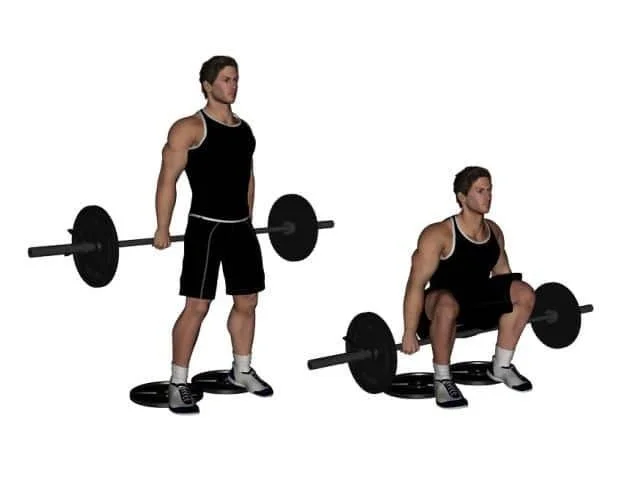
The barbell hack squat is one of the most underused exercises in strength training. Holding the bar behind your body rather than in front fundamentally changes the mechanics of the squat — forcing a more upright torso, shifting load heavily onto the quads, and producing a deep, full stretch at the bottom that most squat variations simply can't replicate. Add heel elevation into the equation, and you amplify every one of those effects.
This guide covers everything: the exact technique, what the heel elevation achieves anatomically, common mistakes, programming recommendations, and how it compares to similar exercises.
High. Quad activation compared to conventional squats
Low. Lower back stress — one of the safest heavy quad movements
2–4c. Optimal heel elevation height for most lifters
What Is the Barbell Hack Squat?
The barbell hack squat is a squat variation where the barbell is held behind the body — at arm's length, resting against the back of the legs — rather than on the back or in front of the torso. This positioning was popularised by the legendary strongman Georg Hackenschmidt in the early 20th century, from whom the exercise gets its name.
Because the load sits behind the centre of mass, the torso must stay far more upright than in a conventional back squat. This dramatically reduces the shear stress placed on the lower back and shifts the mechanical demand almost entirely to the quadriceps. It is, in essence, a barbell version of the leg press — but with the coordination demands, range of motion, and free-weight benefits that no machine can fully replicate.
What heel elevation adds: Elevating the heels shifts the centre of gravity forward, allows deeper knee flexion, and increases the range of motion through which the quadriceps work under load. The muscle fibres are stretched further and recruited more completely — particularly the VMO (vastus medialis oblique), the teardrop-shaped muscle on the inner lower quad that is notoriously difficult to develop.
Muscles Worked
Quadriceps
PRIMARY — ALL FOUR HEADS
The dominant muscle in this movement. All four quad heads are heavily recruited, with particular emphasis on the VMO due to the deep knee flexion angle.
Glutes
SECONDARY
Active at the bottom of the movement and through the drive phase, though significantly less loaded than in a conventional squat due to the upright torso position.
Hamstrings
STABILISER
Minimal dynamic contribution — primarily working isometrically to stabilise the knee joint and assist in the transition from the bottom position.
Hamstrings
STABILISER
Minimal dynamic contribution — primarily working isometrically to stabilise the knee joint and assist in the transition from the bottom position.
Core
STABILISER
Braced throughout to maintain the upright torso position and protect the lower back. Less taxed than in a conventional squat due to the reduced forward lean.
Grip / Forearms
LIMITING FACTOR
Holding the bar behind the body at depth taxes grip and forearm strength significantly. Wrist straps are frequently used to allow the legs to be trained to true failure.
Why Elevate the Heels?
Ankle mobility is the limiting factor for most people attempting deep squats. When ankle dorsiflexion (the ability to bring your shin forward over your foot) is restricted, the heels rise off the floor as you descend — collapsing the squat mechanics and reducing depth.
Heel elevation solves this mechanically. By raising the heel 2–4cm using weight plates, a wedge, or purpose-built lifting shoes, you artificially increase the available dorsiflexion range. This allows the knee to travel much further forward over the toes — producing a deeper, more upright squat position with significantly greater quadriceps involvement.
Beyond solving the mobility limitation, heel elevation actively changes the biomechanics of the squat in ways that benefit quad development even in athletes with excellent ankle mobility:
Greater knee flexion angle.The shin can travel further forward, creating a deeper knee bend and placing the quads under maximum stretch at the bottom of the rep — the most powerful position for hypertrophic stimulus.
Increased VMO recruitment.The VMO is most active in deep knee flexion. Heel elevation makes that range easier to achieve and sustain under load, directly targeting the teardrop shape that many lifters struggle to develop.
More upright torso.Less forward lean means less hip and glute involvement, isolating the quads even more effectively than flat-footed variations.
Reduced ankle restriction.Training becomes about the legs rather than fighting against mobility limitations — allowing full concentration on the working muscle.
Step-by-Step Technique
01 - Set Up Your Heel Elevation
Place two weight plates (or a heel wedge) on the floor, roughly shoulder-width apart. A 1.25kg or 2.5kg plate provides the ideal 2–4cm of elevation for most lifters. Olympic lifting shoes with a built-in heel are the best long-term solution but plates work perfectly.
02 - Position the Bar and Your Body
Stand with heels on the plates, feet roughly hip to shoulder-width apart, toes turned out 15–30°. Hinge at the hips and bend your knees to reach the bar behind you. Grip the bar with both hands using a double overhand grip, just outside your legs. The bar should rest across the back of your thighs.
03 - Brace and Initiate the Lift
Take a deep breath and brace your core hard — as if bracing for a punch. Keep your chest tall and shoulders pulled back. Drive through your heels (even though they're elevated) and stand up, keeping the bar close to the back of your legs throughout the ascent. Squeeze your quads at the top but do not lock out aggressively.
04 - Descend Under Control
Push your hips back slightly and bend the knees, lowering the bar back toward the floor in a controlled 2–3 second descent. Keep your torso as upright as possible. The bar should track close to the back of your legs. Aim for a full range of motion — thighs at or below parallel — to maximise quad stretch.
05 - Drive From the Bottom
At the bottom position, pause briefly if needed — do not bounce. Drive through the floor, extending the knees powerfully. Keep the torso upright and resist the urge to lean forward as you come out of the hole. The quads should be doing all the work.
06 - Breathing and Bracing
Inhale and brace at the top before descending. Hold your breath through the descent and bottom position. Exhale through the sticking point on the way up or at the top. This is the Valsalva manoeuvre — it protects the spine and allows maximum force production.
Common Mistakes — and How to Fix Them
Mistake
Bar drifting away from the legs.Allowing the bar to swing forward on the descent reduces tension on the quads and makes the movement far more mechanically difficult. The bar should maintain contact with — or stay very close to — the back of the legs throughout.
Fix
Think "bar stays close." Actively pull the bar back into your legs as you descend. Warm up with lighter weight and consciously practise keeping the bar tracking tightly against the back of your thighs on every rep.
Mistake
Excessive forward lean. If the torso tips forward significantly during the descent, the movement loses its quad-isolation advantage and starts loading the lower back similarly to a conventional deadlift. This defeats the purpose of the exercise.
Fix
Increase heel elevation and reduce weight. Forward lean is almost always caused by insufficient ankle mobility or too much load. Raise the heel height slightly, reduce the weight, and focus on keeping your chest tall and eyes forward throughout the rep.
Mistake
Cutting depth short. Stopping the descent above parallel dramatically reduces quad stretch and hypertrophic stimulus. The bottom of this movement — where the quad is most lengthened — is where most of the growth signal comes from.
Fix
Prioritise depth over weight. Use a weight that allows you to reach at least parallel, ideally slightly below. If you can't reach depth with good form, the weight is too heavy or your heel elevation is insufficient.
Mistake
Grip failing before the legs. The behind-the-body grip position is awkward and fatiguing. When grip gives out before the quads, you're forced to end the set prematurely — leaving muscle-building stimulus untapped.
Fix
Use lifting straps. Wrist straps are entirely appropriate for this exercise. The point is to train the quads — not the forearms. Straps let you take sets to genuine muscular failure in the legs without grip being the limiting factor.
Coaching Cues
"Chest tall, knees forward." As you descend, think about keeping your chest up while driving your knees out over your toes. This dual focus keeps the torso upright and ensures the knees track correctly over the foot.
"Bar stays on my legs." Maintain contact of the bar with the back of your legs on every rep. This single cue keeps the bar path correct and prevents the most common form breakdown in this exercise.
"Push the floor away." On the drive up from the bottom, think about pressing the floor down through your elevated heels rather than pulling yourself up. This activates the quads more effectively and encourages a balanced, symmetrical drive.
"Squeeze through the top." As you reach the top position, consciously squeeze the quads hard for one second before beginning the next descent. This reinforces the muscle-mind connection and ensures you're not just going through the motion.
Variations to Know
Flat-Footed Hack Squat
The standard version without heel elevation. Good starting point for beginners learning the movement, but reduced quad activation and depth compared to the elevated version. Requires solid ankle mobility.
Machine Hack Squat (Heels Elevated)
The plate-loaded machine version — allows heavier loading and removes the grip limitation entirely. The heel-elevated principle applies equally here. A great companion movement to the barbell version.
Machine Hack Squat (Heels Elevated)
The plate-loaded machine version — allows heavier loading and removes the grip limitation entirely. The heel-elevated principle applies equally here. A great companion movement to the barbell version.
Slow-Tempo Hack Squat
Same exercise with a 3–5 second lowering phase. Dramatically increases time under tension and hypertrophic stimulus without adding load. Excellent technique for advanced lifters looking to progress without increasing weight.
How to Programme It
Warm up thoroughly.T he behind-the-body bar position places the wrists, shoulders, and hips in an unusual range. Spend 5–10 minutes on dynamic mobility and work up in weight gradually before your working sets.
Start lighter than you think. Most people are humbled by their first session of barbell hack squats — the movement feels awkward and the coordination demands are high. Ego-check the weight and focus on form for the first 2–3 sessions.
Progress weekly. Add 2.5–5kg or 1–2 reps per week. This exercise responds very well to consistent, patient progressive overload — don't rush the loading.
Use straps from the start. Grip should never be the limiting factor. Strap up on every working set and focus entirely on the quads.
Who Should Do This Exercise?
The barbell hack squat heels elevated is best suited to intermediate and advanced lifterswho have a solid foundation of squat mechanics and are specifically looking to develop quad mass and definition. It is particularly valuable for athletes who:
Want to develop the VMO (teardrop quad) which is difficult to isolate in conventional squats
Have lower back issues that make heavy back squatting uncomfortable or inadvisable
Don't have access to a hack squat machine but want the same quad-focused stimulus
Are plateauing on conventional squat movements and want a novel stimulus
Want a deep range of motion quad movement that doesn't require a squat rack
Beginners: Start with the heel-elevated goblet squat to learn the mechanics first. Once you can perform that with excellent form through a full range of motion, the barbell hack squat becomes a natural progression. Attempting the barbell version too early typically results in poor bar path and incomplete depth.
The Bottom Line
The barbell hack squat with heels elevated is one of the most effective quad-building exercises available — demanding, precise, and deeply underused. Master the technique, load it progressively, and your quad development will reflect it.