
10 Exercises for Bigger Arms
Bigger arms don't come from doing more curls. They come from the right exercises, at the right intensity, targeting the right muscles — with equipment that matches what you have available.
The biceps, triceps, and forearms are smaller muscle groups, but they respond exceptionally well to targeted, high-quality work. The problem most people have isn't dedication — it's doing the same two exercises every week and wondering why their arms don't grow. This article covers 10 of the most effective arm exercises across three types of equipment, so you can build complete arm development whatever you're working with.
⅔ of your upper arm is tricep — most people overtrain biceps and neglect it
3 muscle groups to develop for complete arm size: biceps, triceps, forearms
10–16 direct sets per muscle per week is the optimal hypertrophy range
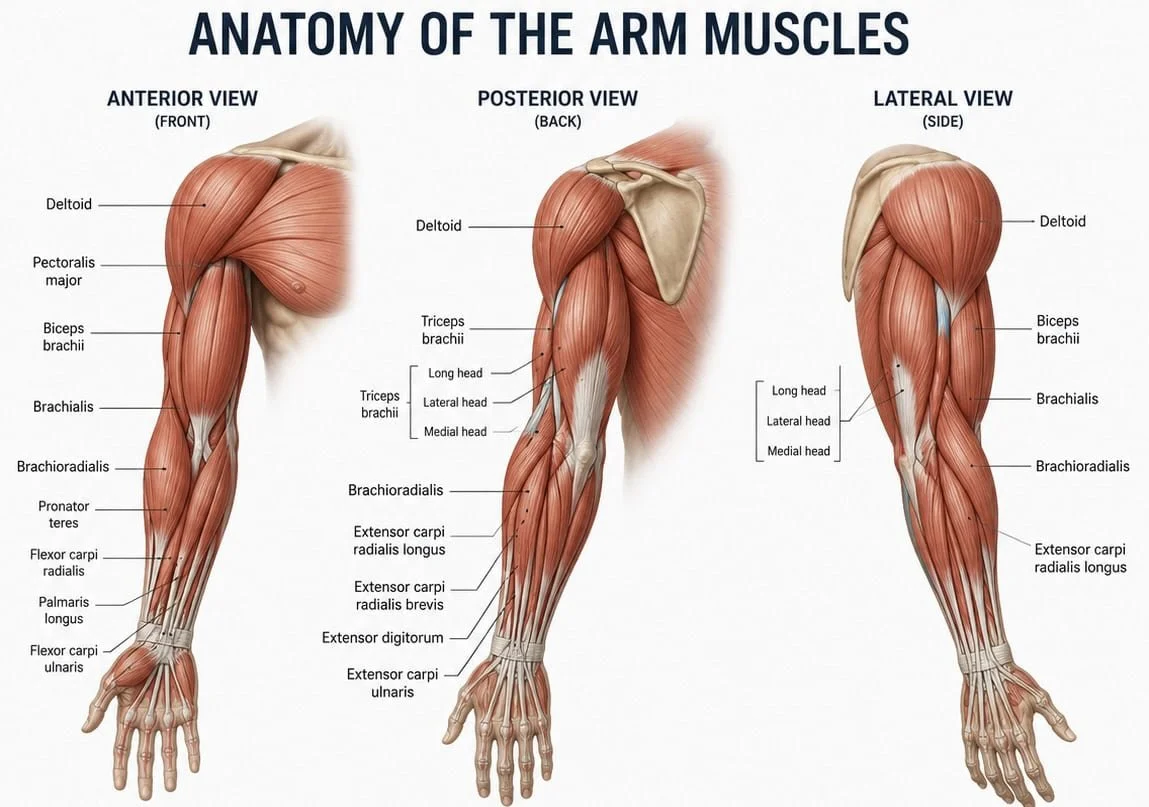
Know What You're Training
Bigger arms require developing all three muscle groups. Most people focus almost entirely on the bicep and neglect the two-thirds of the arm that matters most for overall size.
Biceps
Two heads (long and short) responsible for elbow flexion and supination. Most visible from the front. Peak development requires full range and supinated grip.
Triceps
Three heads — long, lateral, and medial. Makes up roughly 65% of upper arm mass. The long head requires overhead work; the lateral head responds to pushdown variations.
Forearms
Often overlooked but critical for arm aesthetics and grip strength. Developed through hammer curls, reverse curls, and loaded carries. Cannot be faked with sleeve-rolled arms.
Training note: The long head of the triceps is only fully stretched when your arm is overhead. This is why overhead tricep extensions consistently produce more hypertrophy than pushdowns alone — always include at least one overhead movement in your tricep work.
The 10 Exercises:
01
Barbell Curl. The king of bicep mass builders
PRO TIP Keep elbows pinned to your sides throughout. Letting them drift forward turns this into a front raise — not a curl. Full extension at the bottom is non-negotiable for maximum stretch.
The barbell curl allows heavier loading than any dumbbell variation, making it the cornerstone exercise for overall bicep mass and strength. The fixed bar also standardises grip position, removing stabilisation demands and allowing you to focus entirely on the contraction.
Stand with feet hip-width apart, barbell held with an underhand grip at arm's length. Brace your core.
Curl the bar toward your chest, keeping elbows stationary at your sides. Squeeze hard at the top.
Lower in 3 seconds under full control. Reach complete extension at the bottom before the next rep.
Avoid swinging the torso. If you need momentum, the weight is too heavy.
02
Reverse Barbell Curl. The most underrated forearm and brachialis builder
PRO TIP Use significantly less weight than your standard curl — expect around 40–50% of your barbell curl weight. The pronated grip reduces mechanical advantage considerably. A straight or EZ bar both work well here.
Flipping your grip to overhand shifts emphasis from the bicep to the brachialis (the muscle beneath the bicep that pushes it up) and the brachioradialis (upper forearm). Developing these muscles adds thickness and width that regular curls simply cannot produce.
Grip the barbell overhand (palms facing down) at shoulder width. Stand tall with arms extended.
Curl the bar up while keeping the wrists straight and elbows pinned. Do not let wrists break upward.
Pause briefly at the top, then lower slowly back to full extension.
03
Barbell Skull Crusher. Maximum mass for the tricep long head
PRO TIP Lower the bar to your forehead or slightly behind your head rather than straight down — this keeps greater tension on the long head. An EZ bar is often more comfortable on the wrists than a straight bar for this movement.
Despite the alarming name, skull crushers are one of the safest and most effective tricep exercises when performed correctly. Lying down isolates the triceps by removing shoulder involvement. The range of motion provides a deep stretch on the long head — the primary driver of tricep size.
Lie on a flat bench, hold the bar with a narrow grip directly above your chest, arms fully extended.
Keeping upper arms vertical and elbows pointing toward the ceiling, bend elbows and lower the bar slowly toward your forehead.
Extend back to lockout, squeezing the triceps hard at the top.
04
Close-Grip Bench Press. The heaviest tricep movement you can load
PRO TIP Don't go too narrow — hands inside shoulder-width increases wrist strain without adding tricep stimulus. Shoulder-width grip is close enough. Keep elbows tucked at roughly 45° from the torso, not flared wide.
Close-grip bench is the most loading-friendly tricep exercise available. It allows you to use significantly more weight than any isolation movement, making it the primary strength and mass builder for the triceps. Use it early in your session when you can push heaviest.
Set up on a flat bench as you would for standard bench press. Take a shoulder-width or slightly narrower grip.
Unrack the bar. Lower it to your lower chest with elbows tracking close to the body.
Press back to lockout, focusing on driving through the triceps rather than the chest.
05
Incline Dumbbell Curl. The best stretch-position bicep exercise
PRO TIP At the bottom of the rep, your arm should hang fully behind your torso — this is the stretched position and where most of the growth stimulus comes from. Don't rush past it. Let the bicep fully lengthen before curling back up.
By lying back on an incline bench, your arms fall behind your torso — placing the bicep under maximum stretch at the bottom of each rep. Research consistently shows that training muscles in their lengthened position drives greater hypertrophy than contracted-position work. This is one of the best bicep exercises available.
Set an adjustable bench to 45–60°. Sit back with a dumbbell in each hand, arms hanging straight down behind the torso.
Supinate your wrists (rotate palms upward) and curl both dumbbells simultaneously toward your shoulders.
Lower slowly, allowing full extension and stretch at the bottom before the next rep.
06
Hammer Curl. Builds the brachialis that pushes up your bicep peak
PRO TIP Try the cross-body variation — curling across your midline rather than straight up — for greater brachialis emphasis. This subtle path change shifts more tension onto the muscle beneath the bicep that creates the illusion of a higher, fuller peak.
The neutral grip in a hammer curl de-emphasises the bicep and targets the brachialis and brachioradialis heavily. The brachialis sits under the bicep and, when developed, physically pushes the bicep upward — creating a bigger-looking peak from every angle. An essential movement for complete arm development.
Hold dumbbells at your sides with a neutral grip — thumbs facing forward, palms facing each other.
Curl one or both dumbbells upward without rotating your wrist. Keep the neutral grip throughout the entire rep.
Lower under control to full extension. Alternate arms or curl simultaneously.
07
Overhead Dumbbell Tricep Extension. The long head stretch that drives tricep size
PRO TIPThe bottom of this movement — elbows bent, dumbbell behind your head — is where the growth happens. Resist the urge to cut the range short. Control the weight down to a full stretch, then drive back to lockout. A lighter weight with full range beats a heavy weight with half range every time.
Recent research has elevated the overhead tricep extension to one of the most important arm exercises available. When the arm is overhead, the long head of the tricep is in its most stretched position — and training muscles in their lengthened state has been shown to produce significantly greater hypertrophy than contracted-position work alone.
Sit or stand holding a single dumbbell with both hands under the inner plate, arms extended overhead.
Keep upper arms vertical and close to your head. Lower the dumbbell behind your head by bending at the elbows.
Drive back to full extension overhead. Squeeze at the top, then repeat.
08
Band Curl (Peak Contraction). Resistance where it matters most — at the top
PRO TIP Bands provide increasing resistance as they stretch — meaning the contraction is hardest at the top of the curl, exactly when your bicep is most contracted. This is the opposite of free weights, and the two work beautifully together in a single session for complete stimulus across the full range.
The unique accommodating resistance of a band means tension peaks right at the top of the curl — the contracted position — where a barbell or dumbbell actually has the least mechanical load. Band curls complement free weight curls perfectly, making them an ideal superset partner or finisher at the end of a bicep session.
Stand on the centre of a resistance band with both feet hip-width apart. Hold one end in each hand with an underhand grip.
Curl both handles up toward your shoulders, keeping elbows pinned to your sides.
Squeeze at the top for a full second, then lower slowly. Use higher reps (12–20) for best results.
09
Band Overhead Tricep Extension. Long head work anywhere, anytime
PRO TIP Stand on one end of the band and hold the other end behind your head. Step forward slightly to increase tension. The further you step from the anchor point, the heavier the resistance. A simple, equipment-free way to train the long head in its stretched position with meaningful load.
The band overhead tricep extension replicates the most important feature of the dumbbell version — training the long head in a stretched, overhead position — without needing any weights. The accommodating resistance of the band also means tension increases through the extension phase, creating a strong contraction at lockout.
Step on one end of the band. Reach behind your head and grip the other end with both hands, elbows pointing up.
Extend arms overhead to lockout, driving the band upward while keeping upper arms close to your head.
Lower slowly back behind your head, feeling the full stretch in the triceps before each rep.
10
Zottman Curl. One curl that works the entire arm
PRO TIP The value of the Zottman curl is entirely in the slow, controlled lowering phase — when your grip is pronated (overhand). This is the part that trains the forearms eccentrically. Rushing the descent kills the point of the exercise. Lower in a full 3–4 seconds on every rep.
The Zottman curl is a time-efficient arm exercise that trains the biceps on the way up and the forearms and brachialis on the way down — all in one movement. By rotating your grip at the top, you double the number of muscles trained per set. It's an intelligent exercise for anyone who wants maximum arm development from minimum exercises.
Hold dumbbells with an underhand grip. Curl both dumbbells up as you would a standard bicep curl, supinating through the movement.
At the top, rotate your wrists so your palms now face downward (pronated/overhand grip).
Lower the dumbbells slowly in 3–4 seconds with the overhand grip. At the bottom, rotate back to underhand and repeat
The Complete Arm Workout
Here's how to combine these 10 exercises across three equipment-based sessions, or one complete arms day:
Full Arms Day
Close-Grip Bench Press Barbell 4 x 5–8
Barbell Curl Barbell 4 x 6–10
Overhead DB Tricep Extension Dumbbell 3 x 10–14
Incline Dumbbell Curl Dumbbell 3 x 10–14
Skull Crusher Barbell 3 x 8–12
Hammer Curl Dumbbell 3 x 10–14
Zottman Curl Dumbbell 3 x10–12
Bands Only
Band Curl 4 x 15–20
Band Overhead Tricep Extension 4 x 15–20
Band Reverse Curl 3 x 15–20
Band Tricep Pushdown 3 x 15–20
Band Curl — slow tempo (3s down) 3 x 12
Dumbbells Only
Incline Dumbbell Curl 4 x 10–14
Hammer Curl 3 x 10–14
DB Skull Crusher 3 x 10–12
Zottman Curl 3 x 10–12
DB Kickback (slow) 3 x 12–15
Barbell Only
Close-Grip Bench Press 4 x 5–8
Barbell Curl 4 x 6–10
Skull Crusher 3 x 8–12
Reverse Barbell Curl 3 x 10–14
Barbell Drag Curl 3 x 10–12
5 Rules for Bigger Arms
Train triceps as hard as biceps. The tricep is two-thirds of your upper arm. If your arm routine is 80% curls, you're leaving most of your potential on the table. Match your tricep volume to your bicep volume — at minimum.
Always include an overhead tricep movement. No other position fully stretches the long head of the tricep. If your tricep work is all pushdowns, you're only developing two of the three heads. Add one overhead movement every session.
Use the stretched position. Incline curls for biceps, overhead extensions for triceps. Research on stretch-mediated hypertrophy is clear — lengthened-position loading builds more muscle. Don't skip it.
Control the eccentric. Lower every rep in at least 2–3 seconds. The lowering phase causes more muscle damage and growth stimulus than the lifting phase. Dropping weights quickly is leaving half the work undone.
Progress weekly. Arms are small muscles and plateau quickly on fixed weights. Add reps, then weight. Track every set. Stagnant weights produce stagnant arms — progressive overload applies here just as it does everywhere else.
The Bottom Line
Bands, dumbbells, barbell, or gym machines — you have everything you need. Train the full arm, load the stretch, control the descent, and add weight over time. That's all it takes.