
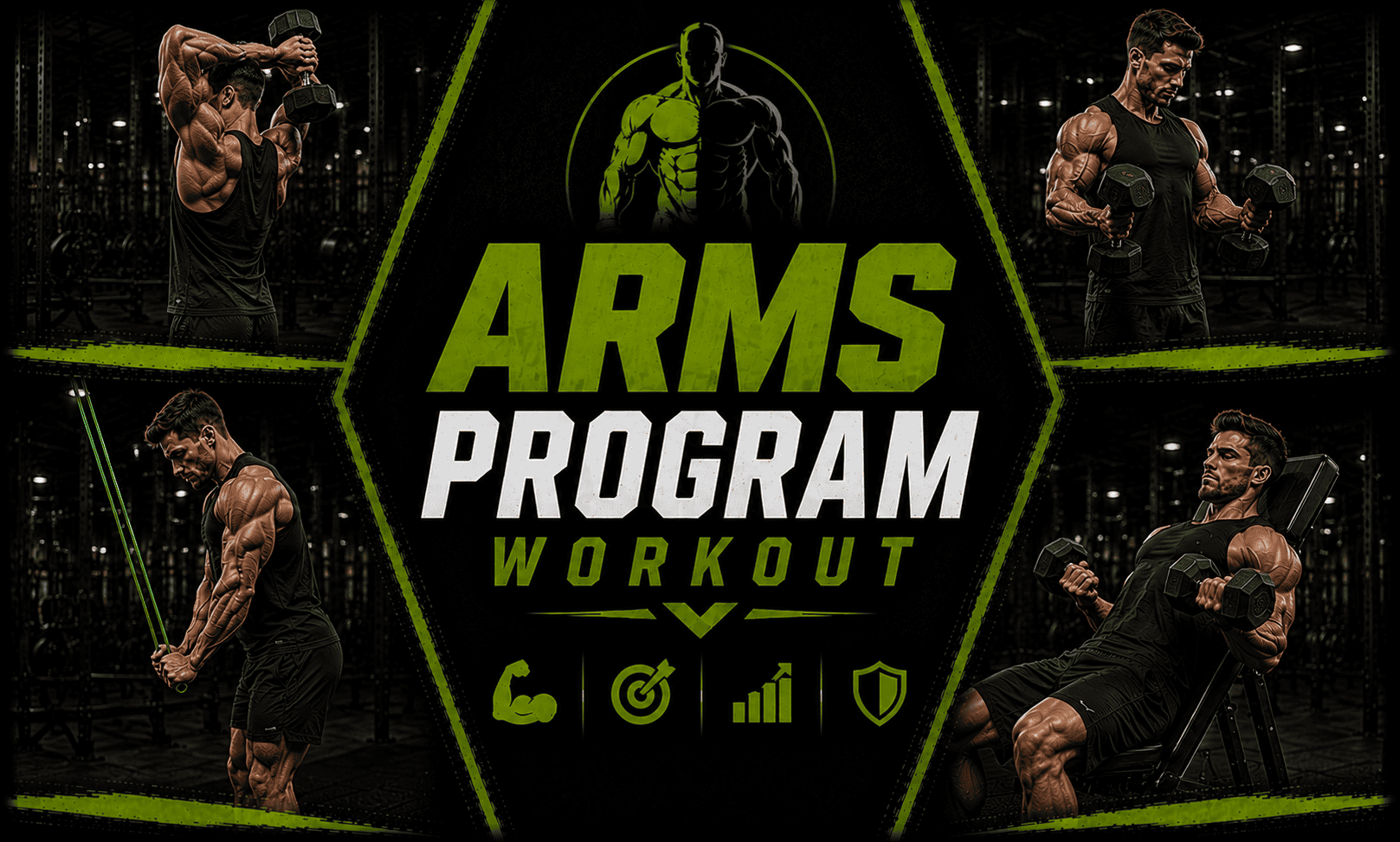
Full Arms Workout
Well-developed arms require training both the biceps and triceps through a variety of movement patterns and resistance profiles. This workout combines heavy compound exercises with isolation work to maximize strength and muscle growth.
Close-Grip Dips
4 sets × 6–10 reps
Keep your body relatively upright and your elbows close to your sides to place greater emphasis on the triceps. Add weight when you can comfortably exceed the target rep range.
Standing Dumbbell Curl
4 sets × 8–12 reps
Curl the dumbbells while keeping your elbows fixed by your sides. Lower the weights slowly and avoid swinging the body to maximize biceps activation.
Dumbbell Skull Crushers
4 sets × 8–12 reps
Lie on a bench and lower the dumbbells toward your forehead by bending the elbows. Extend the arms fully at the top and maintain control throughout the movement.
Incline Dumbbell Curl
3 sets × 10–15 reps
Set the bench to a moderate incline and allow the arms to hang naturally. This position places the biceps under a greater stretch and is excellent for overall arm development.
Resistance Band Triceps Pushdown
3 sets × 12–15 reps
Anchor the band overhead and press downward until the arms are fully extended. Focus on squeezing the triceps at the bottom of every repetition.
Hammer Curl
3 sets × 10–15 reps
Hold the dumbbells with a neutral grip throughout the movement. Hammer curls emphasize the brachialis and brachioradialis, contributing to thicker-looking arms.
Overhead Resistance Band Triceps Extension
3 sets × 12–15 reps
Face away from the anchor point and extend the arms overhead. This variation places the long head of the triceps under a significant stretch.
Bodyweight Bench Dips Finisher
2 sets to near failure
Perform controlled repetitions using a bench. Focus on achieving a strong triceps contraction rather than rushing through the movement.
Progression
Aim to increase weight, resistance, or repetitions whenever you reach the upper end of the target rep range with good technique. Consistent progression combined with adequate nutrition and recovery is the key to long-term arm growth.
Arm Program
Beginner
Arms have two major muscle groups — biceps (front, pulling) and triceps (back, pushing). Most beginners overtrain biceps and neglect triceps, which make up 2/3 of upper arm size. This program balances both from day one with clear technique fundamentals.
Dumbbell Bicep Curl. Stand, dumbbells at sides, palms forward. Curl both dumbbells up simultaneously keeping upper arms completely still — elbows stay pinned at your sides. Squeeze hard at the top, pinky side of hand higher than thumb. Lower in 3 seconds. Full extension at bottom. (Upper arms pinned to sides is non-negotiable. The moment your elbows drift forward, the front deltoid takes over and the bicep gets a free ride. If your elbows move — the weight is too heavy.)
Dumbbell Hammer Curl. Same as bicep curl but palms face EACH OTHER (neutral grip) throughout the entire movement — thumbs always up. This grip shifts emphasis to the brachialis, a muscle underneath the bicep that pushes the bicep up when developed. Curl to shoulder height, lower slowly. (The brachialis is the key to bicep peak and arm thickness. It only gets trained with neutral grip movements. Most people skip hammer curls and wonder why their arms don't look full.)
Tricep Dips (Bench). Hands on bench edge behind you, fingers forward, feet extended. Lower body until upper arms reach parallel to floor — elbows point backward, not outward. Press back up to full lockout. Keep torso upright and close to the bench throughout. (Full lockout at the top is where the long head of the tricep gets its peak contraction. Never cut range short at the top — that's where the growth signal comes from.)
Band Tricep Pushdown. Anchor band high (bar, door). Grab both ends with overhand grip, elbows pinned at sides at 90°. Push hands straight down until arms fully lock out. Hold 1 second at lockout squeezing triceps hard. Return slowly — only forearms move, upper arms stay still. (Bands maintain constant tension at the bottom (lockout) where cables and dumbbells get easy. The lockout position is the most productive part of tricep training — never rush through it.)
Close-Grip Push-Ups. Push-up position, hands close — index fingers and thumbs nearly touching or shoulder-width (whichever is comfortable). Elbows track backward along your body as you lower, not outward. Lower chest to hands. Press back up to full lockout. Squeeze triceps hard at the top. (Full lockout extension at the top is the most important part. The tricep's primary function is elbow extension — if you don't reach full extension, you're cutting out the peak contraction.)
Band Bicep Curl. Stand on band, hold both ends with underhand grip. Curl up exactly like dumbbell curl — elbows pinned, full range. The band gets progressively harder toward the top, where the bicep is strongest. Control the descent fully. (Band curls complement dumbbell curls perfectly — bands are hardest at the top (bicep strongest), dumbbells are hardest in the middle. Together they cover the full strength curve.)
Forearm & Elbow Stretch. Two stretches: (1) Arm extended, palm up — use other hand to gently press fingers down (stretches biceps side/forearm flexors). (2) Arm extended, palm down — press fingers down (stretches tricep side/forearm extensors). Hold each 60 sec per side. (Forearm tendon health is the limiting factor in arm training long-term. This stretch prevents the two most common elbow overuse injuries. Always do it after arm sessions.)
Intermediate
For those with 3+ months of arm training. Separates bicep and tricep emphasis across sessions. Introduces isolation techniques, angle variation, and the advanced training principles that drive the size and peak development that basic curls and pushdowns can't.
Incline Dumbbell Curl. Set bench to 45–60° incline. Sit back, arms hanging straight down — this pre-stretches the long head of the bicep. Curl both dumbbells up, keeping shoulders back against the bench. The starting stretch position is what makes this exercise unique and superior for bicep peak. (The incline curl is the #1 bicep peak exercise because it starts with the long head fully stretched. The long head is what creates that high bicep peak when flexed. No other curl replicates this stretch.)
Concentration Curl. Sit on bench, lean forward, elbow braced against inner thigh. Curl dumbbell toward shoulder — the thigh prevents any swinging or upper arm movement. Rotate wrist so pinky is highest at the top (supination). Squeeze hard at the top for 2 seconds. Lower slowly. (Bracing the elbow eliminates ALL cheating. You'll immediately need to drop weight — that's the point. Pure, isolated bicep work with zero help from shoulders or momentum.)
Chin-Up (Underhand). Underhand grip (palms face you), shoulder-width. This supinated grip fully activates the biceps — you're curling your entire bodyweight. Pull chest toward bar. At the very top, hold 1 second and consciously squeeze the biceps hard. Lower in 3 full seconds. (Chin-ups build more bicep mass than any curl because you're moving your entire bodyweight through the full range of motion. The 3-second lowering is where most muscle damage and growth occurs.)
Overhead Tricep Extension. Stand or sit. Hold one dumbbell with both hands overhead, elbows pointing forward and close to head. Lower dumbbell behind head by bending elbows — feel the long head stretch. Press back up to full lockout. Keep elbows pointing forward — don't let them flare. (The overhead position is the ONLY way to fully stretch the long head of the tricep (it crosses the shoulder joint). The long head is the biggest portion of the tricep — building it is building arm size. No other tricep exercise stretches it like this.)
Skull Crushers (Dumbbell). Lie on bench, dumbbells extended above chest. Keep upper arms vertical and STILL — only forearms move. Bend elbows to lower dumbbells toward temples (hence the name). At the bottom, elbows should be at 90° or slightly past. Press back up to full lockout. (Upper arms must stay vertical and stationary. The moment they drift backward, it becomes a pullover and loses tricep isolation. Imagine your upper arms are glued to the ceiling.)
Band Overhead Tricep Extension. Anchor band low behind you. Hold both ends, step forward, bring hands overhead. Extend arms overhead against band resistance — the band pulls backward constantly, making the long head work at its stretched position the hardest. Slow 3-second return. (Bands anchored low create resistance in the direction that challenges the overhead position most. This is the band version of a cable overhead extension — the gold standard for long head isolation.)
Alternating Dumbbell Curl (Supinating). Start with neutral grip (thumbs up). As you curl up, rotate your palm upward so at the top, pinky is higher than thumb (full supination). Lower rotating back to neutral. The supination at the top is what fully contracts the bicep — it's not just a curl, it's a curl AND a twist. (Supination (rotating the forearm) is 50% of the bicep's function — most people only train the curl half. Adding the twist doubles the peak contraction and builds the bicep through its complete function.)
Tricep Dips (Weighted). Place a dumbbell on your thighs for added resistance. Same form as beginner dips — torso upright, elbows backward. The added weight increases the load on the tricep without changing the movement pattern. Go full range — parallel at the bottom, full lockout at top. (Adding weight here is significant progression. Even 5–10 kg on your lap makes a large difference. Progress the weight before adding reps.)
Elbow & Forearm Tendon Work. Sit on bench, forearm resting on thigh, wrist hanging off knee. Hold light dumbbell. (1) Wrist curls: palm up, curl wrist up and down. (2) Reverse wrist curls: palm down, extend wrist up and down. These are slow, controlled movements — not heavy. (Forearm and wrist tendon strength is the often-ignored foundation of arm training. Weak tendons limit how heavy you can curl. 5 minutes of wrist work weekly builds the connective tissue that carries heavier loads.)
Advanced
For experienced lifters chasing maximum arm development. Uses advanced intensification techniques: pre-exhaust supersets, 21s, mechanical drop sets, time under tension protocols, and loaded stretch positions — the techniques used by bodybuilders to push past plateaus.